When Quiet Comes


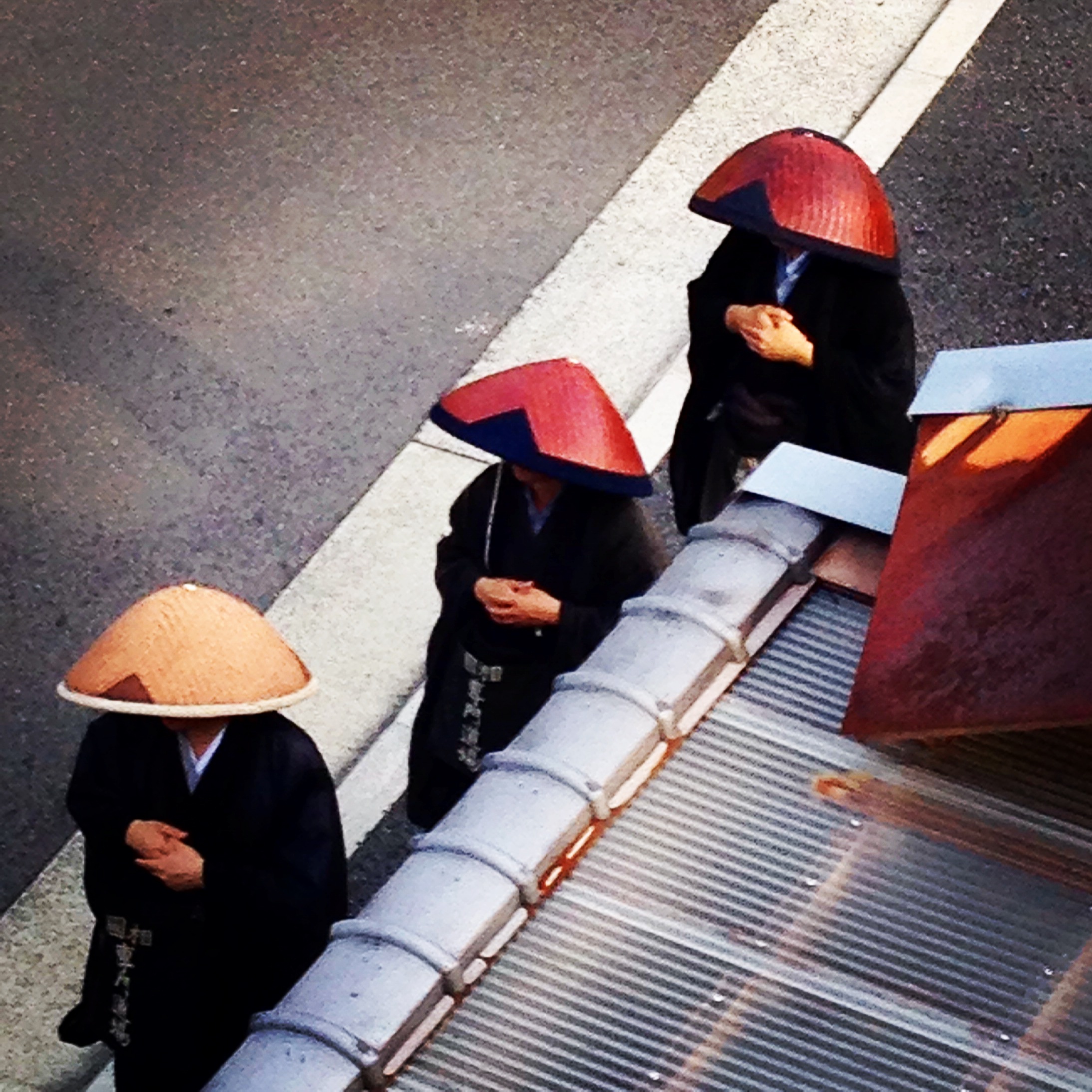
Morning Monks. Demachiyagi, Kyoto, Japan.

Morning Monks. Demachiyanagi, Kyoto, Japan.

When quiet comes, do not run.
Do not fidget, obsessively filling
the vacuous spaces with this,
with that. None of it matters.
Come into the quiet, though
the world around you continues
its daily churning.
Come into the quiet, though
it pains you with a different
kind of loudness.
Come into the quiet, willingly fold
your hands, lower your head,
look softly on the path before you
and walk on. This too is a gift.
Learn to accept it graciously.

***

When we’re lucky, practice brings us to a stillness that is precious. We finish practice and lay down and surrender. We appreciate it, resting deeply in its embrace for some five, ten or fifteen minutes. And then, we scramble to get up, get dressed so we can jump through the hoops of our daily lives, some we are duty bound to go through but others are scenarios and dramas that we ourselves create. And then we crave for the next quiet moment but when it comes, we hardly allow ourselves to truly feel it, to truly sink into it.

This is so strange. We crave it, sometimes working so hard to attain it, and, yet, when it’s there, we work even harder to ignore it or avoid it. We should learn to enjoy our moments of peace, of rest, of quiet, forming a new healthy relationship with stillness.


Happy Guru Purnima! Celebrating Guruji!

IMG_5541

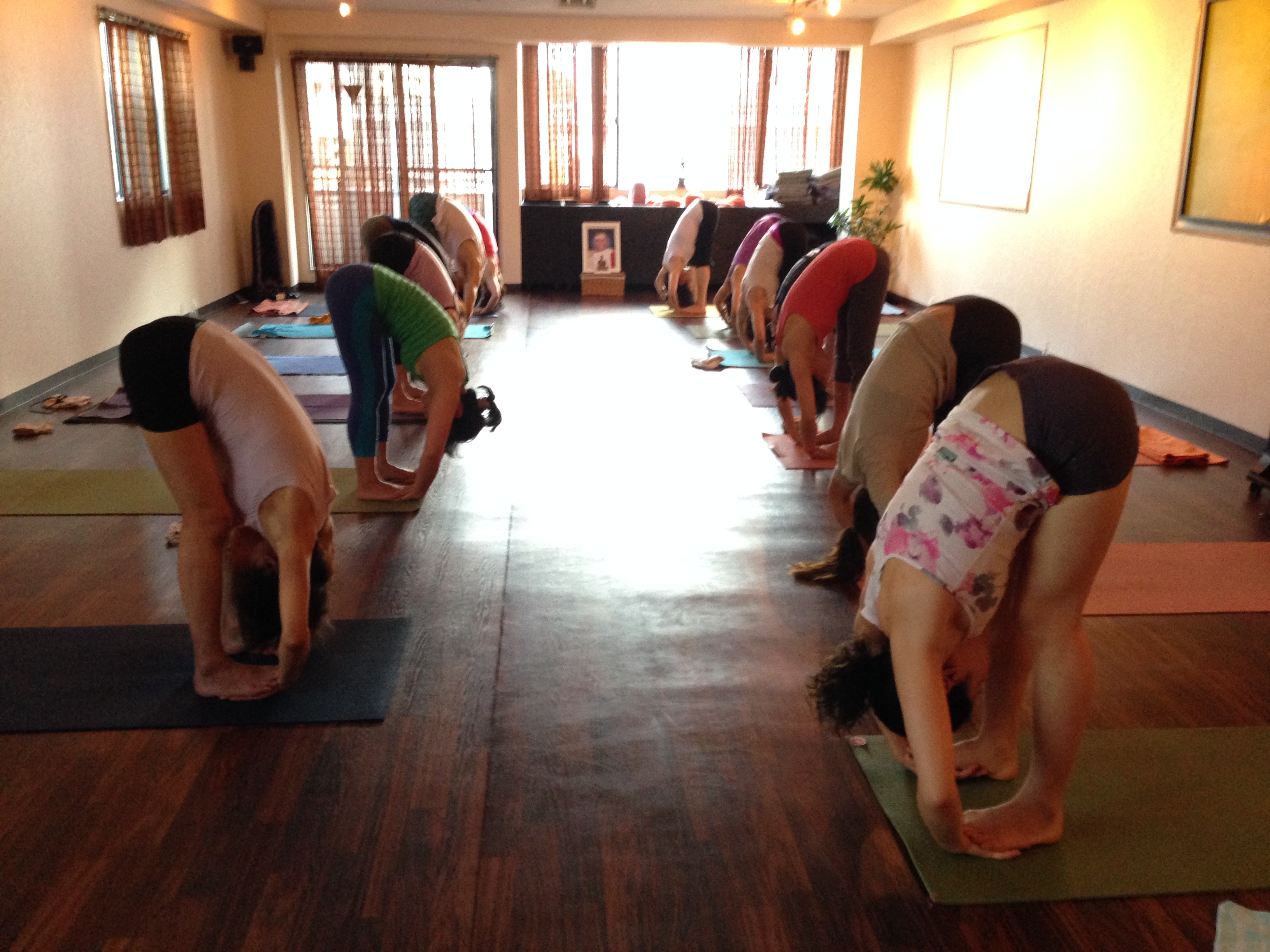
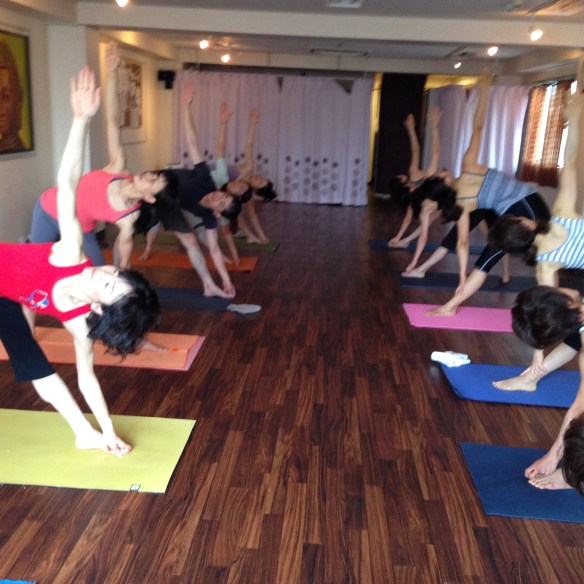
Padahastasana, standing forward bend, in Ashtanga Primary Led class this Friday at Spirit Yoga Osaka. A beautiful posture of humility and surrender. Satsang today is a celebration of Guru Purinam, in which we remember Guruji, Pattabhi Jois.

Friday led class is followed by Satsang, here in the Spirit Yoga Osaka Mysore Program. It’s a great opportunity to open the practice floor for discussion, answering questions, and exploring the practice in a conference setting. 

Last night, in anticipation of the storm that was supposed to hit Osaka, I was all set to speak about “Weathering the Storm of Life” (I know, I have a penchant for drama!) in the yoga context when Veronique Tan (whose program I am covering) reminded me that tomorrow, the Full Moon of 12 July, is Guru Purnima–an Indian festival that celebrates our highest teachers–and that it might be a good opportunity to talk about Sri K. Pattabhi Jois, known lovingly as Guruji.

It was a good call, as this morning, there was no storm. Only sunshine and the light that a true teacher can bring–guru, after all, often translates to the remover of darkness, obscurity or ignorance. 

I did not expect myself to get emotional as I talked about Guruji. But you can imagine where this is going…

I explained in brief his life, his humble beginnings, how he loved to learn Sanskrit and yoga so much so that he ran away from from home at the age of 14, how he was devoted to his guru Krishnamacharya and to his practice, how one Belgian European wandered into his tiny home-based yoga shala in the 1960s, and how by the 1970’s he was touring to teach workshops for his Western students.

I did not have to illustrate how ashtanga yoga has grown, nor did I have to explain in great detail that Pattabhi Jois lives on through us as we breathe and move according to the system that he introduced to the world, nor did I have to touch on how deeply this man’s work has moved each and every one of us–there was no need! I looked around the circle gathered at satsang and I could see the well spring of emotions that the practice has inspired, that Guruji inspired. How I too was teary eyed, feeling his contribution to my life, how ashtanga has changed me. 

So beyond words, we all understood our connection to the yoga practice, to each other, to our teachers and to our teachers’ teachers, to the yoga shala in Mysore, to Sharath, to Guruji, even though he has passed on. Parampara. This is the lineage. We are a part of that beautiful line of student-teacher, student-teacher, Guruji is at one end and we are at another, we are connected. 

We closed satsang by singing a guru mantra in celebration of a truly amazing teacher. Thank you, Guruji! We celebrate you! 

Gambatte! Do your Best!

IMG_5108

Friday morning led class is followed by Satsang here in Spirit Yoga Osaka. This is a time when the Mysore group can meet to practice other aspects of ashtanga yoga, whether it’s chanting or discussing yoga philosophy. Yesterday, July 4, 2014, was my first Friday here. It was a full power led primary; and I actually had fun counting the vinyasa-s! I particularly looked forward to discussing the Japanese word “ganbatte,” often translated as “Do your Best!” — which I realize can differ slightly in meaning depending on context. I wanted to explore “ganbatte” in the context of yoga and how I mean it when I say it in class. Here is a written expansion of yesterday’s talk.

I ask the circle of students (with the help of Naoko-san translating) gathered after Friday’s led class what they feel when someone tells them: “Ganbatte.” Many nod in agreement that it is a motivation, a cheer to go on, to do better. Hiroko-san, sitting across from me, nods too but also adds that depending on the context it can also come with a lot of pressure.

The Japanese are renowned for their work ethic and discipline, it is deeply ingrained in the culture–and beautiful to see when applied to the yoga practice. When taken to an extreme, it has a dark side. In Japan, karōshi, 過労死, or death from work, is legally recognized as a cause of death. People in their thirties have strokes or heart attacks due to working long hours and suffering from extreme stress–they’re just doing their best, right?!

This, of course, would not happen with the skillful yoga students here attending class and practicing with great awareness. Still, it begs the question: What does it mean to do your best in the yogic sense? What does ganbatte mean for the yogi?

Ganbatte is an encouragement, often translating to Do your Best! or Do well! or Be courageous!

It is supposed to inspire courage. In her famous TedTalk on Vulnerability, my favorite researcher/storyteller Brene Brown speaks about how the root of the word courage comes from the Latin “cor,” which is the heart. That in its early form, to be courageous was to speak from one’s heart.

These days we look at courage as bravery, having guts or gumption, daring to do what is difficult. All well and good. But to be truly courageous we must act according to what is true to our hearts as well, and from that place of authenticity we are able to act with greater awareness and equinimity. When we are true to ourselves, then we are in satya, one of the five yamas, the foundation of Patanjali’s ashtanga, or 8-limbs.

Now: what is best exactly? We often confuse what is best for what we think of as what is perfect. We often look towards some future ideal or goal. In our yoga practice, we often think of perfection as the final expression of the posture the way we see it in some yoga video, on YouTube or on Instagram.

Patanjali’s first sutra in the Yoga Sutras is “atha yoganusasanam.” Yoga is happening now. It does not look towards the future. It exists in the present moment.

Never does Patanjali outline the particularities of what an asana looks like, he doesn’t go into degrees or alignment, but rather on each individual’s feeling in the pose. “Sthira sukha asanam,” The posture is both steady and easy. And this will depend on the truth of each and every person, as they discover the balance between strength and flexibility, steadiness and comfort.

So wherever you truly are in your practice, so long as your put the right effort into finding that “sthira” and “sukha,” the right presence and awareness, no matter what the asana looks like, it is perfect for that particular moment.

So: Gambatte! Gambatte!!! Practice with true courage, practice from the heart! That is already the best practice.

PHOTO: Friday’s Led Class here at Spirit Yoga Osaka.


Drawing on Sand

Image

Drawing on Sand

Last week, I hit a beautiful stride in practice. All was flowing smoothly: the breath, the corresponding postures. Even my difficult poses seemed to be giving way. Backbending, which has been so elusive of late, seemed to have returned. I was so happy.

The last two days, however, has been a different story with a completely different body. I’m not thrilled, but I also accept that this is a part of the journey.

It’s a humbling reminder that sometimes practice is a little like drawing on sand, that some depths take a great deal of time to set, that there is a certain impermanence to day to day practice, that it takes little to sweep away what we have so artfully crafted.

Still, there is no need to be frustrated. There is no need to be attached. This is the nature of things, that nothing stays the same, least of all our minds, our bodies.

Maybe this is the greater lesson: to know that what we do, what we create, what we breathe life into will inevitably change, or die, or go away–and not just be ok with that, but instead actively celebrate this cycle of life and living.


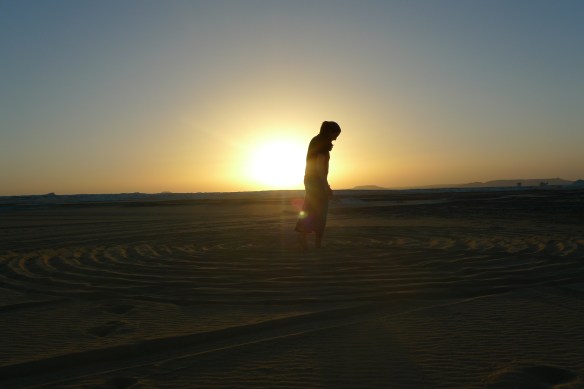
Photo: Zeina composing circles in the sand, the sun setting behind her, during our Ashtanga in the White Desert Retreat. White Desert, Farafra, Egypt.

Snakes & Ladders, The Game of Practice

Image

Surely as we develop strength and flexibility, both in the body and in the mind, the practice should get easier. Right?

Practice doesn’t always work that way; it isn’t black and white; it isn’t so straightforward.

Since last week, for example, I’ve been struggling with kapotasana (pidgeon pose), a posture that I had thought I’d gotten to know, gotten comfortable with. Kapo and I made friends, I thought…

But between deepening my relationship with my leg behind the head and the winter weather here in Barcelona (it’s mild I know, but I am have been living many many many years in the tropics), what was once manageable has gotten a whole lot harder. In fact, backbending in general, which I really love, has changed so dramatically over the last two weeks, it’s been startlingly humbling.

I realize, however, that I have a choice: I could despair, I could get frustrated or angry, I could give up this crazy leg behind the head business and preserve the postures that I’d worked so hard  for, that I was admittedly very attached to–the later of which may be one of the reasons, along with tight hips, why it’s taken me so log to get here, this awkward place–

Or I could just practice; practice with acceptance that my body is adapting and that it’s not always easy; practice with patience that these openings take time; practice with understanding that moving forward sometimes comes with its share of backsliding–that practice is an interesting game of snakes and ladders; practice with trust, with faith in this system which has just about turned around every limited thought I have even had about the bounds of my own physical body; practice with love, showing up everyday with an open heart and mind…

Guruji, Pattabhi Jois, said it best: “Practice, practice, all is coming…”

PHOTO: This photo–like practice, like life–taken in “black and white” is full of subtleties in tone and shades. We will be talking more about the struggles that come with practice on the Sunday, March 1 workshop on the Bhagavad Gita, Pazzifica Ashtanga Yoga, Barcelona. More details on www.pazzifica.com.

Naked Truth

Image


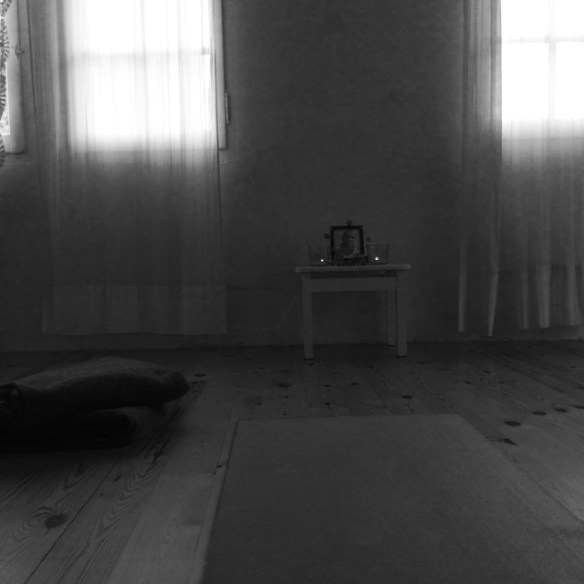
There are times that when I get to the end of practice and there is only me, the mat, and an empty room.

For a moment, nothing else, no one else exists. Everything has fallen away, shifted from the mind and body, dropped during a series of movements, or melted away by the breath. If it doesn’t drop away so easily, the practice finds a way to peel it back or to pull it out. Weight is shed.

And in the end, there’s this feeling of lightness, of nakedness. Beautifully, wonderfully naked, it is easy to sit with myself.

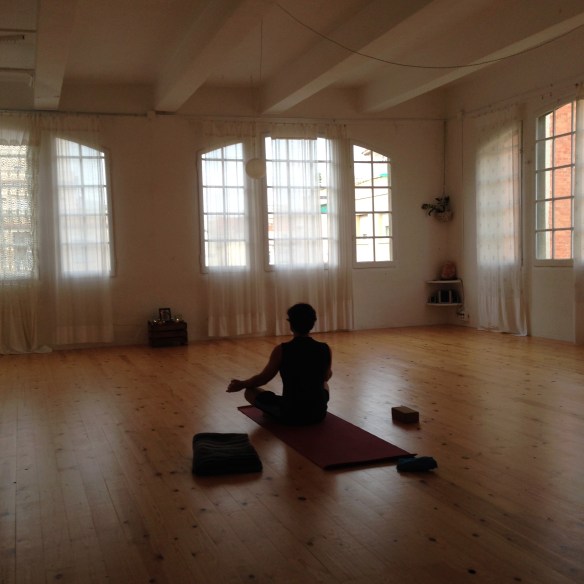
Photo: Last student, for the morning session, Alejandro coming into finishing sitting postures. Morning mysore practice is Monday to Friday, 7am-9:30am here in Pazzifica * Ashtanga Yoga, Espacio Vacio, Plaza Verreina.

Playful Spaces

Image

Playing Outdoors

Yes, there are such things as ideal conditions for practice: a windless place, even floors. If you’re going to get all picky about it, you can go for wood floors and a temperature-controlled environment that duplicates the degrees produced by 65 bodies practicing in the shala in Mysore, India between the fall and winter months of the year.

Wherever you practice, you want to be able to cultivate focus and create a healthy platform for the body.

Recently, however, as I traveled between Aswan in Northern Egypt and Naweiba in Sinia, I found that outside the constructs of the “yoga studio”, spaces have a life of their own. They were often outdoors where cold, wind and sunlight  invariably come into the practice. Objects, passers-by, animals come into view, tugging at the focus. Noise calls for attention. In Naweiba, the most even ground was carpet atop gravel.

During the retreat I was teaching, there was one day we thought we had sneakily secured a chance to practice at a sweet spot in the Philae Temple in Aswan. The floor was stone, hundreds of years old. And even. I rejoiced at the flat surface on which we could go over the finer details of jumping forward and back in the vinyasa. That was until the guards totally panicked as they saw us get started on our colorful mats and we were only just standing and breathing. They freaked and ran us (infidels) out of the temple.

As a teacher, I wanted to be able to provide my students with the best learning experience. The space is a crucial part to that experience. And so far, we had no space and our poor logistics had resulted in unnecessary drama. As we chugged along in our boat to another island on the Nile River where our local guide said he knew a spot, I wondered whether I was failing my students in some way.

Said island was amazing. And sandy. Unevenly sandy! I tried not to panic. Instead, we started where we’d left off in Philae, “Aummmm,” getting on with the afternoon workshop program.

It wasn’t what I had planned–as I’d planned for having a nice stable ground to work with. But the result was so much better than I could have planned or anticipated. We adapted to the environment and adopted a sense of fun and playfulness that you can’t help but feel when you are out of doors, enjoying the afternoon sunlight, feeling the sand at your feet. It was probably the most fun class we had that weekend. It was spontaneous, light-hearted, but also quite challenging physically.

Sometimes the conditions for practice is far from perfect. Try not to scoff at it; for all you know it might be better than perfect!

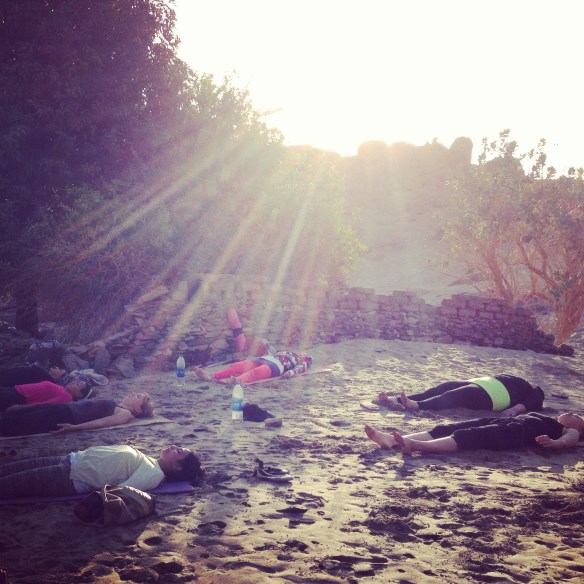
Photo: So successful was our class in this spot that we planned the same outing for the second retreat in Aswan. This is batch 2 retreat participants enjoying their savasana in the late afternoon sun on the slope of this picturesque river beach.

Masks We Wear

Image

Unmask

We all have different masks we wear. Some, we hide behind. Some, we use as a shield to protect ourselves. These figurative masks can be tools of evasion, of subterfuge, of inauthenticity.

But what of the mask of practice, this mask of yoga which we put on each time we get on the mat? The face inevitably changes as we get into the flow–and at times, some kind of strange, indescribable thing happens. And we call it “yoga.”

What is this? Is this real? Or are we just pretending for the moment, wearing a guise of yoga?

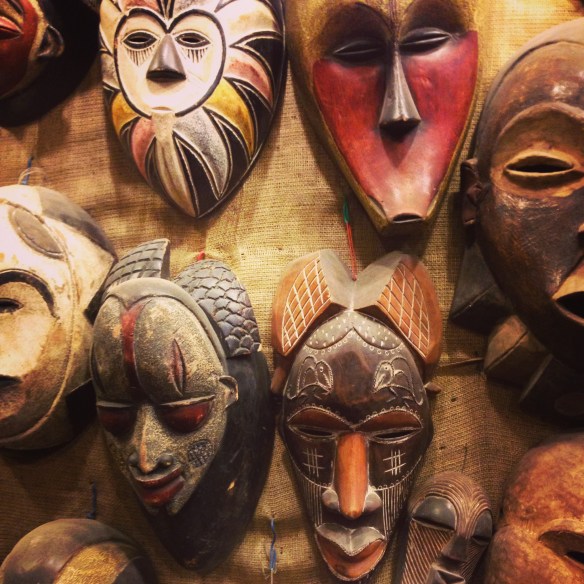
In Africa, traditional masks, such as these pictured above, are used in ritual practices often with music and dance. The mask helps the wearer conceal his human identity and helps him transform into a medium between the earthly and spriritual realms

The mask of practice works similarly.

We come into it, this sacred ritual: the steady gaze and breath, the stoic expressionlessness of the face, only to disengage with our identifications with the self and attachments that come with that self.

And then, we dance. We dance to the most primordial sound, the rhythm of our own breath, communicating, connecting for that brief moment with something that exists beyond ourselves.

Photo: Traditional African mask collection in a shop in Aswan’s (Upper Egypt) souk.

Feeling Feedback

Image

Feeling Feedback

There I was at kapotasana (pidgeon pose) yesterday morning nearly a week since touching heels. The New Year’s revelry in Sinai, trek back to Cairo, and travel to Barcelona–where it has taken some days to settle in both in life and in practice–had taken a toll on me. Needless to say, it was an intense five inhales and exhales.

As I sprung out of it, I felt an old emotion in my chest, a soft explosion, a subtle but potent release. I gasped aloud, grateful that I was alone self-practicing because crying came so very naturally with the breath. I felt my heart. I was surprised and relieved to feel a release from an old ache, which had been hiding so very stealthily in my body.

There you are, I thought, pulling myself together and getting on with the rest of practice–still crying, mind you.

Sometimes we can see it coming, this wave of emotion from some deep down place, moved out of its hiding place by one or a combination of unpredictable factors: real life events, an hour and a half of deep concentrated effort, strong intentions, a deep stretch or posture…

As a teacher, it’s quite a sight when you’re watching from a distance. The signs can be so clear, the flow of practice perturbed by the movements of the heart and mind. We actually look as delicate as we feel at these moments. The breath changes. The vinyasa stutters. The posture wobbles. Brows furrow. The face changes.

Other times it catches us unawares, and it feels a little bit like being an innocent bystander observing some great but secret shift happening in the mind, heart and body. And then it passes…sometimes softly, other times not so.

When it comes–and if you practice long enough and with enough consistency, these moments certainly will come–we must honor them. We must give ourselves enough space to observe this process called yoga, to learn the lessons that come, to work out what needs to get worked out. But this too needs to be balanced with a healthy amount of surrender, of letting things go and simply getting on with it, returning to the breath, returning to the steadiness of practice.

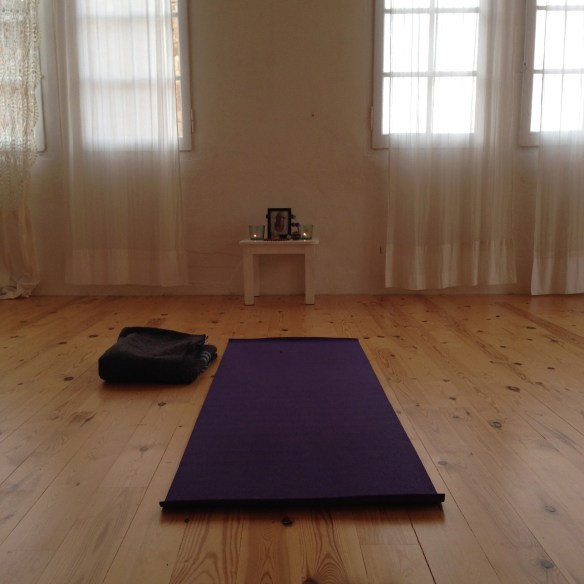
Photo: Mat laid out for my own practice this morning after the mysore class at Pazzifica Ashtanga Yoga in Barcelona. When I look at this photo I see a very special meeting place, where me and the deep down parts of me get to know each other intimately.

Giving & Receiving

Image

IMG_7743It’s Christmas Day here in Aswan. And Christmas, we like to say, is a time of giving. which consequently means receiving too.
Often, I’ve experienced this exchange as something between two parties. One gives, the other receives. Or visa versa.

And then there are those moments when the lines blur and the act of giving is experienced as an act of receiving as well; to give is to receive.

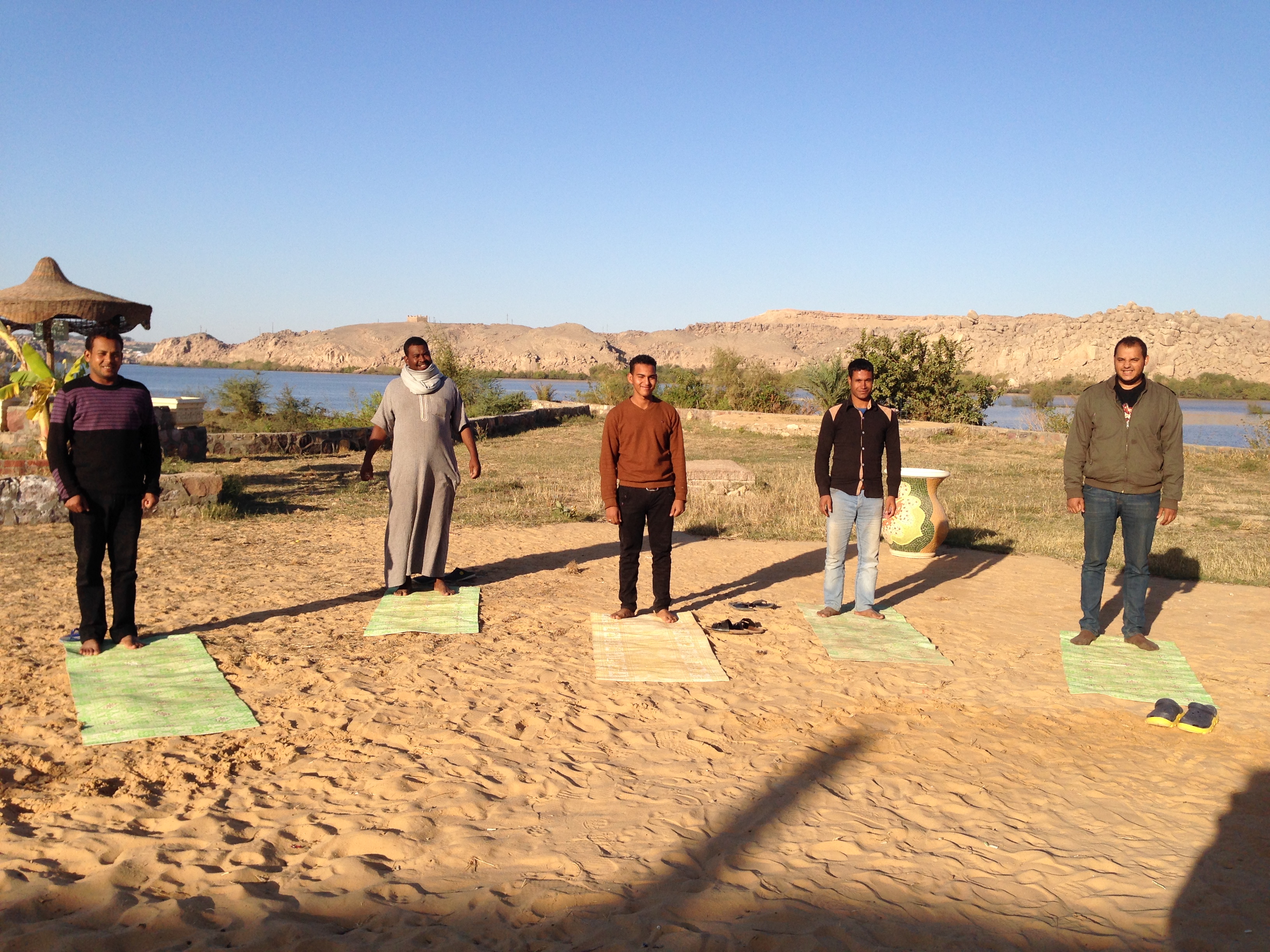
Photo: Christmas Eve and the staff here at Fekra Cultural Center enthusiastically consent to a yoga class when I offer. Today, they were eager to go again. Tomorrow, will teach them the Sun Salutation sequence so that they can practice without me. Very excited, it’s the cherry on top of an amazing second retreat already.