Fly Your Prayers

IMG_6244

Paris, Beirut, Syria, Iraq, the list goes on. So much darkness all around. There is too much loss, one too many people displaced, everywhere there is suffering. And from practically everywhere, too, at least a week ago, after the attack on Paris, prayers were launched via hashtags towards the darkest places on the planet at that moment. A week on and social media is now abuzz with the backlash from all sides: criticism and fear-mongering.

What to do now? Where do we all go from here? Incredibly big questions for incredibly complex problems, which have a whole lot of history that needs, first, understanding, and then careful and steady undoing. What happens now to all these prayers?

Over the months here in San Francisco, I have had the great opportunity to explore the ashtanga practice and intention-making as medicine with some amazing teachers. There is a great healing energy that comes with declaring one’s clear and simple prayer. It is personal, our prayers are our own but they are also universal. Your prayer for peace and happiness and love–guess what, everyone wants that too! We forget that, ultimately, we want and deserve the same things, yet we continue to build walls of separation–personal and physical and political boundaries.

When we come to our mats and we practice, we open with a mantra. In the western yoga community, there’s a lot of sensitivity about what that is. For me, it’s a prayer. The essence of this prayer honors the great process of being led from darkness to light. We sound this out and then we practice. We plant this sound, this seed, into our body and then we nourish it with our breath, our movement and our attention. And whoever has been really practicing knows that this prayer becomes alive, it grows in the body and blooms in one’s life.

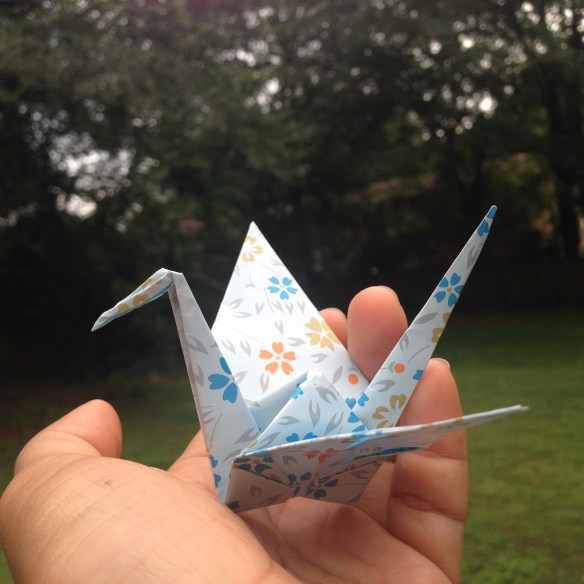
When we practice, we fly our prayer. It grows wings and it soars.

It’s really good to see people express their prayers, their hopes, even their admonishments during these difficult times because it shows that we as a community of human beings acknowledge that the world should not be like this. But how do we now live in these prayers, how do we breathe life into them, and walk into them with grace, how do we take these hashtags and sounds and ideas and bring them into a living practice that can support substantial change?

I feel personally challenged by this, how can I be this prayer, for myself as much as for everyone else.  I know it will look different for me in my life as it will for someone else. But I hope that we all start to do so, to really live in these prayers.

I want to close with a poem from Rumi that a friend sent a couple of days ago just as I was starting to write this blog. These questions are very old and perhaps we should defer to wisdom of the Sufi poet:

What will our children do in the morning?
Will they wake with their hurts wanting to play, the way wings should?

Will they have dreamed the needed flights and gathered the strength from the planets that all man and woman need to balance the wonderful charms of the earth?

So that her power and beauty does not make us forget our own.

I know all about the ways of the heart-how it wants to be alive.

Love so needs to love that it will endure almost anything, even abuse, just to flicker for a moment. But the sky’s mouth is kind, its song will never hurt you, for I sing those words.

What will the children do in the morning if they do not see us fly?

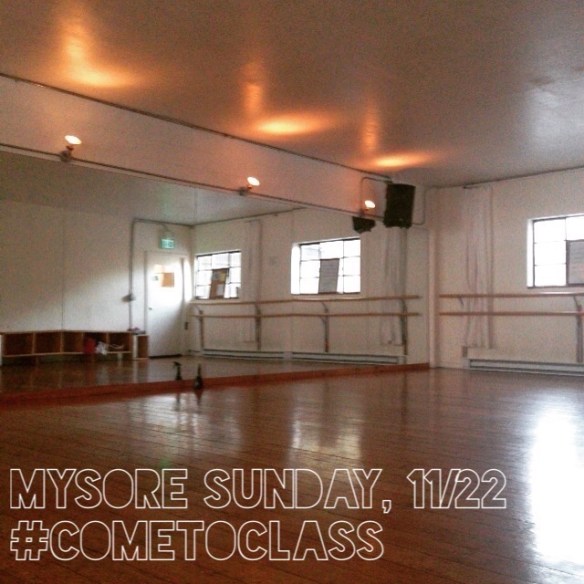
Mysore Sunday, Final Session

IMG_7567 (1)

So much of my most precious interactions happen on a rubber mat with students while teaching in a Mysore space. Where else do you get to meet someone in this way, slowly over time, whilst they quietly cook in the juices of their own humanity, turning over with each deliberate breath and movement the fluctuations of the mind and heart.

It’s like getting to know someone without any context other than what plays out in the half-hour, hour, hour and forty-five minutes that one practices. Story-telling is minimized, so is the drama. The body is so intelligent. The practice is so precise. I love meeting in this way. It is so raw and real… and honest.

As a mysore teacher, the challenge is to meet as honestly as well. To cut out the superfluous, the desire to people please, the need to teach, so that the practice can do it’s thing. I often have to remind myself that the best thing that I can do is to get out of the way. The opposite is also true, when it arrises; it’s important to recognize when it’s a good time to get involved, when support is necessary.

Meeting in this way, in mysore-style classes, it is looking into a mirror and seeing who you are at that one moment. Sometimes, what I see is glorious. Other times, I see that I am one hot mess. All of it is ok and also, none of it matters. By meeting, we submit to an alchemical process, a world of change.

It has been incredibly special to lead the Mysore Sunday classes here in Mysore SF twice a month. Please come to class, I love to meet with you. I will also continue to assist Magnolia Zuniga in Mysore SF until December 10, 2015 before heading back to Asia to prepare to study with my own teacher in Mysore, India.

Shine On: Happy Diwali!

IMG_3085

Be Light. Happy Diwali!

Today is one of my favorite festivals in India. Well, except, when I am, actually in India–then it’s a little harrowing, very loud, and driving a scooter across town is akin to traveling across war zones as one needs to weave deftly around pockets of merry-making firework-obsessed celebrants making noise and explosions very few meters from each other.

Diwali is the Festival of Lights. It is a reminder than even in the darkness of the new moon today, that each of us is an oil lamp, that we each have a role of lighting each other’s path.

It has been an amazing period of time for me here in San Francisco. Amazing for all of the gifts, but likewise so were all the challenges. Being stationary for the last 7 months has given me a chance to really sit with myself and stand in my own life–and it was at the darkest stages where I saw the most light. That is the relationship between light and dark, the great common sense between the duality of it.

I am grateful to all those night lights, bright and shiny human beings, who I feel incredibly blessed to know. I also know that in these exchanges, I have been the same, a little light that has helps in the dark.

I like to think that at some point, I should be able to see my own light all the time. Perhaps when that happens, the path disappears and there isn’t anywhere else to go. Until then, let’s tend those oil lamps, celebrating not just the lights all around us, but that deep internal glow that never gets extinguished. Shine on, everyone!

Happy New Moon, as well as Diwali, no class at Mysore SF today. Take rest. See everyone back on the mat on Thursday. 

Share The Love Sunday

IMG_7401
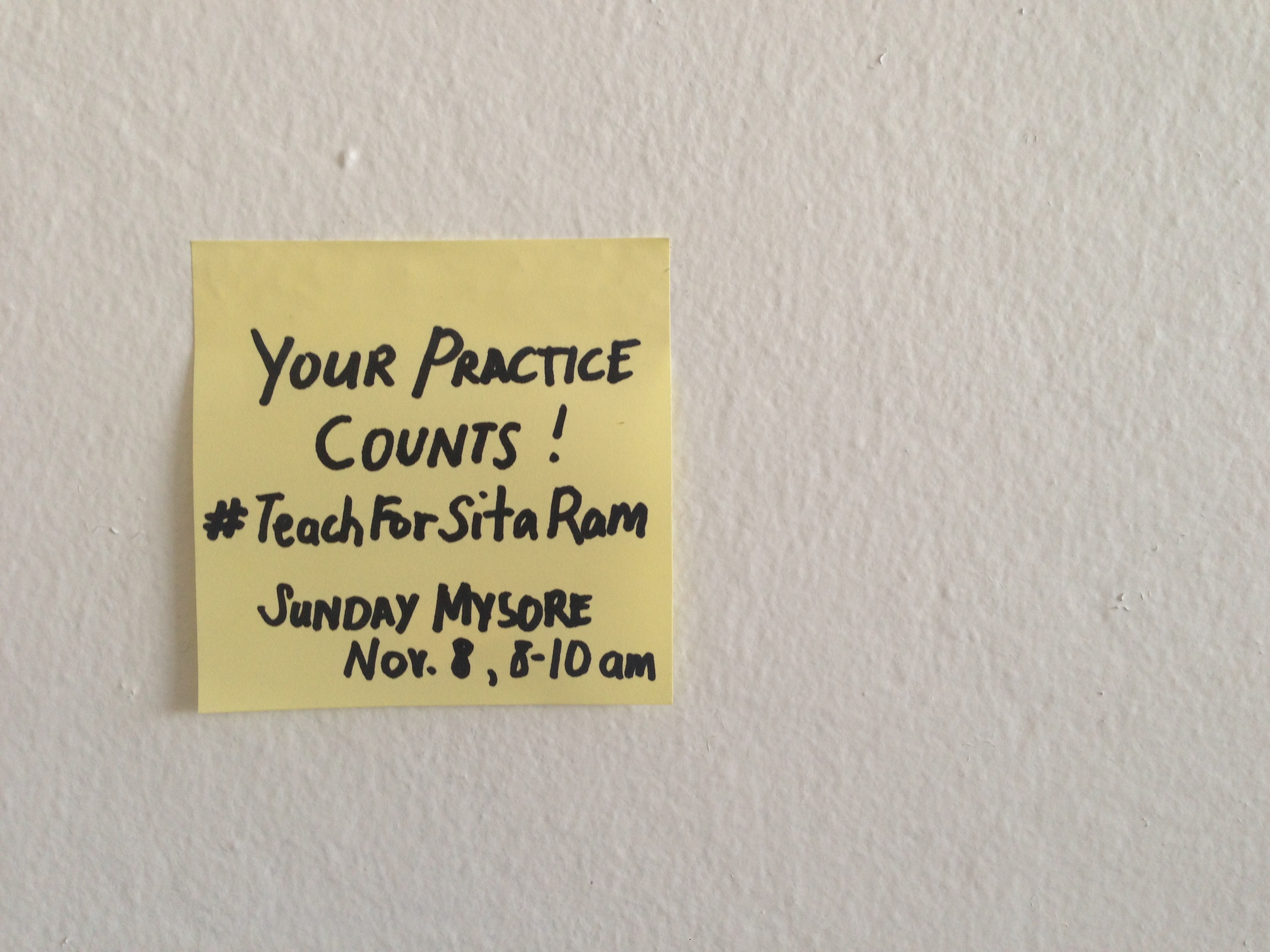
#TeachForSitaRam
Mysore Sunday
November 8, 8-10am

This Mysrore Sunday, I will be teaching class for the benefit of a young man from Mysore named Sita Ram who has suffered an unfortunate accident with an exploding mobile phone. He will never completely recover from his injuries, but money raised through this class will help him as he adapts to a new way of life.

There are so many causes, so much tragedy in the world, you might ask, what makes this different or special? My answer is “not much,” suffering is pretty universal. We all have to roll with the punches and get on with it–that work, ultimately, it’s a solitary one, but it helps to know that we aren’t alone.

Our yoga practice calls us to cultivate one-pointed attention, it asks us to stop being distracted, to draw our energy inwards. How many times has our drishti (point of focus) drifted, and somehow, sometimes by someone, we are reminded to mind our own business?! We so often look beyond because we’re so afraid of looking close.

Over the last few months, I have been focused on self-love. Being one so used to giving energy away, this came with certain challenges. It is tough work reconciling that some things are meant for us and other things aren’t, it is harder to recognize that we are not just enough the way we are, but really ample and full.

These days, I feel incredibly blessed and grateful. Having taken time to nourish myself, I feel my cup very, very full—and it is in such instances that it feels most right to share our energy and blessings with others who may be in greater need of love and attention.  If you would like to join me, class is at 8-10am on Sunday. All with established ashtanga practices are welcome.

You are welcome to make a donation even if you don’t make it to class. Contact me for details kaz.castillo@gmail.com. Thank you.

Into the Horizon

IMG_7140

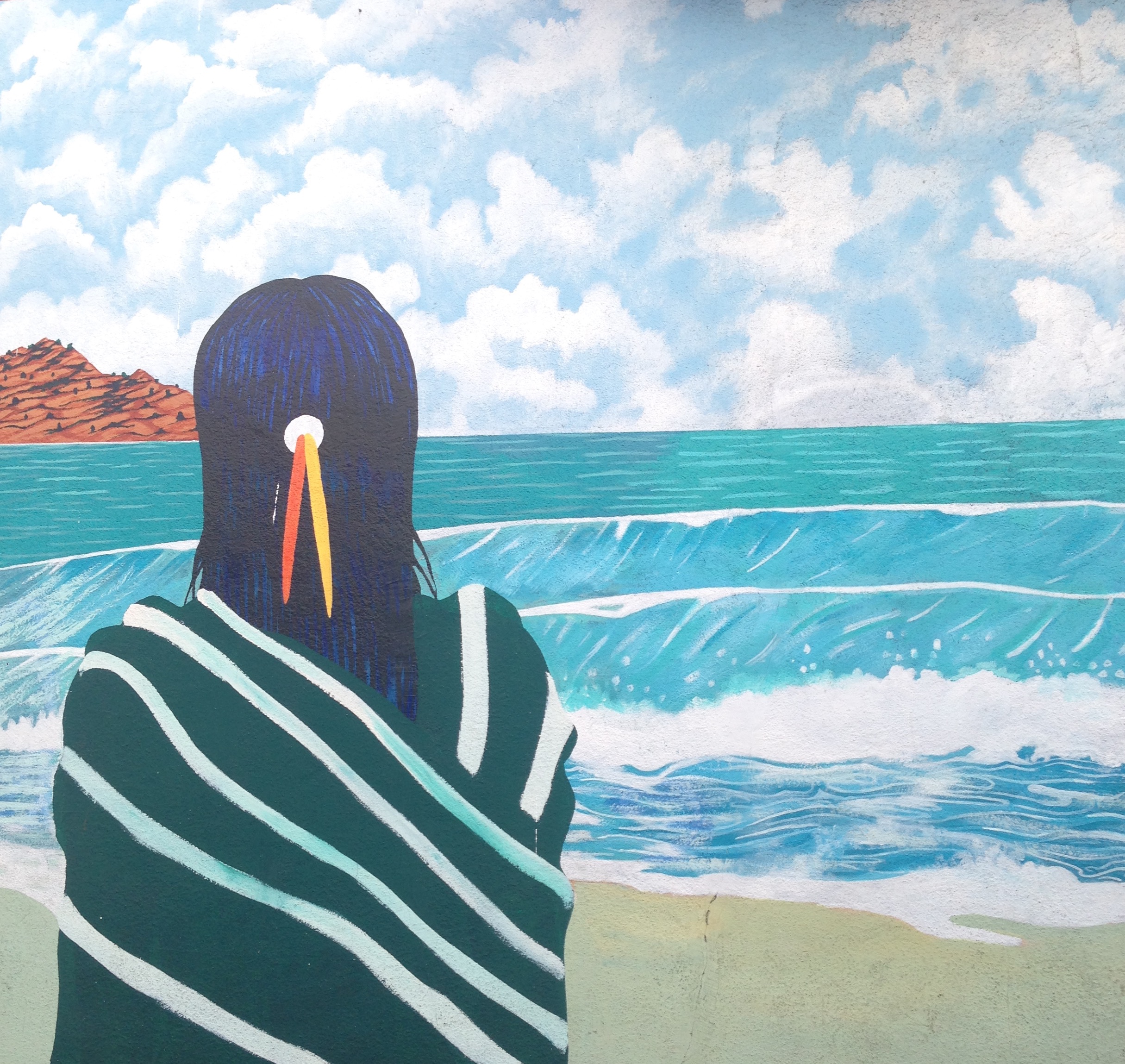
We do not always know where we are going and we certainly don’t know where we’ll end up, but we look out anyway into the horizon, our eyes trying to make out that fine line between the knowable world and that which is totally uncertain. The meeting of the two can inspire so many feelings: anxiety, sorrow, trepidation, joy, excitement…

We want to know if swimming into the ocean of life, hitting against its backwater, navigating its swells, we want to know that it’s worth it, that there’s going to be something on the other side.

In our practice and with life, we are told not to reach so much, that our task is to simply be in the present moment. And, still, we can’t help but to look out beyond the now, often wanting to quantify the great unknown. We want to know that practice, that doing our thing, that living our lives will be worth it–in the end. So fixated at the big what next, we often fail to see what is before us: a whole ocean of life, teeming with possibility, and that there is actually enough mystery here to keep us busy. There is just so much, so much to explore, to learn, so much depth to dive into, to experience.

I often pray these days that I simply enjoy all that is in front of me, that I enjoy practice for what it is, not what it can be, that I savor living life for the sake of simply living it, to recognize its vast greatness, rather than overlooking it.

PHOTO: Mural in Mission District, San Francisco. Teaching at Mysore SF throughout November. http://www.mysoresf.com

One with World and Practice

IMG_7060

Sunset at Fort Bragg’s coastline in Mendocino, California.

How many times have we looked out into the great big world, taking in one of those breathtaking views, and are awed by all that we are not? We are inspired, our imagination stirred, we are humbled, but these feelings also put us in different places–us and the world.

What would it be like to look out at the greatness that is and see a reflection of ourselves? What would it be like if we saw sameness instead of separation? If we looked out and instead of noting difference, we say: “wow, I’m a part of that,” or “that’s me, too!”

What if we looked at everything, big and small, every person we meet, no matter what the circumstance, every interaction we have in the same manner? Imagine how different life might be.

In the microcosm, this is a challenge we meet in daily practice–at least, I know I do. There’s me and then there’s the room and the people in the room. There’s my practice, and then the practice of others and my idea of an ideal practice. How many times does our drishti (point of focus) slide and we take in through our periphery some excellent (or sometimes, less than excellent) posturing and we compare ourselves to another?

There was a time when I looked upon these thoughts with a great deal of shame; I wanted  to be above it all, thinking that would make me a good yoga practitioner.

When these thoughts come up nowadays, I find more humor in them and more gratefulness for them. For the function of practice is to tease these reflections of the ego up to the surface where they can be seen in the full light of day–that they come up is not a problem but a part of a solution. As we observe them, they come up less and less and they subtly loose their power.

More and more, I have different kinds of moments when I’m teaching  or when I am practicing. Sometimes, I perceive someone who may be dissimilar in practice, body type, everything, and still I think: yup, that’s me! Maybe the current me, or 7-years-ago me, or the me I might be in a few years, but that’s me, that’s my experience also, that’s my challenge, that’s my strongpoint too, that’s my fear–and in these incredibly precious moments, I see sameness, I feel compassion.

There are other times when I see someone doing just the most impossible, gravity-defying, beautiful thing, which I cannot even imagine getting close to, and I feel beyond envy this great sense of incalculable possibility. I am inspired by our shared potentiality, though it will, no doubt, express itself differently for me.

And then, there’s the practice, which is so very personal. Yet, over time, it starts to feel quite impersonal also. Especially in a mysore space, there’s the practice that I feel is mine, (my mat, my body, my motions) and then there’s the practice that is ours, that is shared in the room, and beyond that, a practice that is shared by a global community that is still connected from teacher to student, teacher to student, all the way back to Mysore, India, the way it has been since the beginning. Then there’s the practice that is shared by everyone, which is life…

I know this looking at unity instead of difference is hard to sustain, so conditioned are we to compare or to see our own smallness.

But the photo above had me thinking about this man looking at the sunset. I imagine his awe at the scene before him, the sun setting into the Pacific coloring the Northern Californian coastline. I wonder, is he thinking: “wow, that’s a sight” or “aren’t we just amazing!” From where I’m sitting, I am also in awe and he is as much a part of the magnificent landscape, his presence completes the scene–and I am also a part of it, even though, from where I’m sitting, I might not see it.

Everything Changes: Story of Broken Glass

IMG_7054

Handful of change. Fort Bragg’s Glass Beach in Mendocino, California.

A week and a half ago, for the last moon day (a new moon, no less!) I was at Fort Bragg’s Glass Beach, pictured above. Here it glitters all golden as the afternoon sun reflects against glass pebbles of all hues, clear, white, green, amber, some blues. The beach was once a dumping ground for trash. It has long since been cleaned up, but what remains is this incredible beach of stunning sea glass, shards of glass bottles broken and rounded by water and waves.

There’s no stopping change. This is actually a good thing. Because all of that terrible stuff, the events that we might freak out about, the things we think are such a waste, they transform too. What may seem like a loss, a tragedy, a mistake turns out to be a gift of immeasurable worth and beauty.

In my own life, I suffer the most in the moments where I have resisted change. I create so much tension in my emotions and in my body. And everything has this “stuck” feeling.

Eventually, I get tired, so tired that I relax enough to see that time, nature, the “nature” of nature, which is change, is moving in the same direction that I really want to go in anyway, only usually better, a lot better. How ironic it is that the thing which challenges us, that recognition of our own impermanence, is also what gives birth to so much possibility. And life is simply a journey in which we learn to trust in that.

This Sunday is Mysore Sunday

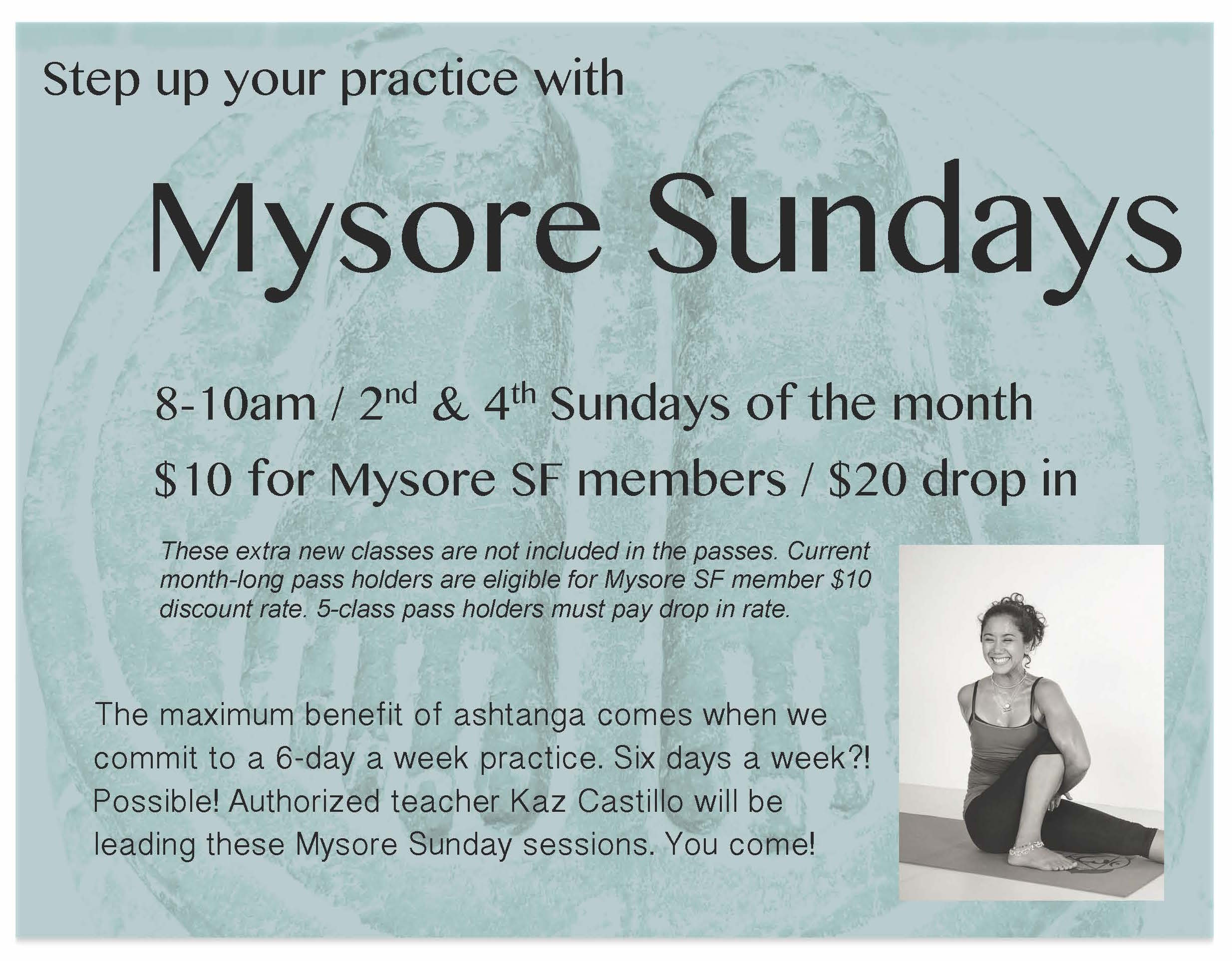
Mysore Sundays Flyer

Mysore Sundays with Kaz here in Mysore SF.

With Moon Day on Monday, this Sunday, October 11 is a good day to hunker down for practice with support of a teacher (in this case, me!). We offer Mysore Sundays on the 2nd and 4th Sunday of the month. Class is between 8-10am, at the Annex, 1420 Harrison St @ 10th. For more info on us, look us up on Facebook Mysore SF or http://www.mysoresf.com.

Trust Your Struggle

IMG_5980

“Trust Your Struggle.” Street Art. Temascal, Oakland.

I love the Mysore room. It’s one of my favorite places to be, whether it’s practicing or teaching, I can’t help but feel alive in such a space. I love the victories after some long-fought challenge, but I also have a great respect and appreciation for the power of practice when I see a student near tears. It’s very real, this hot house of human action, people moving within a small portion of rubber mat. It’s steamy and there is a palpable thickness in the air. There’s a lot of love here–but it’s not the love of fluffy bunnies or candy-colored unicorns–it is often a love forged from gritty, sweaty, face-all-twisted struggle.

Struggle? That seems like a paradox, right! Ashtanga is a yoga practice, after all, so shouldn’t it promote a deep sense of peace and calm, physical ease and mental equilibrium?

Ashtanga is a very honest practice, reflecting back at its practitioners their life in concentrated form. When life is hard, practice takes on that hardness. When life is easy, sometimes (when we’re lucky) it’s easy, but often practice will dig a little deeper to find a soft spot. It’s a tradition designed to make you strong and also flexible–and a component of that is to whittle away at what’s unnecessary: shame, fear, pride, all forms of ego–these are not easy things to be grappling with, thus, the struggle. The struggles are there for a reason: for us to understand ourselves better.

I think it’s important to note that I’m not speaking of binding in maricasana D, suptakurmasana, learning to drop back or getting the leg behind the head but rather the human struggle that comes with the challenges that are presented by certain postures, sometimes by practice as a whole. The struggle isn’t actually getting past the pose but getting past the challenge/turmoil that the pose creates. It’s not about moving forward in any particular series, it’s about moving beyond it.

As practitioners, we are responsible for the struggles that present themselves on the mat. We must meet them, rather than run from them. And with practice, meeting them means getting up close and personal with them through our bodies pretty much everyday with as much equanimity as we can muster until they loose their power. We might relax into them, melting into some mythical grace, or we might fight them tooth and nail in some epic shit fight, there’s no blue print for how exactly we are meant to face these moments. But I think we must trust that the struggle is there for a reason, that it serves some greater purpose other than to annoy or frustrate us, it isn’t getting in the way of our ease and happiness–rather, it is the way.


Continuing to grow here in Mysore SF. It is such a pleasure to be working in such a space where the practice and the teaching is so very alive, so very real–real in the struggle as much as the joy of practice. There’s an alchemical force in the room. The potential for transformation is there. Very grateful to be taking part in it. Mysore is Mon-Thur, 6-9am. Led Class is Fridays 6am and 7:30am. Sunday Mysore is 2nd and 4th Sundays (no class September 27, it is moon day). 

When Something Shifts

Kapotasana. Photo by Denise Tolentino

Kapotasana. Photo by Denise Tolentino

Something is happening in my practice. I know because it feels different.

There are, of course, the physical markers that undeniably tell me so. The hips are finally opening, alleluia! All the pantheon of Hindu deities know these hips of mine have taken their sweet ole time to open–bless them, I have enjoyed the sweet time they have given me!

Mostly it’s subtle, so subtle that it’s hard to quantify: a depth in the breath, an ease while deepening into a fold. A robustness in the asana, a stability in the vinyasa.

Then there are the other remarkably odd moments when a pose just shifts almost as if over night. One day, it’s like grappling with demons. Next day, it’s like butter. And the opposite can also happen, a pose that was there one moment, poof!, gone inexplicably on vacation with no note or return date.

The transformation of the physical practice happens slowly over time, over days, months, years of consistent practice, steady exploration, with skillful guidance from a teacher or teachers. The body becomes more receptive, so does our awareness, and the two begin to work with each other. Change inevitably happens. This, of course, is the basis for the growth we experience throughout our sadhana.

We cannot, however, discount the aha! moments that can turn things around quickly. A light goes on and something invisible is seen. Maybe it’s a technique we hadn’t learned, a crucial element in the execution of a posture, or, perhaps, a shift in our thinking mind or in our feeling heart.

What happens when we let go of fear? Or when we release trauma or anger or sadness? Or when we allow ourselves to drop into that precious but totally frightening space of vulnerability, which is so humbling/humiliating and which ultimately helps us surrender our holding patterns?

The body changes when we change. Something stuck, moves. Something hard, softens.

Right now that something is showing up in my kapotasana. An extreme back bend in the intermediate series, this posture has evolved as much as I have over these five-some-odd years that I have been doing it. It was challenging to begin with, became easy at some point relatively early. Then I began to notice that it was always the first posture to fall to pieces whenever I was troubled. When my heart was challenged, kapotasana became more challenging. Over the years its intensity has triggered a few tearful epiphanies. Whenever I got better, so did kapo.

A year and a half ago, it became almost terrifying to get into it, causing much anxiety with each effort. Physically it was possible, but the sensations that came with each attempt made it uncomfortable. I could not rebound from it. Whatever ease I used to enjoy in the posture had disappeared. Since then, I have struggled.

Then, last week, something shifted. No doubt this shift was greatly supported by a daily practice, to meet a thing of challenge everyday without judgement simply makes one stronger in body and mind. Practicing the same movement sharpens ones skill and agility. The big difference, however, was the absence of anxiousness, it seemed to just happen without all the drama in my head, and as a result it felt much easier.

The great irony is that the last few weeks have been trying, certain personal events have pushed me to a place of vulnerability and I am allowing myself to simply be with all of it: all of the joy and sadness and frustration and disappointment and awe and so on and so on. I had been struggling, fighting to not drown in it all, and then, last week, I decided not to just swim in this thick eclectic feeling soup but to also feel grateful for the struggle, the blessings, all of it. It is not easy to feel this raw, but it is also incredibly freeing to not be holding myself so tightly together. And perhaps it is the acceptance of these feelings and the cultivation of gratitude that is creating space rather tension.

And so, for me, kapotasana is changing–again. I am sure it is not the last time as I am surely going to continue to change. I’m sure there will be other postures, too, that will reveal different challenges in the future. It’s a very fine and beautiful relationship, the one between the life of our practice and the practice of our lives. It’s truly amazing and simple and perfectly symbiotic. When our practice changes, we change. When we ourselves shift, our practice likewise makes an adjustment, letting us know if we are spot on or just plain loosing it.

It’s not going to be kapotasana for everyone. Sure, kapotasana is a difficult posture for most people, which is why it can have profound effects. Learning to drop back likewise poses similar challenges/gifts. “Gauge” postures don’t have to be complex, either. I had a student who shared that padangusthasana in the standing series and paschimattanasana, at the early part of primary, both forward folds, made them want to cry. When we start to understand that the way we move, breathe, hold our bodies is a deep and honest expression of our selves, the practice becomes an incredible tool for self discovery and transformation. It’s not about how strong we get or how bendy we become, though it also facilities both, but how we learn about our limitations and how we learn to overcome them.