
Mysore Zamalek, October Schedule

October MYSORE ZAMALEK Schedule

We are super excited to be publishing our second month’s schedule. Consistency is key in practice, and the same goes for teaching. And the synergy between teacher and student is grounded in the commitment we have to the practice.

Community will build in any kind of yoga class, but the potential for community in a Mysore Program, where practitioners are regularly studying in the same space, is huge. We hope that students can come to Mysore Zamalek @ Nūn Center and find a kind of home, this is a place where we can grow, sweat out our issues, seek peace, and cultivate health.

If you are interested in joining our Mysore program located here at Nūn Center (4 Shafiq Mansour, Zamalek), please message me at mysorezamalek@gmail.com or book through we@nuncenter.com.

BEING Ashtanga Yoga

When Filipa Veiga, Portuguese ashtanga teacher and writer, asked me to join the contingent of yoga teachers offering classes at the Being Gathering 2017 at Boomland in Idanha-a-Nova, Portugal, it put into motion a plan to spend the summer in Europe. I wanted to go see my teacher in mid August in London, I was suddenly committed to my first festival date in early July, what to do then with the time between?

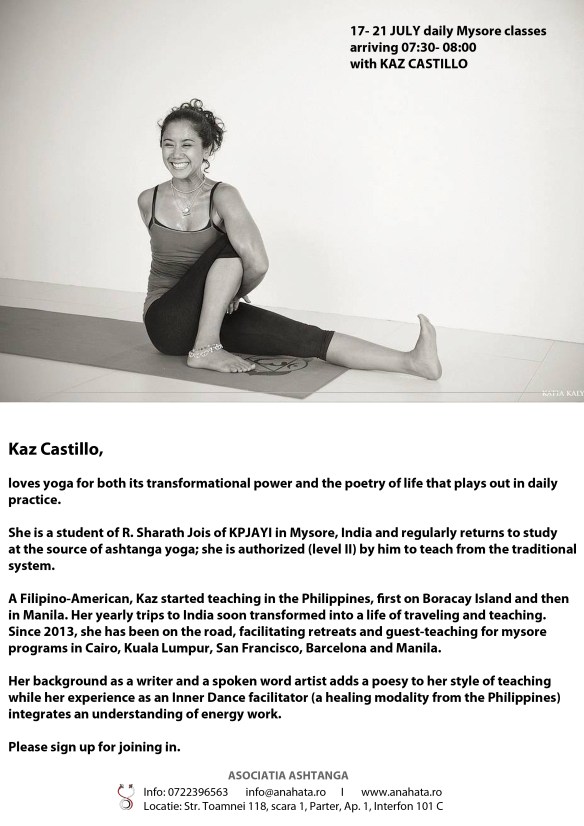
Before I knew it, I had before me a bit of vacation, time to spend with beloved friends, a restart to a personal project that had been put on hold, and a small offering of teaching dates in Portugal, Romania and Vienna. I’m excited for this period after a 7 month stint in Cairo, where I will return to continue teaching after August.

These breaks from routine, the opportunities to connect with other teachers, especially to be a student myself, to tap into the global movement having to do with yoga and healing, allows me time to recharge and also ruminate on what exactly we are doing in our day to day, what is this practice, what is it’s purpose, why do we come to the mat day after day?

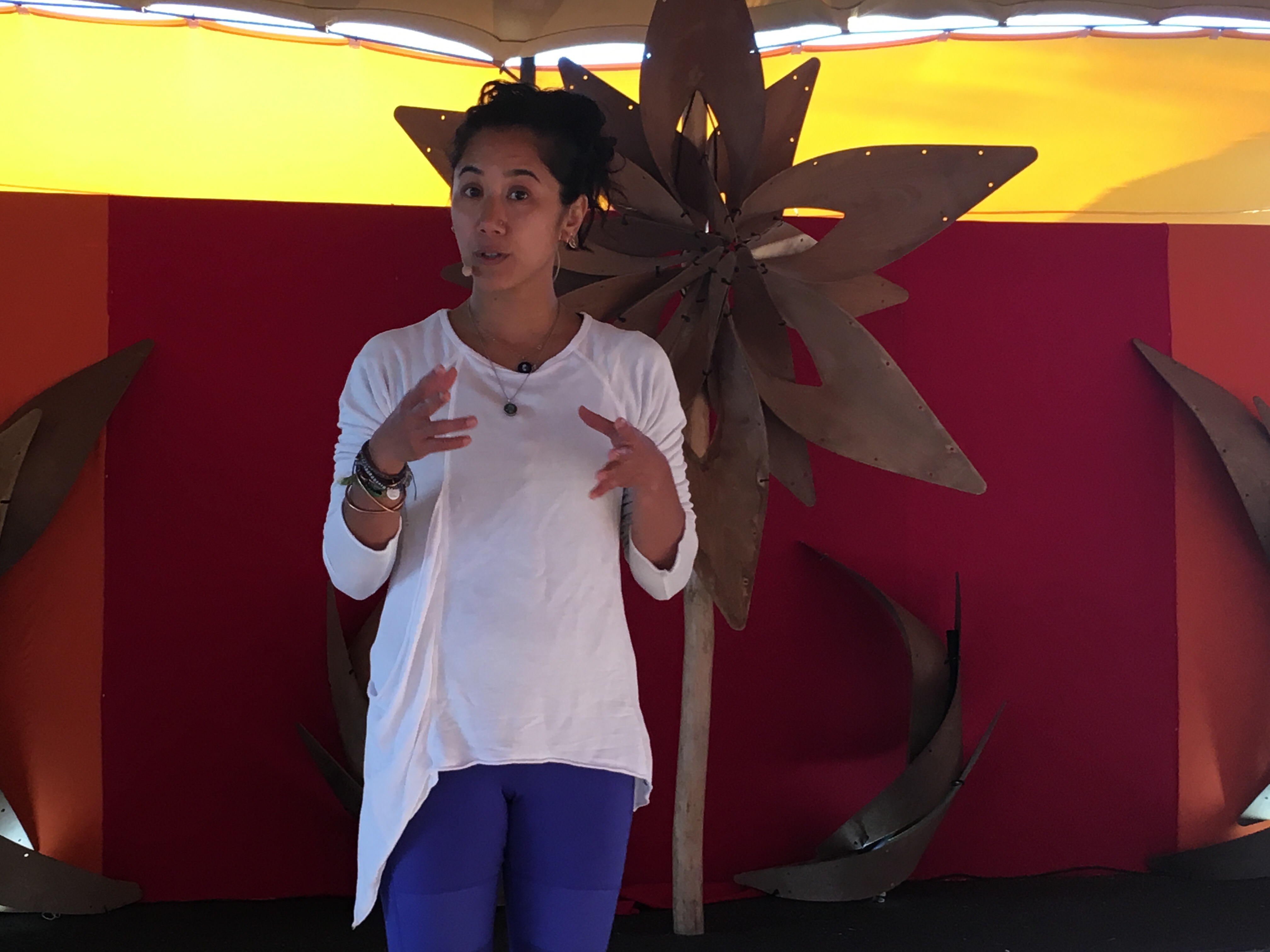
On the last day of the festival, I introduced ashtanga yoga as a tool for BEING, for being a better person, for being more focused, more attentive, more present. I alluded to the great Patanjali, to the first line of the Sutras: “Atha yoganuśasunam” Now, begins yoga. It brings us to the present moment. I ended the class with Patanjali, as well, and how he described yoga practice as “dirgha kala nairantarya asevitam,” a long time, without interruption, with whole hearted devotion.

And so begins the summer for me, starting with a most extraordinary of gathering of people, from healers to storytellers, green warriors to spiritual seekers, but also with a great sense of what it means to BE in yoga, how we have a responsibility to be as present with ourselves, our relations, our fellow creatures and planet as much as possible and how practice doesn’t end after our hour and half of sweating and grunting on the mat, it goes on into our day, in every action, in every breath.

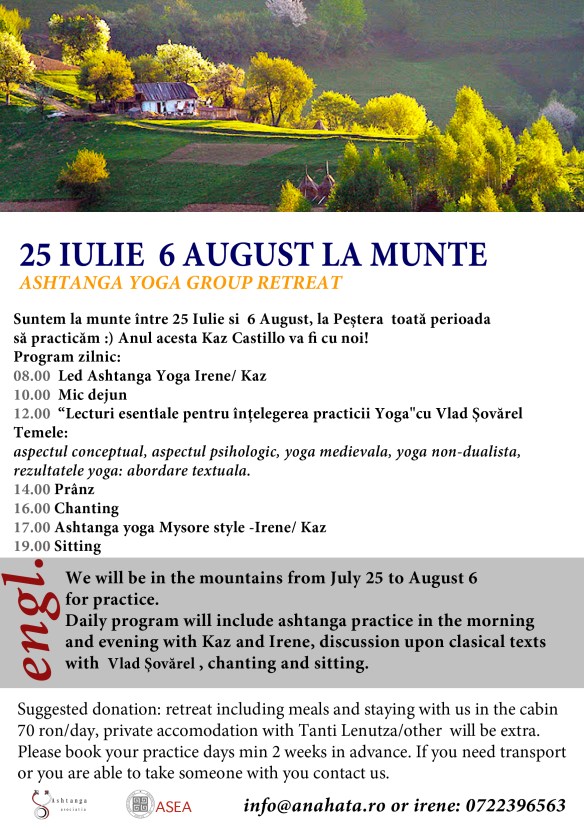
Join me in this extraordinary experiment of being through the ashtanga yoga system. I teach in Yoga Lisboa July 11, 12, 13 (www.yoga-lisboa.com), Asociata Ashtanga/Ashtanga Yoga Romania (info@anahata.ro) on July 17-30, then finally in Mysore Vienna from July 31 to August 8 (www.mysorevienna.com).

Photos taken by Clara Lua, Being Gathering, July 2.

Ashtanga Yoga and Ramadan

Last year, I decided to teach through the first 3 weeks of Ramadan. It was the first time any of my trips to Egypt coincided with this period. I hadn’t planned for it, but was happy to have a new teaching experience.

I had been told that it would be different, a few teacher-friends based here advised me on what worked best for them and their students during the month-long period where practicing Muslims fasted from sun-up to sundown.

I scheduled classes with a bit of trepidation, a shorter morning class as usual for non-fasters and another afternoon session before the breaking of the fast, iftar. It wasn’t my ideal to break up our already-small group and work the extra hours, but, in my gut, I felt that traditional ashtanga practice would suit Ramadan, that it could be a good compliment to the season as a meditation and as a physical support system.

In truth, the entire rhythm of Cairo changes during this time, the breaking of the fast determines the working and living hours of its 9.5 million residents, regardless of one’s faith. Energy consumption becomes a serious issue among fasters, but non-fasters too take on some of the rigorous social schedule dictated by meal times. Also, revised office hours creates time, particularly in the hours before Iftar. The clubs and bars cease to serve alcohol and everything quiets down or turns inwards.. A totally different energy and pace blankets the city.

Teaching during Ramadan last year reminded me how important it is to be flexible as a teacher; and reinforced my belief that the mysore-style self-practice is designed to be flexible itself, how it can give students the space to tune into their personal needs, and to practice in a way that is nourishing and safe.

In the end, I really fell in love with the experience. I’m happy to say that the students did as well.  The afternoons were hours of exploration through which I could experience Ramadan through my students. Together, through the practice, we tuned into the body, worked with the various phases that comes with fasting, from the lightheadedness and fatigue early on to the lightness of body and bursts of energy that came later.

I saw how the initial effects of fasting effected practitioners and we were careful to respect and honor them especially during the first week of practice. We focused on a softer breath and slow steady movement, careful not to push bodies. We approached postures, like standing forward-bends, carefully to avoid dizziness. We spoke about the yamas and how important it is to practice with non-violence, with honestly, with non-attachment, in a way that we aren’t stealing from ourselves and in a way that we are using our energy wisely.  I encouraged students to honestly tune into their available energy reserves, stopping early on in their practice if they felt low energy. With new students, we learned the sequence slowly, pretty much as we would do in the regular Mysore sessions.

By the second week, students were over the headaches caused by caffeine withdrawal. People were more used to breathing after a day of no water. The body was more used to fasting. Students could do more and proceeded further than the week before. By the third week, students were actually light and lithe, often more so than before Ramadan started. The practice was energetic but also stable and focused.

I saw the effects of the practice in a concentrated form with a group of people on a particular spiritual journey. How the Mysore practice, so often villainized as being a difficult-hard-as-nails sort of yoga method, could be used as a gentle tool for personal introspection as well as a means for students to condition their mind and body, developing flexibility and strength steadily over a period of time.

In a week, Ramadan will start. I’m looking forward once again to teaching those hours before iftar, on top of the morning sessions, experiencing the shifts and learnings that come with it, which inevitably make us not just better students, but hopefully better people in the process.

Mysore Ramadan Schedule (May 27-June 24)
Sunday to Thursday
8:30-10:30am
4:30-6:30pm
Month Pass: 1600LE/ 1 Week Pass 550LE
We accept Drop-In Students who have existing practices already 150LE
(If you are a beginner to the practice, you will need roughly an hour and a month pass)

NŪN CENTER is located at 4 Shafik Mansour, Zamalek. Call or email us for questions or to book for Ramadan: 0122 398 0898 / we@nuncenter.com. http://www.nuncenter.com

Practice of Pieces 


Should you come to a “mysore” self-practice class with me for the first time, I’ll most likely ask you to close your eyes and breathe. First, with your ordinary breath. And from there, we start to extend each inhale and exhale, sipping the air from our nostrils until we create a soft sound, which slowly heats the body. We’ll probably do a few sun salutations, maybe some standing postures, but the real lesson on that first day is breathing. It is the most basic unit of learning in the traditional ashtanga method.

Over time, we introduce other units: the engagement of our core muscles or energy locks called bandha. vinyasa or movement-breath, and various postures that condition and open the body differently. On a more subtle level, there are lessons in focus and awareness, effort and conservation of energy, dedication, devotion and self-love–all these units are actually inexhaustible, we return to them over and over, each time more in-depth. Slowly but surely the lessons expand over time.

When we start, it’s a little like learning something in pieces and it’s hard to see the big picture. Many get impatient or frustrated that they can’t see where it’s all going. People get bored of the pace, or angry at the level of concentration we often ask from beginners, or afraid of the level of commitment we ask from all students.

I ask new students to commit for the month, recommending them to practice the 5 teaching days, at the barest minimum 3. And here, in Egypt, I’ve actually seen people physically recoil at my suggestion as if I were some yoga sadist. Yes, I do know life is hard here, that Cairo traffic is ridiculous, that a morning practice is counterflow the nocturnal rhythms of the city. I totally understand. And yet…

I also know that people want to be healthier, they want to have better habits, they want to be more flexible and strong, they want to have peace and focus. So I ask anyway, daring aversion to such structure because I know that this is a formula for change that really works. For those who practice regularly, the pieces come together relatively quickly, and the yoga practice becomes wholesome, full and giving.

As I approach March and another month of teaching here in Cairo, the questions I want to ask from new and old students are the following: Are you willing to show up for yourself on a regular basis? Are you willing to breathe and move, everyday learning something new about the practice and maybe about yourself, everyday recognizing that you are this amazing creature that can get stronger and more flexible not just in the body but in the mind and heart too? Are you willing to stand before the difficulties so that we can piece the practice together?


Regular Teaching continues here at Nūn Center:
Mysore Mornings is Sunday to Thursday, 7-10:30am.
Evenings are Monday & Wednesday, 8-9:30pm.

We have some special programs at the start of this month at Nūn:
Full Led Primary
Friday, March 4, 9-10:30pm

Ashtanga Yoga: Tool For Change
Saturday, March 4, 11am-1pm

Inner Dance, Sound and Movement Meditation
Saturday, March 4, 6-8pm


Bookish Beware: Less Reading, More Experience


img_0171

A world of books. A rare little independent Japanese book seller in Nakatsu, Osaka.

I’ve always identified myself as being a literary person. I studied English literature in university and even majored in creative writing. I love books, the actual physical touch of them, the weight of them in my hands, the smell of paper. As a youth, books were my escape from an awkward adolescence. My first experiences of love, obsession, heartache were from the novels I read, even the experience of reading them was very real to me, from forming attachments to the characters to feeling sadness when our time together would inevitably end in the last pages of a story. I still enjoy getting engrossed in a good novel, but I don’t seek them out as much as I used to.

My last bookish phase came with the beginning of my yoga practice. I collected as many books on yoga, I wanted to understand it, to use the same love for words to experience this new way of living. I don’t think I read through a third of these books that take a whole shelf on my bookcase in Manila. The ultimate teacher is always life itself, every book, lecture, teacher is a supplement to the greater lesson-maker which is life.

No one and nothing can show you the experience of anything. One might help facilitate or guide or share. Ultimately the job of experiencing anything is our own. We must, simply, experience it. To learn yoga, we must must practice. To live life, we must live.

Sometimes, I miss my books. I miss the old me totally absorbed in the pages of another world. But I also know that my lack of enthusiasm for a world of paper, stories and information is due to a greater engagement with the world that I live in–that these days, I favor activities that dissolve the stories and words that have previously defined me and my life. And perhaps, in the future, I will enjoy reading again with the same voracity as before, but for now, I am content in enjoying the moment before me, the unfolding story of life in real time.

The Practice of Flight


Ashtanga has this gravity defying reputation. All over social media there’s a plethora of photos and videos of ashtanga practitioners displaying incredible aerodynamic feats, floating/levitating in and out of postures. All around there are workshops that focus on these technical aspects, of jumping forward and back, of engaging bandha to the point of slowing down time, of achieving this lightness of the body that mimics flight. And why not, it’s fun and looks amazing, and moreover it builds a particular awareness in the body.

I remember in my earlier years of practice, I loved it, I loved the feeling of height, and flight, that moment of suspension as I moved my body forward on the mat, before landing. I remember a fellow student once compared me to a grasshopper. And, if I remember correctly, I rather liked the comparison.

I’m not much of a “flyer” anymore. I’d probably still enjoy it, but over the years of studying with Sharath Jois in Mysore, India, that among other bits and pieces have dropped off the program.

I think for some strong practitioners this comes quite naturally. What I realized, however, for me, it did not. A lot of extra energy went into that one particular inhale, the effort was disproportionate, and practice is about an evenness of breath and effort. And extra effort in jumps, meant extra work for shoulders and arms which then resulted in tighter albeit stronger muscles.

Letting go of it, and for sure attachment was there, was just as much a part of me growing as a practitioner as it might be for someone else who chooses to develop these abilities.

Over recent years, practice has been more about streamlining, taking out the extra flourishes, those dramatic flares, which– when they are effectations–are simply distractions from the meditative flow of sadhana. It’s been about efficient use of mind and body (at 40, I am more concerned with being able to have a healthy and sustainable practice).

With a practice like ashtanga yoga, I think there is more than one way to fly. There’s the kind of flight that’s physical and really stunning to see. Then there’s another kind, and this is the one I find myself more and more impressed with, the practice that glides with such ease it barely registers. These belong to the super heroes in disguise practicing quietly beside you in the shala, so subtle until that one sliver of a moment you note with much surprise that they are doing something quite extraordinary. Likelihood is that there are even more practically invisible yogis who are totally going unnoticed, soaring above us all.

Whatever our mode of flight (I think different ways suit different people), ashtanga simply inspires us to take off to greater heights–and to greater heights we must go, no matter what that looks like.

The Light Is On, Mysore Room KL


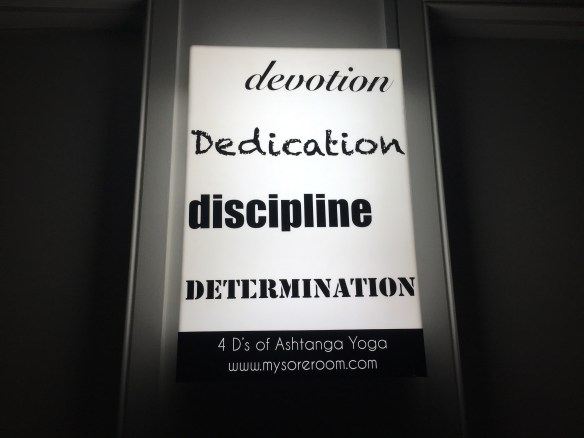
In the mornings that I was teaching there, turning on the lights at Mysore Room in Kuala Lumpur was a bright reminder of what my teacher Sharath Jois calls the 4 D’s of Ashtanga Yoga. “Devotion,” “dedication,” “discipline,” and “determination” would light up the room, which was still dim before sunrise. These four attributes make a good ashtanga student, to be sure. The kind of student who gets up 6-days out of the week to meet their physical/mental/emotional edge sometimes before the crack of dawn, and then get on with the rest of their day. Truth is most students don’t come with these D’s built in.

Practice itself cultivates these characteristics over time. When I started practicing ashtanga yoga, I had no idea what it meant to be devoted to a spiritual method, I certainly didn’t know what it meant to dedicate myself to any one particular thing, nor did I have the discipline or determination to do so. My relationship with ashtanga started with one class, which eventually turned into three to four classes a week, and usually in the evenings after work. I would even take up other yoga styles, once in a while, for fun. Eventually, I was practicing in the morning daily. Over time, I was practicing more and more with devotion, dedication, discipline and determination. They came naturally with practice–sometimes with ease, sometimes with difficulty, but always quite naturally.

So if you’re feeling lacking in the 4 D’s, not to worry, everything comes with practice.

It was a pleasure to cover for my friends Yan Ong and Manuel Ferreira in their school Mysore Room in Kuala Lumpur. These two have created a very special place of learning ashtanga yoga in the heart of the city. Once traveling teachers, their move home to set up shop in Malaysia is so inspiring for me. For information on their classes, see www.mysoreroom.com.


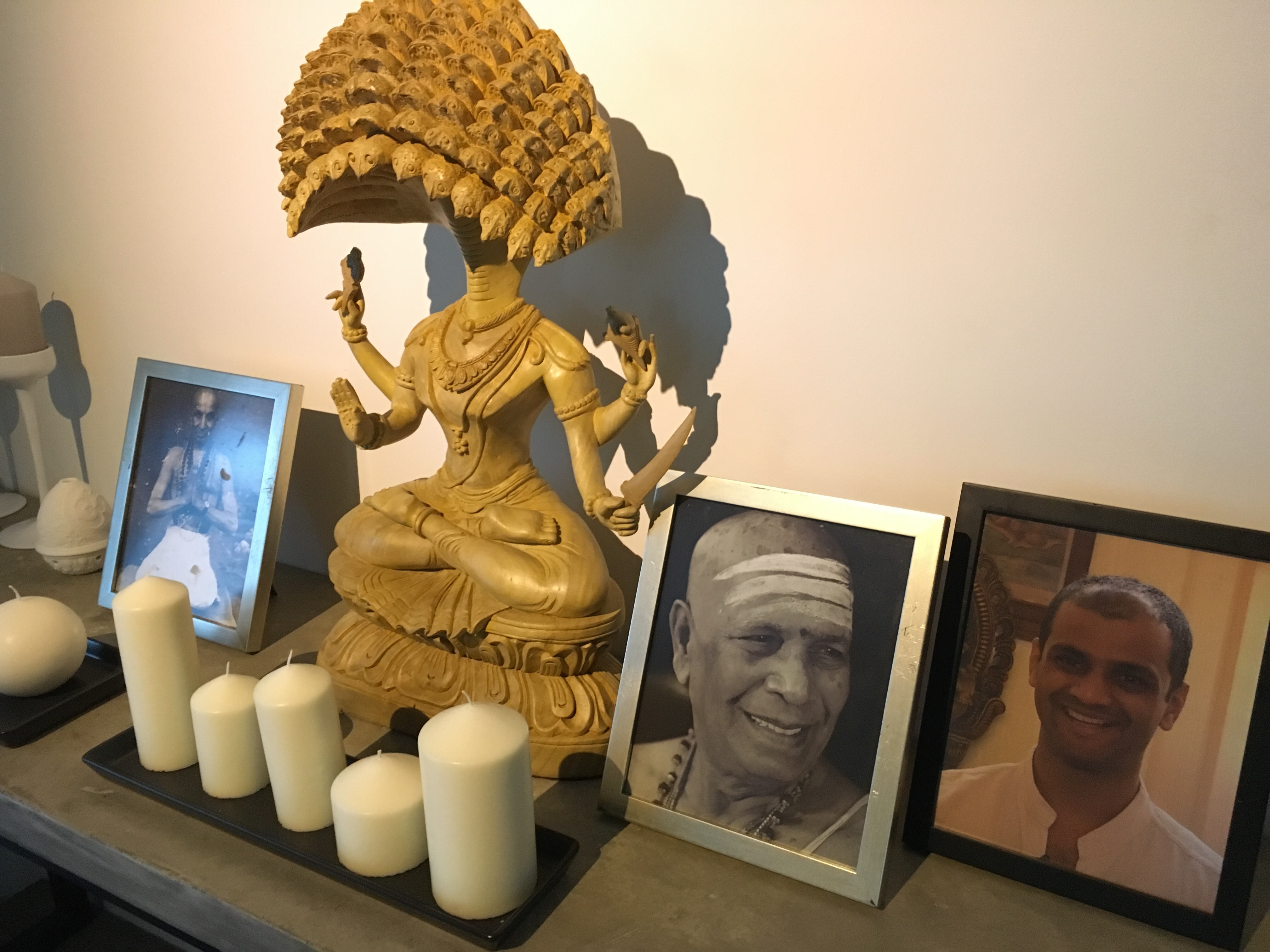
The ashtanga lineage: Patanjali, Krishnamacharya, Pattabhi Jois and Sharath Jois watching over Mysore Room.


āsana and the yoga of cairo

It’s been a spell since leaving Cairo, but this piece inspired by the old city and its people has long been stewing. People often ask me why I keep coming back to Cairo. There are many reasons but one of the big ones is this: it inspires a level of sadhana that is well beyond the body. It’s a place that reminds me to live my yoga practice.

There’s this chair in a room. It’s a small receiving room in an old apartment in Downtown Cairo. The square room is painted red, and despite its tiny floor size, it stretches up and up with high ceilings. The chair is the only real furniture in the room. There’s a desk lamp, that sits on the ground and the three walls of the room are filled with artworks of varying sizes that reaches up the wall.

The seat, a wooden antique reclining chair with white cushions, feels lonely to me, partially lit by the lamp. Framed against the bits of modern art crawling up the red, it feels stoic, but solitary.

Later, my friend, to whom this space belongs, tells me about his life in Cairo. The struggles of ordinary life filled with victory and loss; he speaks of caring for a parent dying of cancer; of the failed revolution; of life in Tahir Square; of the many crazy things he witnessed during that crazy time; he shares the oddness and disparity between the different social stratas which he straddles, because Cairo, the world he lives in, constantly vacillates between extremes.

In yoga, “āsana” is often referred to as the postures we take while we practice. It is the “seat” of yoga.

These days, we mistake āsana as taking shapes in space. There is a proliferation of this on the internet with photos and videos of beautifully performed handstands and human pretzels… The day I started writing this article, a funny spoof on the yoga video phenomenon went viral among my yoga circles. The following day, a number of the same people who shared it online were once again liking yogāsana snap shots on social media. There’s nothing wrong with that, we can, of course, appreciate all sides. But it had me thinking, once again, what it means to be sitting in yoga.

It is truly something awesome to see a human being defy the limits and gravity with his/her body. They definitely inspire. But I wonder, are they accurate representations of āsana?

I do not offer any photos for this post, though originally I wanted to share one of the chair itself. My friend asked that I refrain from doing even that, such things are, after all, private and the delicate practice of our lives is sacred.

My friend and his chair (neither pictured here) move me in a way that I do not feel when seeing some popular representations of yoga. My friend and his chair, his seat, remind me that the essence of yoga cannot fully be captured in a polished physical posture, however amazing, however artistically articulated.

My friend, he’s no expert at Cairo life, certainly not at yoga. He’s simply doing his best to just sit in all the crazy, all the joy and all the disappointment, striving to find peace with all of it. And that feels like yoga practice to me.

When we practice, we are practicing our ability to sit in yoga, to find equanimity in the body, mind, heart. The greater practice is life itself, the challenge of which is to find equanimity in the body, mind and heart amidst the chaos of an ever changing world.

I think one of the reasons I continue to be drawn to Cairo is that the city’s version of the ebb and flow of life is on some serious kind of overdrive: it is a vortex of living, of varying energies, sweet and terrible (political, economic, cultural, social, individual) all swirling rapidly together in this thick soup of a city, layered with modern and ancient civilizations, and with them their countless innovations, numerous mistakes and unfathomable mysteries.

To sit in it, to stand, to walk, to move, to work, to be there, to be well–let alone, thrive there–takes a special kind of practice.

That’s not to say that everyone in Cairo is sitting in yoga, with every challenge there’s a good amount of avoidance or numbing–but the opportunity to practice yoga exists at every turn, every interaction, every bit of gridlock and difficulty. It is easy to see this in the lives of many of the city’s inhabitants, most of whom don’t know what the inside of a yoga studio looks like. Practice is alive in the struggle. It’s inhabitants must simply do what they can, working to find some stillness in all this whirlpool of energy; Cairo is their yoga.

The search for softness or grace or space or peace in the whirlpool of life is both challenging and sublime. I suppose it’s like this everywhere, though the extreme energies of a place like Cairo accentuates the experience. It is the same experience in a mysore room, where practice is alive and well, gritty and difficult, at the edge of some seemingly insurmountable odds, which we learn to overcome little by little.

Ultimately, the āsana of Cairo is that of everyplace, it is the practice of every man. It is about how we sit, stand, move, interact with our environment, with the people we meet, it’s how we rise up to our challenges and it’s how we live up to our victories.