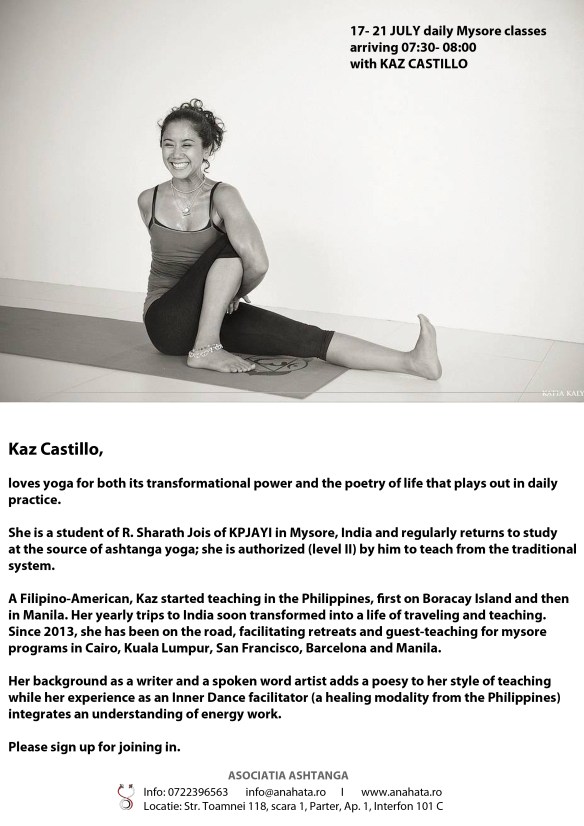
Coming Soon: Daily Mysore in Bucharest
Image
Reply

 Last year, I decided to teach through the first 3 weeks of Ramadan. It was the first time any of my trips to Egypt coincided with this period. I hadn’t planned for it, but was happy to have a new teaching experience.
I had been told that it would be different, a few teacher-friends based here advised me on what worked best for them and their students during the month-long period where practicing Muslims fasted from sun-up to sundown.
I scheduled classes with a bit of trepidation, a shorter morning class as usual for non-fasters and another afternoon session before the breaking of the fast, iftar. It wasn’t my ideal to break up our already-small group and work the extra hours, but, in my gut, I felt that traditional ashtanga practice would suit Ramadan, that it could be a good compliment to the season as a meditation and as a physical support system.
In truth, the entire rhythm of Cairo changes during this time, the breaking of the fast determines the working and living hours of its 9.5 million residents, regardless of one’s faith. Energy consumption becomes a serious issue among fasters, but non-fasters too take on some of the rigorous social schedule dictated by meal times. Also, revised office hours creates time, particularly in the hours before Iftar. The clubs and bars cease to serve alcohol and everything quiets down or turns inwards.. A totally different energy and pace blankets the city.
Teaching during Ramadan last year reminded me how important it is to be flexible as a teacher; and reinforced my belief that the mysore-style self-practice is designed to be flexible itself, how it can give students the space to tune into their personal needs, and to practice in a way that is nourishing and safe.
In the end, I really fell in love with the experience. I’m happy to say that the students did as well. The afternoons were hours of exploration through which I could experience Ramadan through my students. Together, through the practice, we tuned into the body, worked with the various phases that comes with fasting, from the lightheadedness and fatigue early on to the lightness of body and bursts of energy that came later.
I saw how the initial effects of fasting effected practitioners and we were careful to respect and honor them especially during the first week of practice. We focused on a softer breath and slow steady movement, careful not to push bodies. We approached postures, like standing forward-bends, carefully to avoid dizziness. We spoke about the yamas and how important it is to practice with non-violence, with honestly, with non-attachment, in a way that we aren’t stealing from ourselves and in a way that we are using our energy wisely. I encouraged students to honestly tune into their available energy reserves, stopping early on in their practice if they felt low energy. With new students, we learned the sequence slowly, pretty much as we would do in the regular Mysore sessions.
By the second week, students were over the headaches caused by caffeine withdrawal. People were more used to breathing after a day of no water. The body was more used to fasting. Students could do more and proceeded further than the week before. By the third week, students were actually light and lithe, often more so than before Ramadan started. The practice was energetic but also stable and focused.
I saw the effects of the practice in a concentrated form with a group of people on a particular spiritual journey. How the Mysore practice, so often villainized as being a difficult-hard-as-nails sort of yoga method, could be used as a gentle tool for personal introspection as well as a means for students to condition their mind and body, developing flexibility and strength steadily over a period of time.
In a week, Ramadan will start. I’m looking forward once again to teaching those hours before iftar, on top of the morning sessions, experiencing the shifts and learnings that come with it, which inevitably make us not just better students, but hopefully better people in the process.
Mysore Ramadan Schedule (May 27-June 24)
Sunday to Thursday
8:30-10:30am
4:30-6:30pm
Month Pass: 1600LE/ 1 Week Pass 550LE
We accept Drop-In Students who have existing practices already 150LE
(If you are a beginner to the practice, you will need roughly an hour and a month pass)
NŪN CENTER is located at 4 Shafik Mansour, Zamalek. Call or email us for questions or to book for Ramadan: 0122 398 0898 / we@nuncenter.com. http://www.nuncenter.com
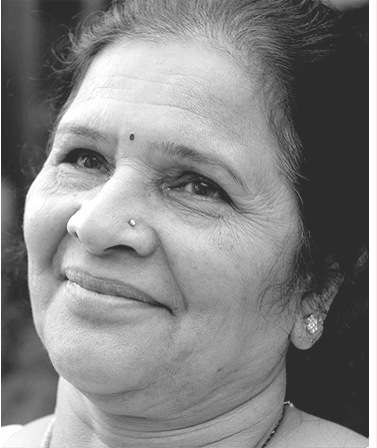

Last year, in conference, Sharath Jois was answering a question about something a student should do–I can’t even remember what about, but he used the masculine pronoun in his response. A female student then asked why he decided to use said pronoun and whether the practice was meant for men. He laughed, his eyes shining, the way he does when he seems to be enjoying a joke to himself, and asked her to look around as he gestured with his hands and chin to the sea of people crammed into the shala, an overwhelming number of which were women.
We have come a long way from the early days when the first westerners had contact with Pattabhi Jois and his ashtanga yoga, where the room of 12 would accommodate mostly men. And while we can count the few remaining senior female teachers, the modern day practitioner base is becoming more and more overwhelmingly female. The modern female ashtangi has come a long way. There are more female teachers now than before. There is a strong movement to champion women’s rights and dignity on and off the mat. Advanced women practitioners used to be a novelty and now it seems a norm that women continue on towards the advanced series, building strength while maintaining flexibility.
It is important to note that our yoga lineage celebrates women practitioners and teachers. Pattabhi Jois taught not just his sons and his grandson, the current director of the school, Sharath, but also his wife Amma, his daughter Saraswathi (both pictured above) and his granddaughter Sharmila. Saraswathi Jois, at 76, continues to teach in Mysore, India alongside her daughter who assists her. Sharath’s wife Shrutti likewise teaches the afternoon classes with Indian students.
I’m not saying it’s perfect, but I am proud to be a part of a modern tradition of yoga that honors women, that encourages householdership as much as the practice, and, for those who are inclined, teaching. It respects the cycle of women, and asks us to do the same by taking our “holidays” during the first three days of our menstrual cycle.
Beyond the ideas of men and women, the practice itself is an incredible tool for empowerment. I came to this practice ten years ago pretty much still a girl. The years of practice helped me come into my own wellspring of inner strength and flexibility, I had no idea that I could be this courageous human being, let alone woman. And so with gratitude, I thank the practice. I thank my teachers and my teachers’ teachers who had the good wit and grace to teach men AND women this great method. I thank the one woman I’ve studied under, you are an inspiration. I thank all the women who came before me, who were brave enough to go to India to study yoga when India was even more foreign and wild and far away than it is today. It is good to remember that women are a part of this great lineage.
Should you come to a “mysore” self-practice class with me for the first time, I’ll most likely ask you to close your eyes and breathe. First, with your ordinary breath. And from there, we start to extend each inhale and exhale, sipping the air from our nostrils until we create a soft sound, which slowly heats the body. We’ll probably do a few sun salutations, maybe some standing postures, but the real lesson on that first day is breathing. It is the most basic unit of learning in the traditional ashtanga method.
Over time, we introduce other units: the engagement of our core muscles or energy locks called bandha. vinyasa or movement-breath, and various postures that condition and open the body differently. On a more subtle level, there are lessons in focus and awareness, effort and conservation of energy, dedication, devotion and self-love–all these units are actually inexhaustible, we return to them over and over, each time more in-depth. Slowly but surely the lessons expand over time.
When we start, it’s a little like learning something in pieces and it’s hard to see the big picture. Many get impatient or frustrated that they can’t see where it’s all going. People get bored of the pace, or angry at the level of concentration we often ask from beginners, or afraid of the level of commitment we ask from all students.
I ask new students to commit for the month, recommending them to practice the 5 teaching days, at the barest minimum 3. And here, in Egypt, I’ve actually seen people physically recoil at my suggestion as if I were some yoga sadist. Yes, I do know life is hard here, that Cairo traffic is ridiculous, that a morning practice is counterflow the nocturnal rhythms of the city. I totally understand. And yet…
I also know that people want to be healthier, they want to have better habits, they want to be more flexible and strong, they want to have peace and focus. So I ask anyway, daring aversion to such structure because I know that this is a formula for change that really works. For those who practice regularly, the pieces come together relatively quickly, and the yoga practice becomes wholesome, full and giving.
As I approach March and another month of teaching here in Cairo, the questions I want to ask from new and old students are the following: Are you willing to show up for yourself on a regular basis? Are you willing to breathe and move, everyday learning something new about the practice and maybe about yourself, everyday recognizing that you are this amazing creature that can get stronger and more flexible not just in the body but in the mind and heart too? Are you willing to stand before the difficulties so that we can piece the practice together?
Regular Teaching continues here at Nūn Center:
Mysore Mornings is Sunday to Thursday, 7-10:30am.
Evenings are Monday & Wednesday, 8-9:30pm.
We have some special programs at the start of this month at Nūn:
Full Led Primary
Friday, March 4, 9-10:30pm
Ashtanga Yoga: Tool For Change
Saturday, March 4, 11am-1pm
Inner Dance, Sound and Movement Meditation
Saturday, March 4, 6-8pm
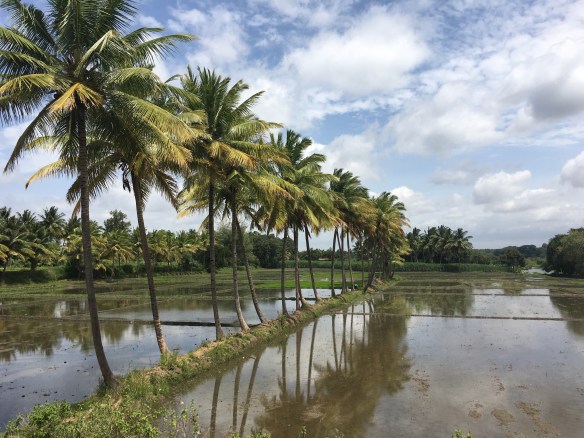
About a month ago, I was feeling so cramped up being mostly in the small the suburb of Gokulam in Mysore, India. I felt this incredible restlessness that could only be quieted by riding my scooter out into the fast road out of town, towards the open rice fields and farmland along the Cauvery River. I was nervous at first, unsure of the way, because I rarely ventured out alone. I had gotten complacent and comfortable in my surroundings, little noticing until that moment that I craved for more than yoga practice, houses, wandering livestock and fellow yoga students.
I remember feeling great relief when the landscape opened up. It was a reminder that wide open green space, fresh air and nature was so readily available so long as I was willing to leave my comfort zones.
This is often what I feel in my own practice and body. How the body I sometimes think I have is a little different from the body I actually have. How, at times, I perceive my limitations as permanent state of being.
Our yoga practice helps us find space where we might think there is none. These spaces can be small, or big, or so subtle that they appear to hardly exist in the body. It can be the difference between comfort and dis-ease, lightness or suffering. At times these spaces are in our minds only, and when we respond to challenges better, we create space and this, too, reflects in our body.
In no way is pushing a good thing. Knowing our limitations is also a good thing too, it keeps us safe. Do not push, but rather be willing to explore, to step beyond what is comfortable and easy, because beyond that bit of uncertainty these is so much space.
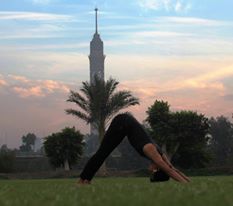
Taken at Cairo’s Gezira Club by the late Zeinab Lamloum, a great photographer, devoted ashtanga student and good friend.
There are some places that simply draw us, that holds a place in our hearts and our imaginations, that stirs in us some deep kind of recollection of what it is to be terribly, beautifully human. Since late 2013, that place for me has been Egypt. So, in this year which I’ve dedicated to living more fully, more authentically, making my fourth teaching trip to Cairo feels like a pretty good idea.
Over the last few years, I realize, I have formed an interesting, and ever changing, relationship with the place and its people. My first trip, I subbed for fellow teacher, Egyptian Iman Elsherbiny when she took her own trip to study with our teacher in Mysore, India. That first experience was like stepping into someone else’s life, living in her apartment, teaching her classes, being taken around by her friends. My second trip, I joined forces with Iman to help her open her new yoga space, The Shala in Maadi, during which we did a few retreats together which solidified our own sisterhood; her friends became our friends. The last time, I was teaching workshops and retreats, mostly on my own, I spent practically every weekend away from Cairo, it was beautiful but discombobulating. I started to make my own connections, but it was snippets of a life in a whirlwind.
In a way, over those trips, Egypt and I were having a romance, intense but fleeting, substantial enough that it has kept me wanting more; so risky at times that I wanted to keep myself at a safe distance. Still, the feeling remains, I know that Egypt and I like each other.
It’s been nearly a year and a half since my last meeting with Egypt and I wonder whether we’ll jive or not, whether we can we still top the magic of the first, second, even the third time?! I’m not going to try to think too much or speculate the possibilities. I can’t speak for Egypt, but I know I’ve changed and I have a feeling that in the backdrop of Cairo I will know how much more different I am from the other times I’ve come to visit. I know I have grown there, and I know there is probably more growing to do together.
I have different intentions than previous trips. Instead of seeking adventure, wanting to teach everywhere and spreading myself too thinly, I am concentrating my energy, hoping for a stable two and a half months of teaching and self-study.
This time, I am making Nūn Center in Zamalek my base for two months, while continuing to offer Inner Dance in The Shala in Maadi, where the healing modality grew a steady following by the end of 2014.
Between April 17 and June 10, I will be teaching a Sunday to Thursday Mysore program between 7:30-10am at Nūn Center (pronounced “noon,” Nūn is the symbol for primordial water in Ancient Egypt), along with supplementary weekend workshop classes on Friday mornings that will include “Introduction to Ashtanga Yoga” and various themed explorations paired with the traditionally counted led class. For more information on the Nūn Ashtanga and Inner Dance offerings, please check out the website http://nuncenter.com. Email or call for bookings and inquiries we@nuncenter.com/+20 122 398 0898.
I will also be facilitating Inner Dance in The Shala in Maadi on Thursday evenings. For information on the Inner Dance schedule please call 01223717729-01222384498 or check out The Shala Facebook Page.
There will surely be more in store, dates are being floated and ideas are brewing. So, please continue to check in for updates.
I can’t say where this romance will take me, but I suspect it’s where I want to be going, deep into the personal work that fuels my own teaching, my hunger for learning, and my love for living. I’m excited to say: Cairo, I’m coming.
For Weekly Mysore Classes & Friday Workshops
Nūn Center
4 Shafik Mansour, Zamalek, Cairo
we@nuncenter.com/+20 122 398 0898
For Thursday Night Inner Dances
The Shala
6, Road 200 (in front of the South Africa Embassy), Maadi, Cairo
01223717729-01222384498
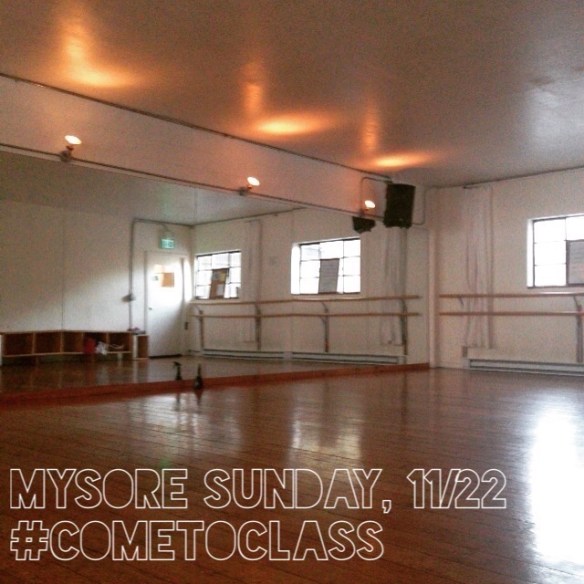
So much of my most precious interactions happen on a rubber mat with students while teaching in a Mysore space. Where else do you get to meet someone in this way, slowly over time, whilst they quietly cook in the juices of their own humanity, turning over with each deliberate breath and movement the fluctuations of the mind and heart.
It’s like getting to know someone without any context other than what plays out in the half-hour, hour, hour and forty-five minutes that one practices. Story-telling is minimized, so is the drama. The body is so intelligent. The practice is so precise. I love meeting in this way. It is so raw and real… and honest.
As a mysore teacher, the challenge is to meet as honestly as well. To cut out the superfluous, the desire to people please, the need to teach, so that the practice can do it’s thing. I often have to remind myself that the best thing that I can do is to get out of the way. The opposite is also true, when it arrises; it’s important to recognize when it’s a good time to get involved, when support is necessary.
Meeting in this way, in mysore-style classes, it is looking into a mirror and seeing who you are at that one moment. Sometimes, what I see is glorious. Other times, I see that I am one hot mess. All of it is ok and also, none of it matters. By meeting, we submit to an alchemical process, a world of change.
It has been incredibly special to lead the Mysore Sunday classes here in Mysore SF twice a month. Please come to class, I love to meet with you. I will also continue to assist Magnolia Zuniga in Mysore SF until December 10, 2015 before heading back to Asia to prepare to study with my own teacher in Mysore, India.

Sunset at Fort Bragg’s coastline in Mendocino, California.
How many times have we looked out into the great big world, taking in one of those breathtaking views, and are awed by all that we are not? We are inspired, our imagination stirred, we are humbled, but these feelings also put us in different places–us and the world.
What would it be like to look out at the greatness that is and see a reflection of ourselves? What would it be like if we saw sameness instead of separation? If we looked out and instead of noting difference, we say: “wow, I’m a part of that,” or “that’s me, too!”
What if we looked at everything, big and small, every person we meet, no matter what the circumstance, every interaction we have in the same manner? Imagine how different life might be.
In the microcosm, this is a challenge we meet in daily practice–at least, I know I do. There’s me and then there’s the room and the people in the room. There’s my practice, and then the practice of others and my idea of an ideal practice. How many times does our drishti (point of focus) slide and we take in through our periphery some excellent (or sometimes, less than excellent) posturing and we compare ourselves to another?
There was a time when I looked upon these thoughts with a great deal of shame; I wanted to be above it all, thinking that would make me a good yoga practitioner.
When these thoughts come up nowadays, I find more humor in them and more gratefulness for them. For the function of practice is to tease these reflections of the ego up to the surface where they can be seen in the full light of day–that they come up is not a problem but a part of a solution. As we observe them, they come up less and less and they subtly loose their power.
More and more, I have different kinds of moments when I’m teaching or when I am practicing. Sometimes, I perceive someone who may be dissimilar in practice, body type, everything, and still I think: yup, that’s me! Maybe the current me, or 7-years-ago me, or the me I might be in a few years, but that’s me, that’s my experience also, that’s my challenge, that’s my strongpoint too, that’s my fear–and in these incredibly precious moments, I see sameness, I feel compassion.
There are other times when I see someone doing just the most impossible, gravity-defying, beautiful thing, which I cannot even imagine getting close to, and I feel beyond envy this great sense of incalculable possibility. I am inspired by our shared potentiality, though it will, no doubt, express itself differently for me.
And then, there’s the practice, which is so very personal. Yet, over time, it starts to feel quite impersonal also. Especially in a mysore space, there’s the practice that I feel is mine, (my mat, my body, my motions) and then there’s the practice that is ours, that is shared in the room, and beyond that, a practice that is shared by a global community that is still connected from teacher to student, teacher to student, all the way back to Mysore, India, the way it has been since the beginning. Then there’s the practice that is shared by everyone, which is life…
I know this looking at unity instead of difference is hard to sustain, so conditioned are we to compare or to see our own smallness.
But the photo above had me thinking about this man looking at the sunset. I imagine his awe at the scene before him, the sun setting into the Pacific coloring the Northern Californian coastline. I wonder, is he thinking: “wow, that’s a sight” or “aren’t we just amazing!” From where I’m sitting, I am also in awe and he is as much a part of the magnificent landscape, his presence completes the scene–and I am also a part of it, even though, from where I’m sitting, I might not see it.

“Trust Your Struggle.” Street Art. Temascal, Oakland.
I love the Mysore room. It’s one of my favorite places to be, whether it’s practicing or teaching, I can’t help but feel alive in such a space. I love the victories after some long-fought challenge, but I also have a great respect and appreciation for the power of practice when I see a student near tears. It’s very real, this hot house of human action, people moving within a small portion of rubber mat. It’s steamy and there is a palpable thickness in the air. There’s a lot of love here–but it’s not the love of fluffy bunnies or candy-colored unicorns–it is often a love forged from gritty, sweaty, face-all-twisted struggle.
Struggle? That seems like a paradox, right! Ashtanga is a yoga practice, after all, so shouldn’t it promote a deep sense of peace and calm, physical ease and mental equilibrium?
Ashtanga is a very honest practice, reflecting back at its practitioners their life in concentrated form. When life is hard, practice takes on that hardness. When life is easy, sometimes (when we’re lucky) it’s easy, but often practice will dig a little deeper to find a soft spot. It’s a tradition designed to make you strong and also flexible–and a component of that is to whittle away at what’s unnecessary: shame, fear, pride, all forms of ego–these are not easy things to be grappling with, thus, the struggle. The struggles are there for a reason: for us to understand ourselves better.
I think it’s important to note that I’m not speaking of binding in maricasana D, suptakurmasana, learning to drop back or getting the leg behind the head but rather the human struggle that comes with the challenges that are presented by certain postures, sometimes by practice as a whole. The struggle isn’t actually getting past the pose but getting past the challenge/turmoil that the pose creates. It’s not about moving forward in any particular series, it’s about moving beyond it.
As practitioners, we are responsible for the struggles that present themselves on the mat. We must meet them, rather than run from them. And with practice, meeting them means getting up close and personal with them through our bodies pretty much everyday with as much equanimity as we can muster until they loose their power. We might relax into them, melting into some mythical grace, or we might fight them tooth and nail in some epic shit fight, there’s no blue print for how exactly we are meant to face these moments. But I think we must trust that the struggle is there for a reason, that it serves some greater purpose other than to annoy or frustrate us, it isn’t getting in the way of our ease and happiness–rather, it is the way.
Continuing to grow here in Mysore SF. It is such a pleasure to be working in such a space where the practice and the teaching is so very alive, so very real–real in the struggle as much as the joy of practice. There’s an alchemical force in the room. The potential for transformation is there. Very grateful to be taking part in it. Mysore is Mon-Thur, 6-9am. Led Class is Fridays 6am and 7:30am. Sunday Mysore is 2nd and 4th Sundays (no class September 27, it is moon day).

Life is not always so accommodating towards practice. There’s, of course, a work, personal and domestic life balance that needs to be maintained. And we learn to negotiate between them.
There are the other times, however, where it is not a matter of time as much as it is a matter of space–emotional space. When the factors above close in on us, it takes a toll. And the tool, our sadhana, which we so often rely on to help us deal with stress and tension, amplifies our emotions, whether it’s anger, or frustration, or pain, or sorrow, or…the list goes on. At the best of times, practice can be a slow uphill battle. When under emotional duress, it can be total carnage.
What then? The teacher’s answer would be to practice anyway. Easier said than done, I know. But when it’s tough to practice, this is when we need to be practicing the most. The mat, the practice, is a sharp yet subtle mirror, and facing it when times are challenging is difficult but ultimately helpful because it does its job. It allows us to see ourselves and the issues that weigh heavily on us.
Practice anyway.
Practice any way. It may not be your optimum, it may not even be your full practice, perhaps it’s simply getting through sun salutations, maybe it’s just getting on the mat and breathing before the thoughts and feelings crowd in on you. Then, come back and do more the next day, giving your body and breath the space to expand. The sheer guts and determination to show up for yourself can become a wellspring of inspiration and strength.
If you have the courage, the heart for it, watch carefully, observing the places of discomfort and the places where there is space. Each day watch as it gets better because everything changes. The practice itself becomes a vehicle for these small or big shifts. Slowly, what was originally disempowering becomes its opposite. When it’s tough to practice, just practice.
 one love yoga