Doing the New Year Thing Right

Happy 2026! Excited to be here, I think we all want to know how to start the new year in a good way and, more importantly, how to keep this good way going through out the year.
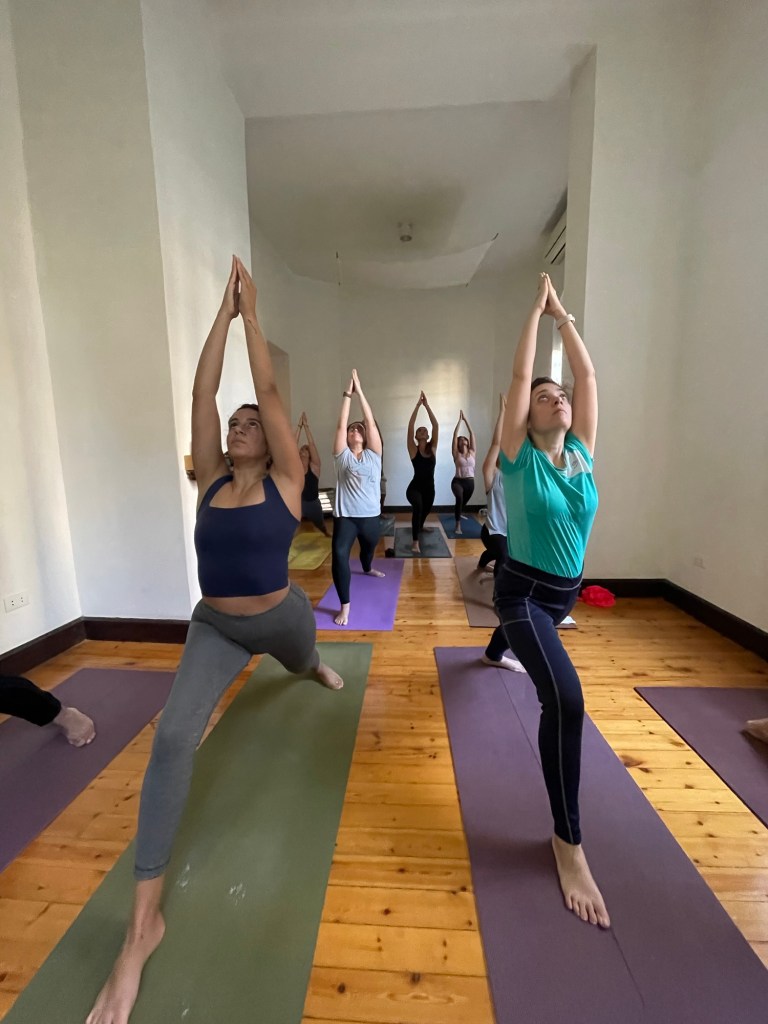
A snapshot of our energetic led class at Nūn Center in Zamalek.

So here we are, well into the first week of the new year! Celebrations and familial obligations out of the way, we ought to be ready to jump into 2026 like we didn’t go through years of just absolute strangeness, right? Is this the year we get back on the program—whatever that was before things got complicated?

Year after year, resolutions are made and broken. Attempts at changing old patterns are strong in the first weeks of the new year but often waver. We shame spiral and then give up. We all know how it goes, so best to be really clear and upfront about it. We aren’t going to get different results by doing the same thing over and over again. We’re not going to break an old pattern by repeating other old patterns, see what I’m getting at?

For many of us “yoga” or something like it is on THE list. You know the one that will make our lives better. Maybe you’ve said: I’m going to do yoga everyday this year. Amazing! I love the enthusiasm. Definitely a good goal.

It’s important to understand what it is that you want to establish. Is it to do yoga daily? Or are you wanting to practice yoga so you can feel more calm, more stable, and create a healthy lifestyle for yourself? If it’s the latter, a daily yoga practice will certainly help but it will take more than turning up daily. It’s important to understand how yoga compliments the life that we are already living, how it can help us grow but also how it can help sustain us when life can be outrageously unsustainable. If your yoga practice is burning you out, then it’s not very yogic.

Here are some suggestions for turning up for yourself in the most yogic way possible in 2026:

  • Make the goals! Goals are good. But this isn’t a sport, the goal posts can move. It’s alright, I swear if you move them mid game.
  • Be forgiving. Don’t use the yoga practice to self flagellate. Of course I’m going to ask you where you’ve been if you missed some classes, that’s because I’m your teacher and I’m concerned and want to understand the context of your absence and how that might affect your practice. But don’t sweat it. Stuff happens.
  • Do your level best. What I mean by level best, is that our best changes based on the circumstances of our lives. Sometimes the best that you can muster is 100%, other times it might be less than 50%.
  • You in Yoga. Yoga is understanding yourself in the context of the yoga practice. Self mastery isn’t going to happen with mastering yogasana. It begins with you knowing how you feel in it!
  • Accountability is key! Sign up for a Mysore program is one way, it’s a bit of a social contract when you have a community of people to practice with. Have a yoga buddy. I have students who ask me directly, please help me stay on the mat and bug me. We need all the help we can get.
  • Strike while the iron is hot. Meaning start now while you have the will and the energy, go big, but be kind to yourself if you aren’t able to fulfill the big-ness of your own aspirations. it’s all good.

Starting a yoga practice, or restarting a yoga practice is a wonderful journey. Can’t wait for you to go on it or return to it. Maybe it will be easy. Maybe it won’t. As someone who has been practicing for 20 years, I can say no matter what level of difficulty it is to stay on the mat, it’s a hundred percent worth it!

Classes will be restarting on January 9th at Nūn Center in Zamalek: 9am Led Class. We’ll be holding a 4-hour intro course on January 10. 1-4pm at Nūn. Everything you need to know to give you the confidence to enter the daily program or to self-practice at home.
āsana and the yoga of cairo

It’s been a spell since leaving Cairo, but this piece inspired by the old city and its people has long been stewing. People often ask me why I keep coming back to Cairo. There are many reasons but one of the big ones is this: it inspires a level of sadhana that is well beyond the body. It’s a place that reminds me to live my yoga practice.

There’s this chair in a room. It’s a small receiving room in an old apartment in Downtown Cairo. The square room is painted red, and despite its tiny floor size, it stretches up and up with high ceilings. The chair is the only real furniture in the room. There’s a desk lamp, that sits on the ground and the three walls of the room are filled with artworks of varying sizes that reaches up the wall.

The seat, a wooden antique reclining chair with white cushions, feels lonely to me, partially lit by the lamp. Framed against the bits of modern art crawling up the red, it feels stoic, but solitary.

Later, my friend, to whom this space belongs, tells me about his life in Cairo. The struggles of ordinary life filled with victory and loss; he speaks of caring for a parent dying of cancer; of the failed revolution; of life in Tahir Square; of the many crazy things he witnessed during that crazy time; he shares the oddness and disparity between the different social stratas which he straddles, because Cairo, the world he lives in, constantly vacillates between extremes.

In yoga, “āsana” is often referred to as the postures we take while we practice. It is the “seat” of yoga.

These days, we mistake āsana as taking shapes in space. There is a proliferation of this on the internet with photos and videos of beautifully performed handstands and human pretzels… The day I started writing this article, a funny spoof on the yoga video phenomenon went viral among my yoga circles. The following day, a number of the same people who shared it online were once again liking yogāsana snap shots on social media. There’s nothing wrong with that, we can, of course, appreciate all sides. But it had me thinking, once again, what it means to be sitting in yoga.

It is truly something awesome to see a human being defy the limits and gravity with his/her body. They definitely inspire. But I wonder, are they accurate representations of āsana?

I do not offer any photos for this post, though originally I wanted to share one of the chair itself. My friend asked that I refrain from doing even that, such things are, after all, private and the delicate practice of our lives is sacred.

My friend and his chair (neither pictured here) move me in a way that I do not feel when seeing some popular representations of yoga. My friend and his chair, his seat, remind me that the essence of yoga cannot fully be captured in a polished physical posture, however amazing, however artistically articulated.

My friend, he’s no expert at Cairo life, certainly not at yoga. He’s simply doing his best to just sit in all the crazy, all the joy and all the disappointment, striving to find peace with all of it. And that feels like yoga practice to me.

When we practice, we are practicing our ability to sit in yoga, to find equanimity in the body, mind, heart. The greater practice is life itself, the challenge of which is to find equanimity in the body, mind and heart amidst the chaos of an ever changing world.

I think one of the reasons I continue to be drawn to Cairo is that the city’s version of the ebb and flow of life is on some serious kind of overdrive: it is a vortex of living, of varying energies, sweet and terrible (political, economic, cultural, social, individual) all swirling rapidly together in this thick soup of a city, layered with modern and ancient civilizations, and with them their countless innovations, numerous mistakes and unfathomable mysteries.

To sit in it, to stand, to walk, to move, to work, to be there, to be well–let alone, thrive there–takes a special kind of practice.

That’s not to say that everyone in Cairo is sitting in yoga, with every challenge there’s a good amount of avoidance or numbing–but the opportunity to practice yoga exists at every turn, every interaction, every bit of gridlock and difficulty. It is easy to see this in the lives of many of the city’s inhabitants, most of whom don’t know what the inside of a yoga studio looks like. Practice is alive in the struggle. It’s inhabitants must simply do what they can, working to find some stillness in all this whirlpool of energy; Cairo is their yoga.

The search for softness or grace or space or peace in the whirlpool of life is both challenging and sublime. I suppose it’s like this everywhere, though the extreme energies of a place like Cairo accentuates the experience. It is the same experience in a mysore room, where practice is alive and well, gritty and difficult, at the edge of some seemingly insurmountable odds, which we learn to overcome little by little.

Ultimately, the āsana of Cairo is that of everyplace, it is the practice of every man. It is about how we sit, stand, move, interact with our environment, with the people we meet, it’s how we rise up to our challenges and it’s how we live up to our victories.


Posture Perfect

Image

Posture Perfect

We strive for perfection. That’s built into us by our schooling, our upbringing, our culture and society. We come in to class and pour our bodies into shapes we’ve seen in magazines, posters, in youtube videos, and in the demonstrations by teachers we look up to. And we want our postures, asana, to be perfect!

But when it comes to yoga, what does it mean to have a perfect posture or asana?

Everyone’s bodies are built differently. We have different proportions, different ranges of motion. Some of us are stronger and have sturdier muscles. Some of us are softer and are more flexible. Our bodies have different gifts and along with that: different challenges.

There are certain issues of alignment, certain goals with each posture, and we must proceed with awareness of how to place the parts of the body in a way that is nourishing and supportive. We move to work certain areas, to open and balance. These principles are important to observe and practice.

Perfection, however, is not in the posture but in the practice. If you practice with presence, with love and awareness, if you breath full and even breaths, if you create the opportunity for the body to feel itself steady and easy, then no matter what your posture looks like at that moment, it is already perfect.

The truth is that what the posture looks like doesn’t matter as much as the effort in which we hold and move ourselves. And as our bodies change, what is perfect changes too. Such is practice, such is life.

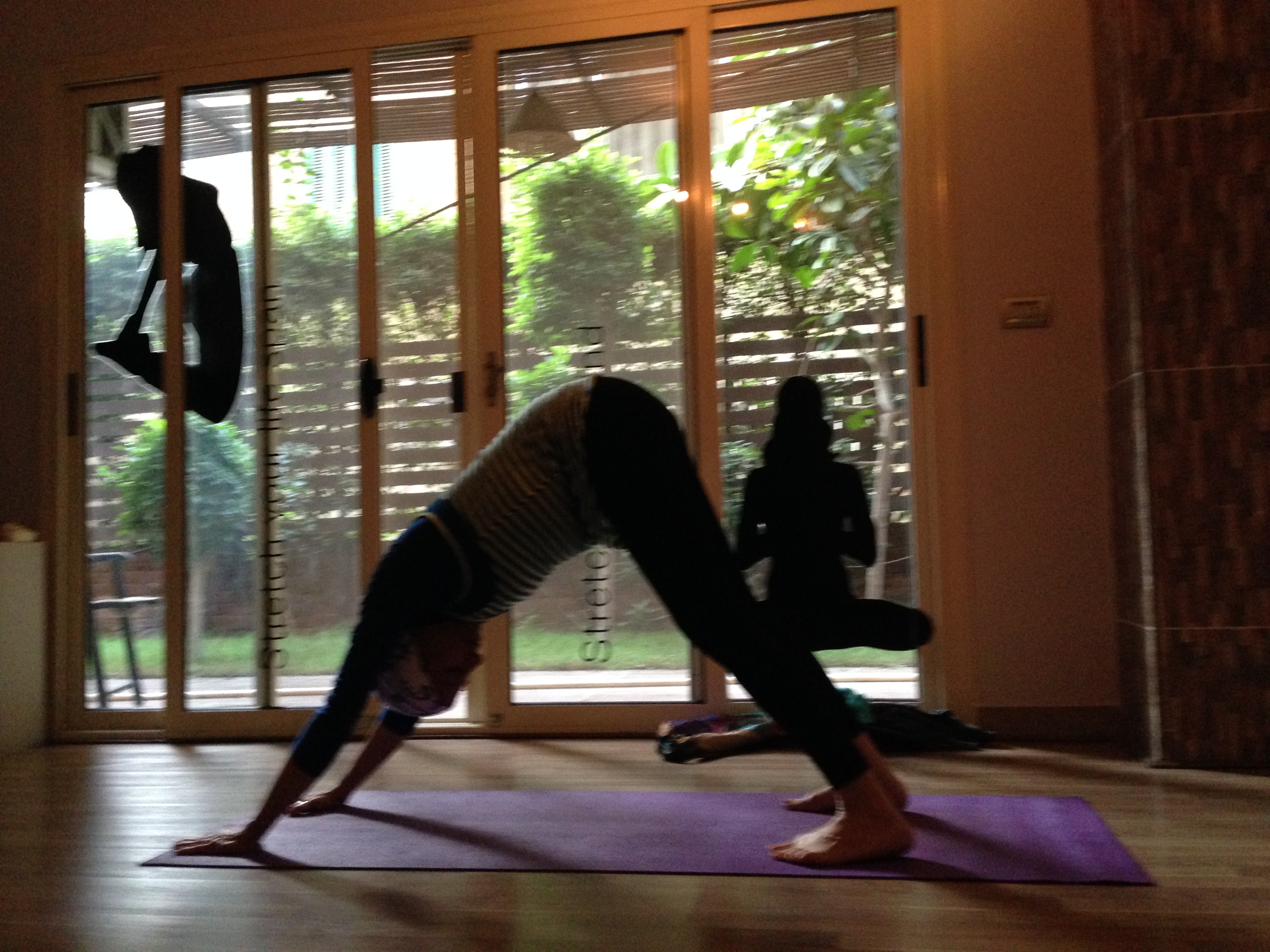
Photo: Hala in downward facing dog, La Zone, Maadi, Cairo.