Tag Archives: Ashtanga Yoga
Gambatte! Do your Best!
Friday morning led class is followed by Satsang here in Spirit Yoga Osaka. This is a time when the Mysore group can meet to practice other aspects of ashtanga yoga, whether it’s chanting or discussing yoga philosophy. Yesterday, July 4, 2014, was my first Friday here. It was a full power led primary; and I actually had fun counting the vinyasa-s! I particularly looked forward to discussing the Japanese word “ganbatte,” often translated as “Do your Best!” — which I realize can differ slightly in meaning depending on context. I wanted to explore “ganbatte” in the context of yoga and how I mean it when I say it in class. Here is a written expansion of yesterday’s talk.
I ask the circle of students (with the help of Naoko-san translating) gathered after Friday’s led class what they feel when someone tells them: “Ganbatte.” Many nod in agreement that it is a motivation, a cheer to go on, to do better. Hiroko-san, sitting across from me, nods too but also adds that depending on the context it can also come with a lot of pressure.
The Japanese are renowned for their work ethic and discipline, it is deeply ingrained in the culture–and beautiful to see when applied to the yoga practice. When taken to an extreme, it has a dark side. In Japan, karōshi, 過労死, or death from work, is legally recognized as a cause of death. People in their thirties have strokes or heart attacks due to working long hours and suffering from extreme stress–they’re just doing their best, right?!
This, of course, would not happen with the skillful yoga students here attending class and practicing with great awareness. Still, it begs the question: What does it mean to do your best in the yogic sense? What does ganbatte mean for the yogi?
Ganbatte is an encouragement, often translating to Do your Best! or Do well! or Be courageous!
It is supposed to inspire courage. In her famous TedTalk on Vulnerability, my favorite researcher/storyteller Brene Brown speaks about how the root of the word courage comes from the Latin “cor,” which is the heart. That in its early form, to be courageous was to speak from one’s heart.
These days we look at courage as bravery, having guts or gumption, daring to do what is difficult. All well and good. But to be truly courageous we must act according to what is true to our hearts as well, and from that place of authenticity we are able to act with greater awareness and equinimity. When we are true to ourselves, then we are in satya, one of the five yamas, the foundation of Patanjali’s ashtanga, or 8-limbs.
Now: what is best exactly? We often confuse what is best for what we think of as what is perfect. We often look towards some future ideal or goal. In our yoga practice, we often think of perfection as the final expression of the posture the way we see it in some yoga video, on YouTube or on Instagram.
Patanjali’s first sutra in the Yoga Sutras is “atha yoganusasanam.” Yoga is happening now. It does not look towards the future. It exists in the present moment.
Never does Patanjali outline the particularities of what an asana looks like, he doesn’t go into degrees or alignment, but rather on each individual’s feeling in the pose. “Sthira sukha asanam,” The posture is both steady and easy. And this will depend on the truth of each and every person, as they discover the balance between strength and flexibility, steadiness and comfort.
So wherever you truly are in your practice, so long as your put the right effort into finding that “sthira” and “sukha,” the right presence and awareness, no matter what the asana looks like, it is perfect for that particular moment.
So: Gambatte! Gambatte!!! Practice with true courage, practice from the heart! That is already the best practice.
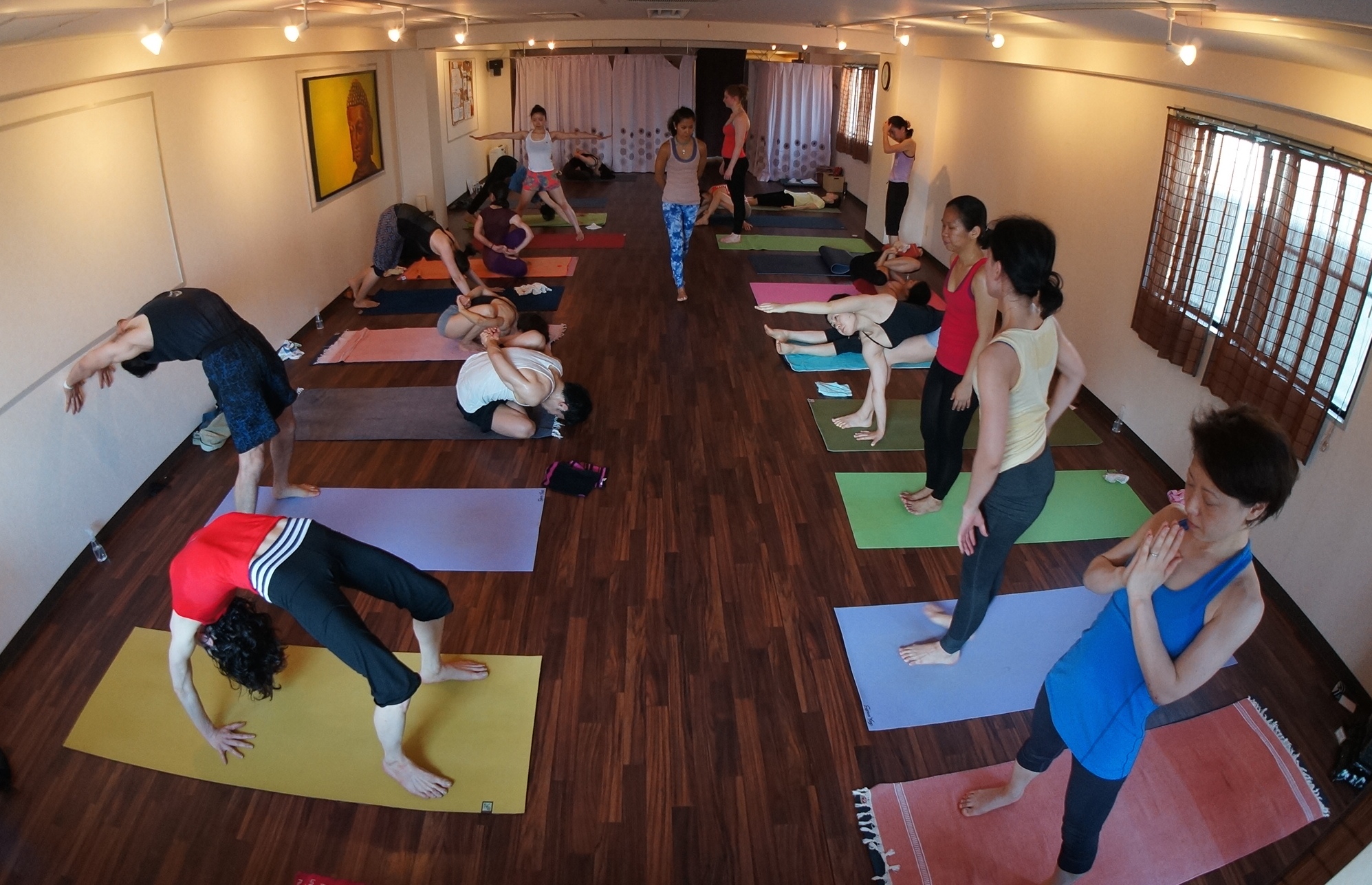
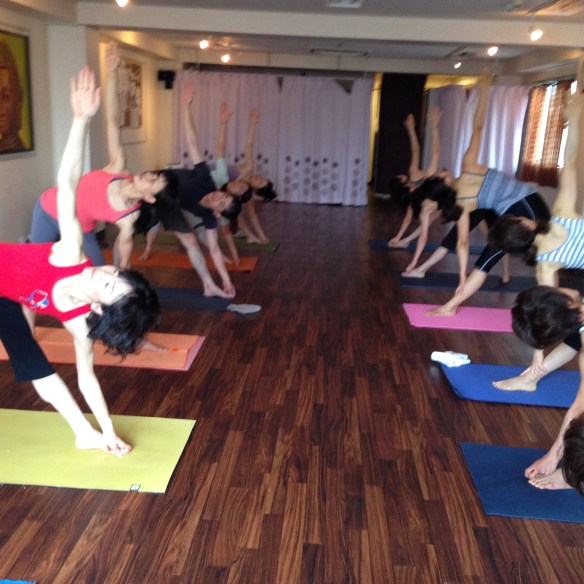
PHOTO: Friday’s Led Class here at Spirit Yoga Osaka.
Do Your Homework
Image
Last week, Veronique Tan, whose program I am covering here in Osaka, distributed a sheet explaining “homework” to each regular student. I was with her, as she explained to each student what she recommended they work on over the next two months that she is away in Mysore. And how I would be here to help.
On Thursday, one student, Akemi-san noticed that I had my own sheet–actually, sheets plural! A neat stack stapled together, on each page was the profile of two students, each a regular Mysore pass holder, their current posture, their work in progress, their challenges and their “homework.” She pointed with delight and laughed!
“Yes,” I smiled and laughed too, explaining that I also had my own “homework” from Veronique-sensei!
And so work begins. Homework in tow, I will be going to Spirit tomorrow morning, my first day of a two month covering stint here at Spirit Yoga Osaka.
The Mysore program here is not new to me. Past teachers that have taught here are friends. The first to hold the program, Ursula Scott was instrumental in inspiring me to make my first ever trip to Mysore, India. Then, last year, I became the interim covering teacher here between August and September. Returning now after nearly 9 months of teaching in Egypt and in Spain, of traveling and having what I can best describe as an epic romantic adventure with myself, I feel a little like I’m returning to the classroom after having done quite a bit of homework myself.
Sure, it’s been a little “off book.” There’s been a lot of practice–but a lot of the prime yoga experiences lately have happened off the mat. Self-study is not an isolated activity that is happening at home, it is happening all the time in life.
One never really knows what to expect or what our practice will be like or what the class will bring each morning. And it’s best not to have any expectations. But we certainly can come to class, to our mats, to our lives a little more prepared each and every morning…
The Schedule of Morning Mysore: Monday-Thursday 6:30-10:00am. Friday 6:45-8:45am Led. Sunday 7:30-10am.
PHOTO: Spirit Yoga Morning Mysore. Photo by: Veronique Tan.
Finding of Treasures
Image
Last day and I weave my way in and out the vibrant souk Khan el Khalili in Old Cairo. There is a lot to see and it’s easy to get lost. I have a particular goal, buying presents for family members, but along the way there are many distractions. Lots of shiny things. Glitzy miniature pyramids, faux pharaonic treasures used to bait tourists. Store sellers calling our attention in English, in Spanish, in all sorts of languages except the local Arabic. I am happy to have a guide, who knows her way around.
There’s a delicate balance to be maintained. Focus enough to keep to our main purpose–in this case, belly dancing costumes for my nieces–but with an openness, spontaneity enough to allow the magic of the souk to happen, wherein the unexpected treasures hidden there may also be revealed.
It takes skillfulness to navigate a bustling market place, teeming with possibility, with novelties and antiquities. It is exciting and inspiring. It can also be exhausting and frustrating if wondered haphazardly.
There is a need to be centered, so that you can spend time, energy and money wisely. Likewise, there is a need to simply be in the moment. To enjoy the souk, which in itself is a delight and a treasure.
Reminds me of (guess what!?) practice! Practice is a bustling souk, full of everything, amazing finds, incredible energy, but also dead-ends and traps. Navigating it can be tricky. It’s good to know our way around (as in self-practice) or to have guidance (with a teacher). It’s also good to go for a wander, to allow ourselves to get lost a little, because this is how we learn.
We aim to practice with concentrated effort. Too much focus on any one particular thing, and we may miss the unexpected treasures along the way. Too little focus and we allow ourselves to get caught up; we get distracted from the main goal, deep connection through practice.
Practice like going to the old souk demands/inspires a balance between skillfulness and surrender, the two facilitating the finding of treasures.
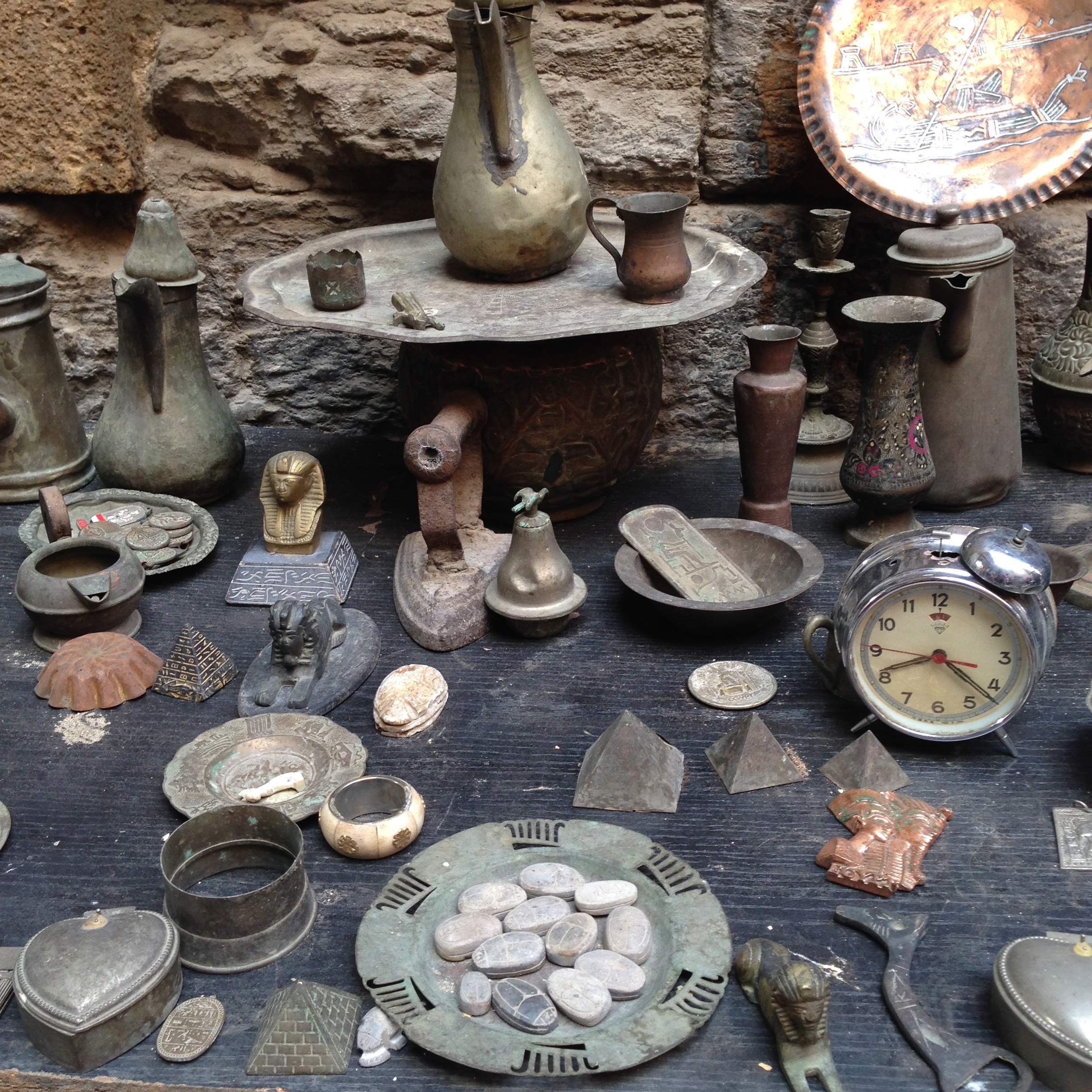
PHOTO: Alley-side stall with an array of old and new trinkets and treasures. No trip to Cairo is complete without diving into the dynamic old Islamic Quarter. So blessed to have such a great guide and companion on my day out at Khan el Khalili. Thank you, Sumaya!
End is the Beginning
Image

It’s surreal to be back in Manila, an entire year since I first set off. Again, coming to full cycle.
So ends an incredible journey of both teaching and learning, which has taken me to North Yorkshire, the Spanish Pyranees, Barcelona, Japan, Egypt, Barcelona again, London, and Cairo for a second time. So ends a series of sharing in Egypt, so begins new opportunities to share and grow. So ends a year of travel, so starts a new adventure. Always: the end is the beginning.
Over a week ago, I was leading a retreat in Gouna, Egypt through Nūn Center. There, away from life in Cairo, overlooking the Red Sea, we found respite from the day-to-day madness. We were coaxed deeply into process: the detox diet coupled with yoga and inner dance facilitated some deep purging. Some kilos, tears, and a lot of old limiting ideas were shed. We were all sad to see this special time come to an end.
In truth, however, the end of the retreat marks the beginning of the real work ahead: the challenge of how to bring the lessons and impressions of that week into our “real” everyday existence. Returning “home” carries the weight of our old samskaras, our old patterns.
Sometimes, these cycles may make us feel like we are on some strange loop, things interminably repeating. And we struggle when we see that we ended up exactly where we started.
But nothing stays exactly the same. Change is inevitable–even if we appear to be revisiting a similar place or moment. One teacher/friend likes to point out that these cycles become more and more refined over time. It’s true; as I sit in my old room here in my family home, where nothing appears much to have changed, I cannot help but notice the biggest difference: me! I am different, and through me, things will continue to change.
PHOTO: Closing Circle for the Ashtanga Yoga & Detox Retreat with Nūn Center in Gouna, Egypt.
Waves on Water, Power of Transformation
Image

This week I am in Gouna. And all around me, there is water: inviting poolsides, the Red Sea, the manmade lagoons that break the desert landscape here with different shades of cooling blue.
I am here to lead the yoga program for Nun (pronounced “Noon”) Center’s Yoga and Detox Retreat. Nun, it turns out, comes from the idea of water. Nun spells out the ancient letter N, the hieroglyphic symbol of which looks like waves on water, like so: VVVVVVV.
Water is a powerful element. Without it, life would be impossible. In the Pharaonic tradition, water is the source of life. From the water, the lotus came into existence and from the lotus, light, everything… Water is the primordial stuff, from which all is created.
And so, it feels apt, that we return to the water. To cleanse. To wash away the grime of daily urban existence. To deeply undo the unhealthy patterns of living, from the food we eat, the activities we engage in, the thoughts we have or the ideas we take in. To create new patterns: healthy and sustainable ways of engaging with our bodies, our emotions, our minds, the food we eat…
It is said that water has memory and that it is a great conductor of information. So, I’m excited. It feels a little like we are diving into this great transformative soup, with many elements to support positive shifts: the different aspects of yoga (yogasana, meditation, breathing, chanting) combined with inner dance, nutrition (organic food, vegan or juice fasting), and body work.
We jump in the water, so to speak, later this afternoon. I am eager to get in, to see the waves on water, to experience the ripples of transformation.
PHOTO: Gouna, Egypt, the site for this week-long yoga and detox retreat with Cairo’s Nun Center.
Pyramids of Practice
Image

Spent the last weekend in Dashur, in the outskirts of Cairo. It was awesome to drive to our destination and to have the Dashur “bent” pyramid pop out of the landscape–the pyramid serving as proof of how incredibly mysterious and surprising life is, how much of it we don’t understand, how compelling it is, so full of untapped power and potential.
And so it is with practice. It can feel everyday, the landmarks looking so familiar. With regular, daily practice, we already know the way. It’s easy to take things for granted. To go on automatic.
Then something shifts. And we are suddenly aware of its power. It pops up like a great pyramid, an enigma, that pushes boundaries. It wakes something within us with a sort of strange understanding that goes beyond words. And we bow to it, with humility, with grace, and let it work its magic.
PHOTO: Dashur Pyramid. Speaking of magic: Inner Dance in an hour and a half in Ashtanga Yoga Cairo in Zamalek. 5pm. Yalla!
Cairo Calling
Image

It was over two years ago when Iman Elsherbiny and I had our first real conversation at a social gathering in Gokulam. By then, we had been singing for at least a month or so in kirtan-s at Saraswathipuram, Mysore whilst practicing at the KPJAYI shala with Sharath.
Without knowing much about each other, we seemed to just click after sharing time and prana with the sound practice of chanting. And the idea of me one day coming to Egypt somehow floated up to the surface.
Fast-forward: Iman is a day away from her return to India and I’m here in Cairo, settling in, and slowly taking over Iman’s classes.
This first intense and surreal week has been a special one, packed to the brim, starting with a couple of weekend workshops here in Maadi and Zamelek where Iman and I have had a chance to work together.
I love working with Iman, who approaches teaching with a lot of sensitivity and good humor.
It has been a shakti powered week, from tag-team teaching the workshops and slowly turning over Iman’s regular classes.
I’ve come despite all the instability here in Egypt or maybe because of it. The way I see it, what better place to practice and share yoga, right in the thick of it, where balance is most needed.
Photo: Iman demonstrating technique behind urdhva dhanurasana during out workshop in Ashtanga Yoga Cairo in Zamelek.