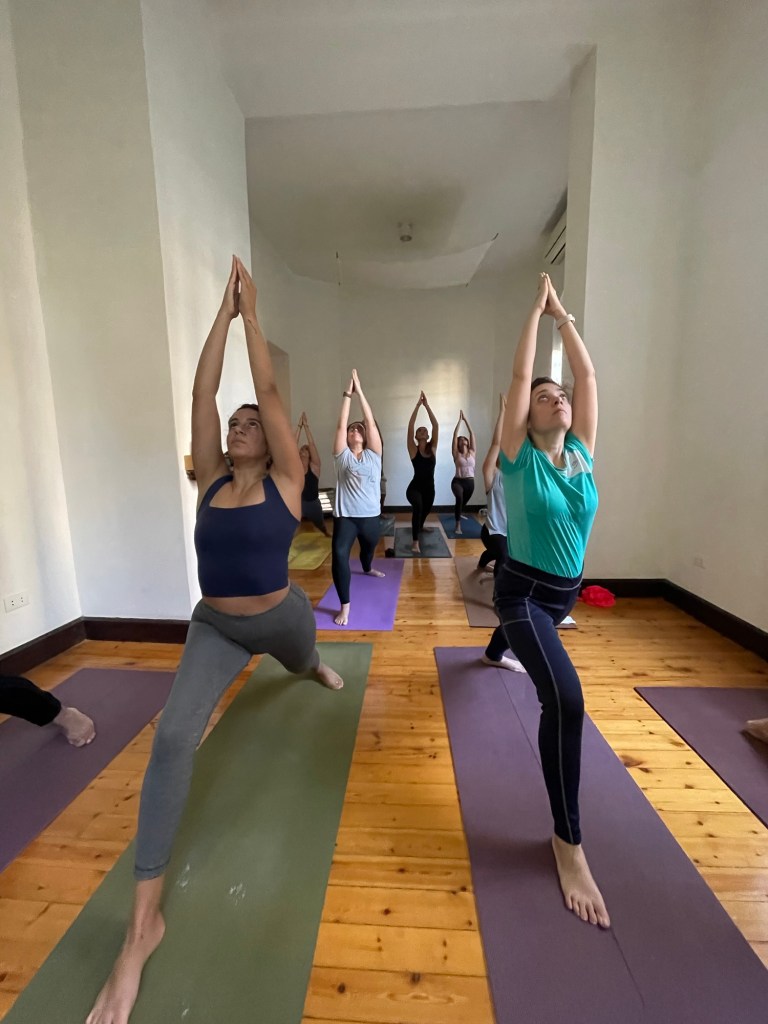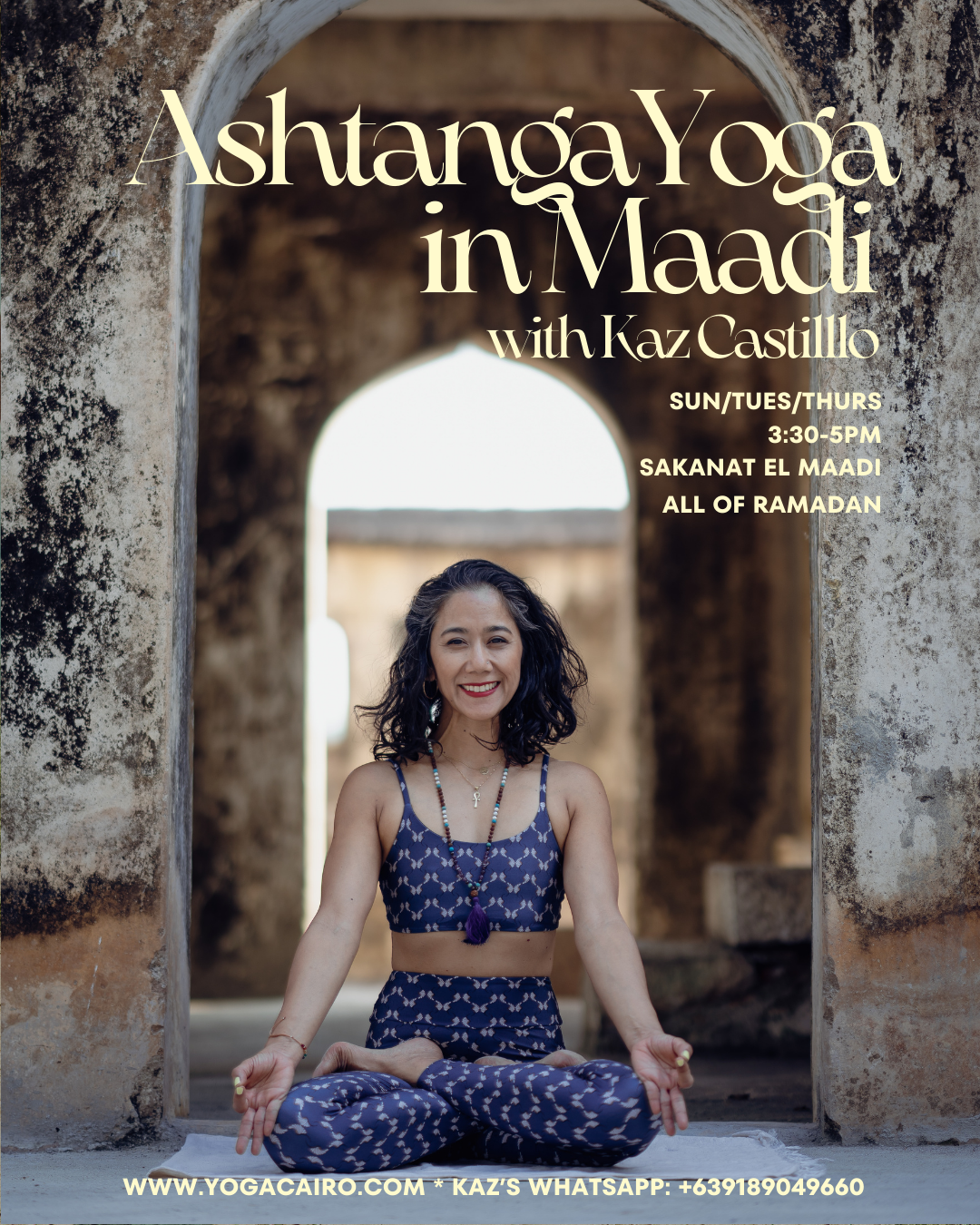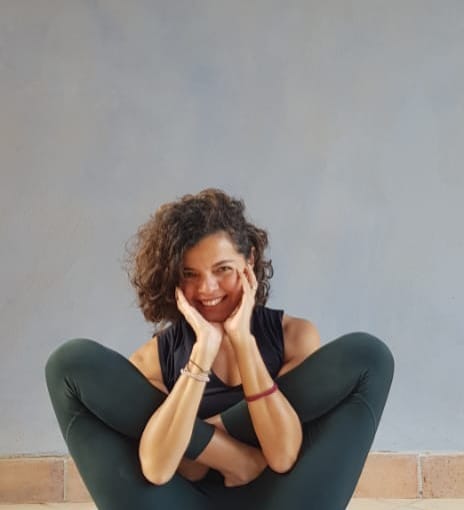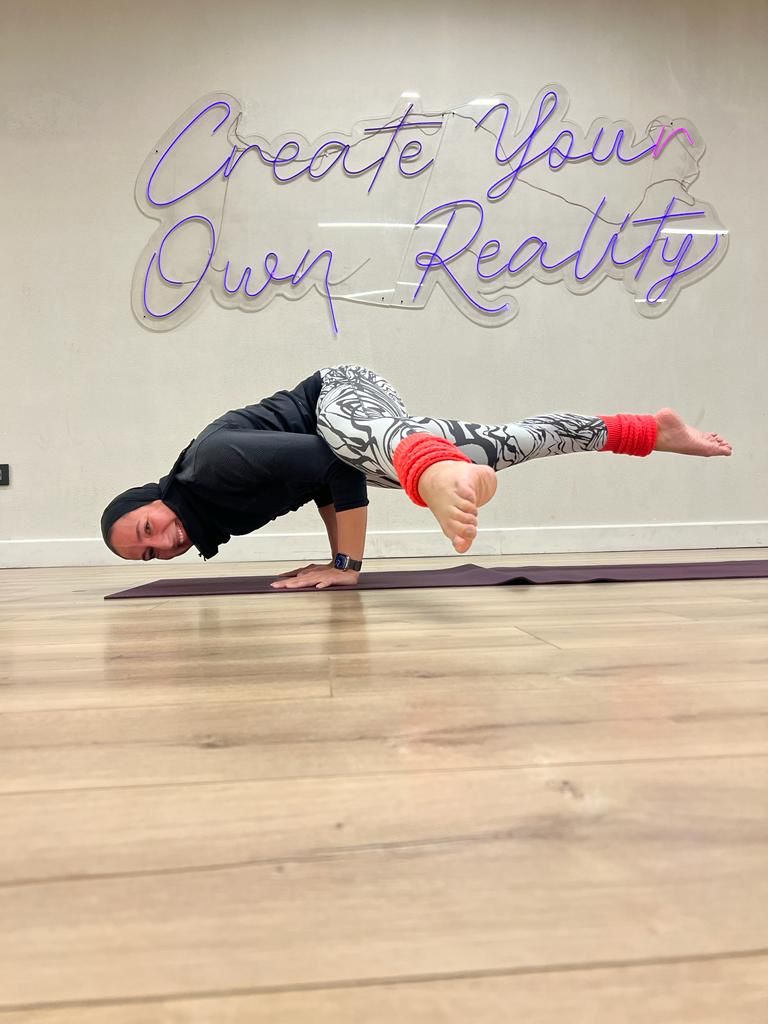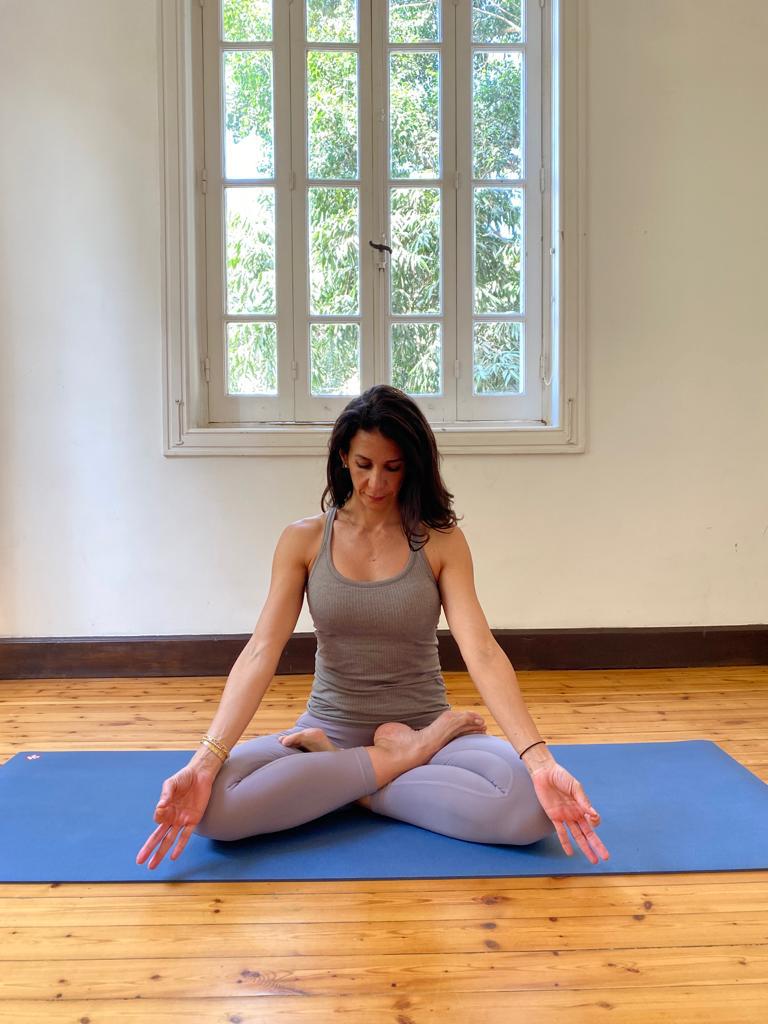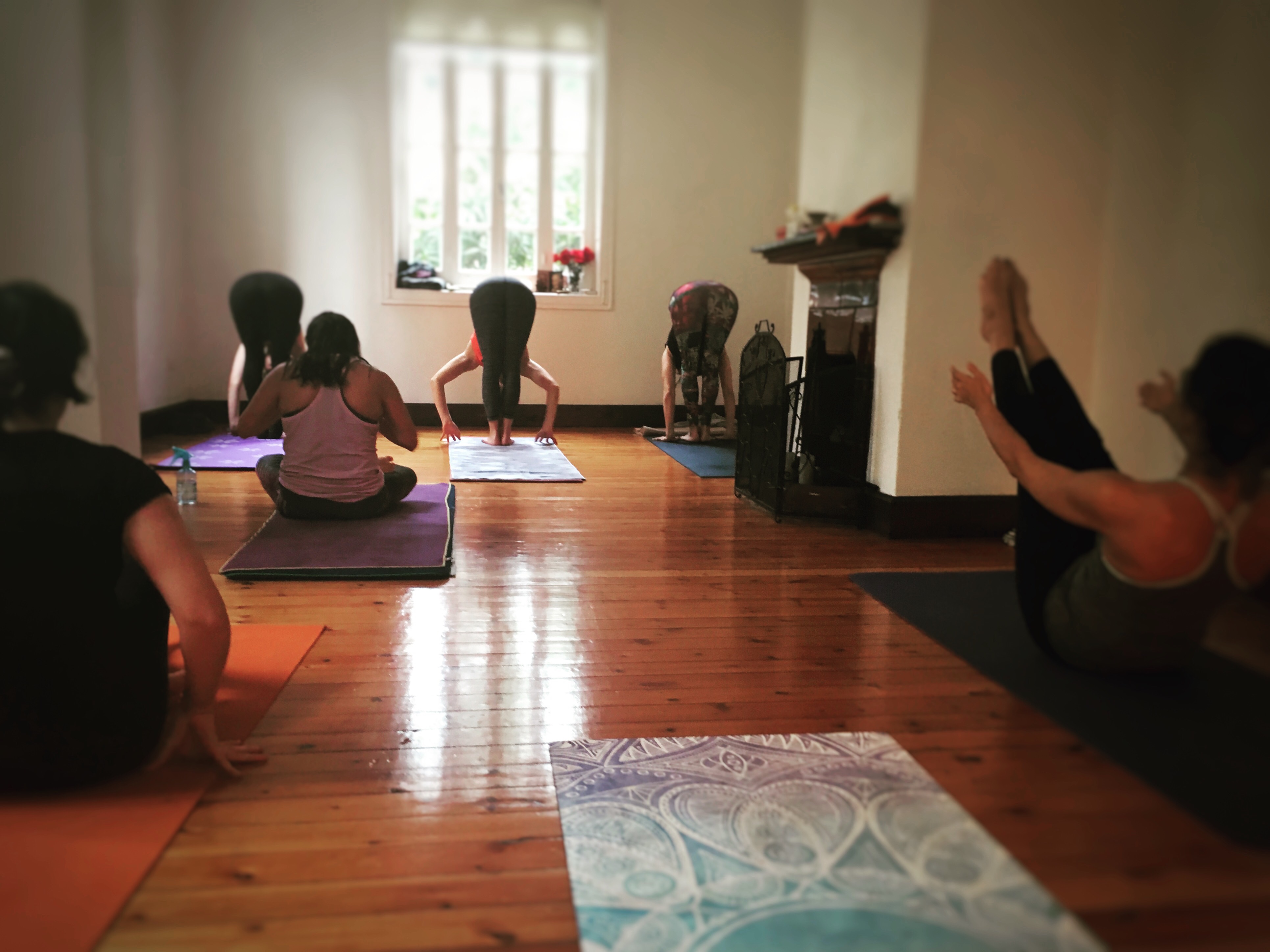
Imagine: inhaling and exhaling your yoga postures in a private rooftop, surrounded by plants and massive tall trees that make Cairo’s Ma’adi so special. I am very excited to be offering these afternoon classes in Ma’adi. It’s a small program in Ramadan, just 3x a week, but also a great pairing with the busy season. We’ll be having class Sunday, Tuesday and Thursday at 3:30pm to 5:00pm, finishing just in time to enjoy the energizing as well as calming benefits during Ramadan.
The rest of the sessions will be Mysore style self-practice, which is the traditional way ashtanga yoga is taught, giving students space to practice silently, connecting with the body. For experienced students with an established practice, instruction is as needed, with an emphasis on verbal cues and hands-on assists supporting the best alignment for you as well as deepening the posture. For new students, instruction is given to help establish the foundational sequence so that students can really learn the sequence the best way for them. This style of teaching pairs so beautifully with the spirit of Ramadan, which is both a solo and communal journey to connecting with our highest purpose.
We are offering two packages: the full program with 12 classes at 3800LE or the option to drop in at 500. We will be opening the Ramadan sessions on the second day, Sunday, March 2 with a gentle guided ashtanga class, offering short cuts and modifications for those settling into their fast and a full led primary on day 12, our last Ramadan session. (More led classes are available at Nūn Center on Fridays at 3pm).
Reservations is a must as spaces are limited. Please message to reserve your spot.
We’re getting ready for Ramadan here in Cairo and I can’t emphasize enough how this sacred month is my favorite time of the year to teach ashtanga yoga. My first Ramadan in Egypt was in 2016, it was summer then and my intention to teach for two months extended into this holy season; little did I know that it would make such a deep impression on me that I find myself excited to fast, practice, pray, teach and enjoy the collective journey that happens when one consciously decides to observe Ramadan. While I am not Muslim, I love the sense of quiet that descends upon this massive city, how the frenetic all-directions energy of Cairo seems to settle into one stream, schedules synch up, and we dive into nourishing the most important connections in our lives.
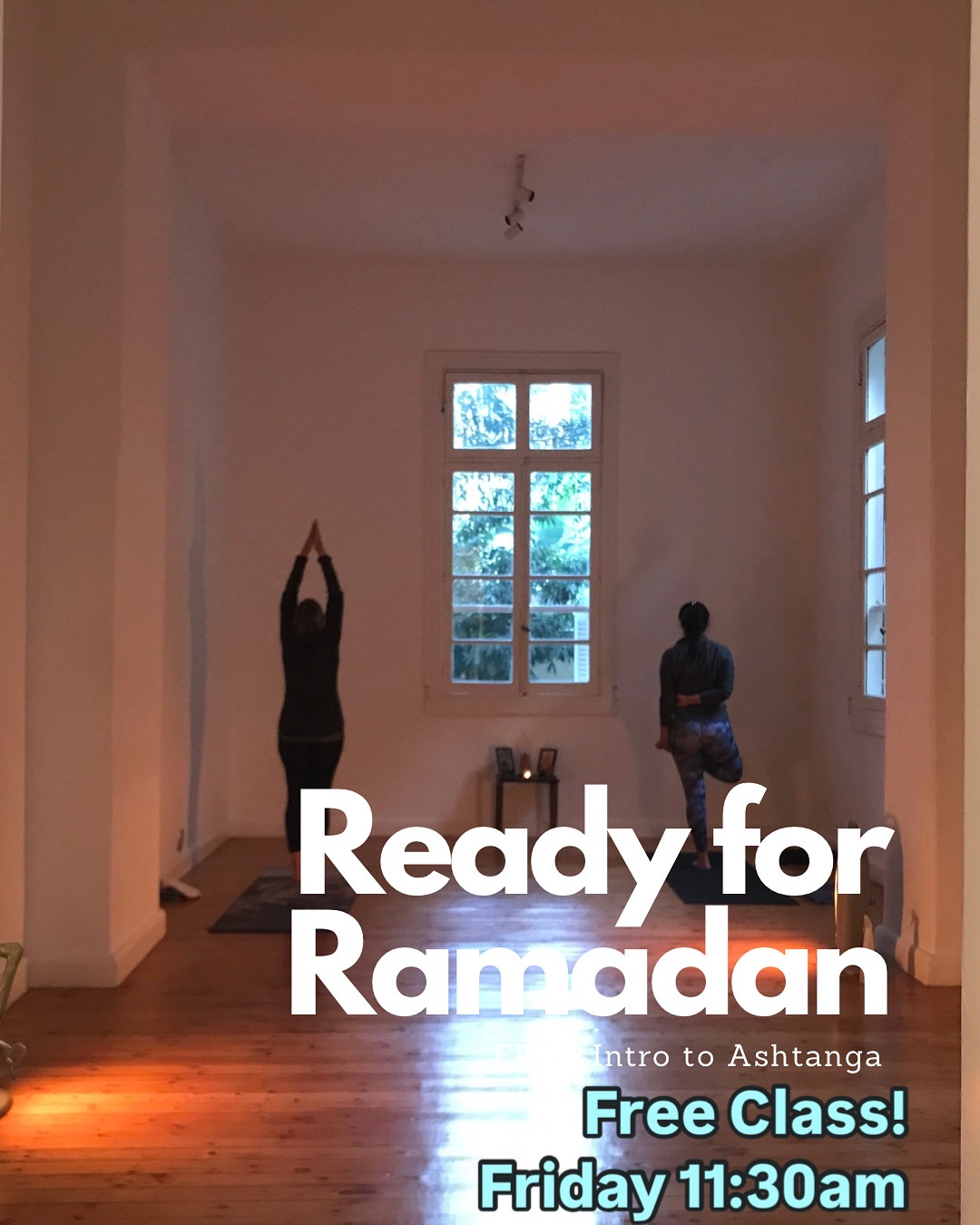
Tomorrow, Friday, February 21, a week before Ramadan starts, I am holding a special free class at Nūn Center, open to all for free. It will be an exploration on how yoga techniques, like ashtanga yoga, can help deepen our connections to our body and spirit, which can also enrich our connections with our community, family and world at large. Whether you plan to study ashtanga yoga or not, I believe it can be helpful to practice basic breathing and movements that we will look at.
Yoga Cairo’s Nūn traditional ashtanga program will continue in the mornings Monday to Thursday with Friday led classes happening in the afternoon at 3pm at the Nūn Center garden.
Exciting news is that I will also be teaching in Ma’adi, 3x a week: Sunday, Tuesday and Thursday at 3:30-5pm during the whole month of Ramadan on a lovely private rooftop in Sakanat El Maadi. Message for more information. Hope to see you either in Zamalek or in Maadi!
On my recent trip to the Philippines, I went home to the island where I first learned yoga. There, I found myself retracing steps to the Mandala Spa shala, practice space, where my yoga journey began. I practiced with members of my first yoga community, who like me are now older and wiser. It’s wild to go back, to see where I came from, to feel giddy with nostalgia, but to also note that the yoga practice wasn’t the star of any of our lives anymore, but rather an integral support. In fact, we barely spoke of yoga when we were together, through somehow the values of yoga and connection seemed ever present. To be among people with whom yoga is a given, like waking up in the morning, like washing your face, or taking breakfast, it was truly so nourishing to just be in this energy.
In the years that I’ve been teaching a traditional ashtanga yoga mysore program in Cairo, the start of the year is always a good chance to remind new students of the endless potential of starting a regular yoga practice. It’s easy to sell “change” when everyone seems to want to change–at least that’s what we say in the new year. And while there’s value to this tactic, I wish I could sell new students on that which is changeless instead. What remains when we’ve gone through the wheels of transformation? This is yoga too, maybe more so. Not the changes but, more importantly, what doesn’t change. Who we are, our core values, the people and the things that are important to us– these become enhanced through yoga practice.
Either way, change or no change, best to approach any endeavor without expectation. Practice for the sake of practice. So here’s my invitation: come to class, be curious about it, about you in it, and see. Have the tenacity to let it all happen. Most times, the growing can be quite striking, especially in the beginning. Over time, changes become more subtle, yet more profound. At nearly 20 years of yoga practice, I still find myself surprised by it, where it takes me. Let’s be surprised together!
Yoga Cairo’s Mysore Program at Nūn Center resumes on February 11, 2025. Our regular program schedule is 7:30-10:30am (two batches 7:30/8am and 9am) Monday to Thursday with Friday Led Class at the garden 9am sharp. See you soon! DM to book your spot!
Some places like Lebanon simply call, it tugs at the heart until the only thing left to do is to answer…
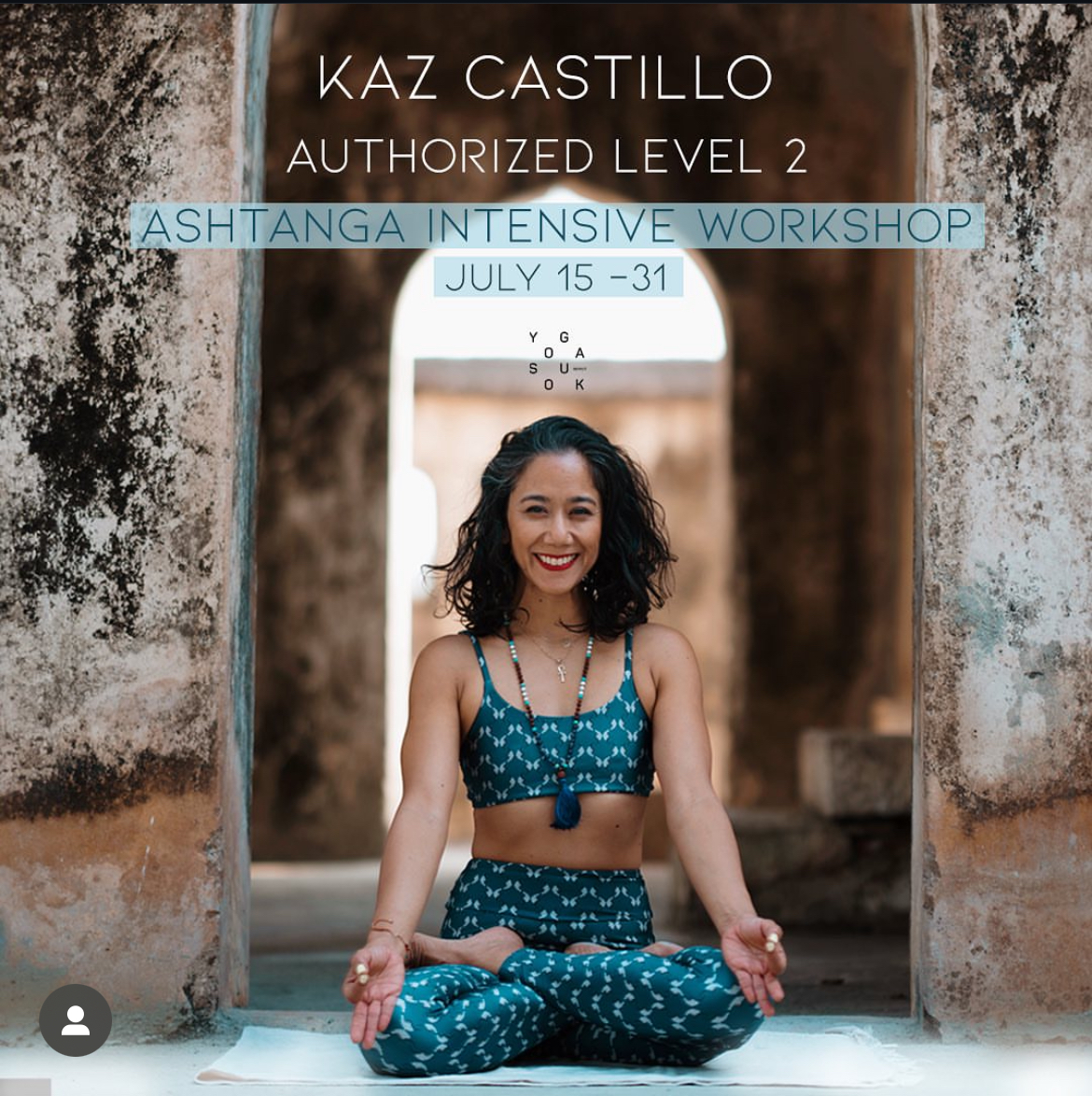
On July 15 to July 31, I will be teaching an Ashtanga Yoga Intensive Workshop in one of my favorite places: Beirut, Lebanon! It’s hard to believe that it’s been over 5 years since my first and last trip to Lebanon, which was to teach at Yoga Souk Beirut. I was 5 months pregnant at the time and happy to be invited to a community that not only welcomed me as a visiting teacher, but my baby bump too. So much has happened, too numerous to list, but what can’t be clearer is how much growth happens when you are put through the fire, when you are literally put through the turning wheels of time. I have watched from afar how this community has grown and evolved and it has always been so close to my heart, I am so excited to reconnect and be a part of a new chapter together.
The Mysore program is open to all levels of practitioners, we are accepting beginners as well, so don’t be shy if you’re new to the practice. We’ll be diving into the rich tradition of Ashtanga Yoga through Mysore-style self-practice Monday to Friday, Led Classes on Saturdays, followed by Conference (a yoga talk and Q&A). I’ll also be offering a Backbending Workshop, details TBA. Again, all levels are welcome as we will be working heart opening postures from the ground up. So if you can stand, you can join!
To book with us, contact welcome@yogasoukbeirut.com
“Parampara” is a term in Sanskrit that describes the succession of knowledge, which is passed down from teacher to student. It is a legacy of learning and, also, what makes the ashtanga yoga tradition interesting and alive. The lessons and method is passed down live from one teacher to the next, and while each student processes and distills this learning in his or her own way, the essence of the teaching is also persevered and treasured and practiced.
I knew I wanted to go Mysore, India, to the source of ashtanga yoga because all the teachers who I had studied with had gone there themselves to learn. Without realizing it, I was a part of the parampara. On my first trip in 2010, I understood what it meant to have a teacher as well as what it meant to be a student. And, now, my students, especially those who are now teaching are also a part of this lineage whether they know it or not, because many of my own important yoga lessons, which I share, have come from teachers who are connected to this very source.
Even in my absence, the teaching will continue because the knowledge of yoga is alive and well in all those who have practiced with me. Many mysore programs around the world cultivate the interests of students who are keen to learn, who have shown a great love and dedication to the practice. When we train assistants, we teach the way we ourselves were taught, and that parampara is a seed that grows in each person.
I could not be more content knowing that I am leaving the mysore program in the hands of those who deeply love it, who are a part of our community, who have grown from it, and who respect the process in which yoga transformation readily happens. I wanted to take a moment to introduce our assistants who will be taking over the program while I am in India. Each are already teachers in their own right and I have myself become a better teacher from the insights that they have brought into the space the year and a half that they have been assisting.
Marwa Saleh first discovered yoga 10 years ago, but started to become a dedicated ashtanga practitioner when she started to practice at Mysore Zamalek at Nūn Center in 2018. From her yoga journey, she has learned to respect and appreciate the here and now, especially with the world changing inside and out. Her yoga philosophy: Yoga is one of the many ways to touch your inner wisdom, to rediscover what you already know in your essence.
Marwa Osman has been practicing yoga for 6 years, and has been studying with us in Mysore Zamalek for the last 4 years. Her yoga philosophy is: “Surrender!” Among her favorite yoga lessons is how to practice non-attachment, that by putting in the effort with no attachment to the results we are able to access a greater freedom of being.
Yasmine Seoud has been practicing yoga since 2017 and started practicing with me at Mysore Zamalek in 2019. Yoga has taught Yasmine to be more present and has enabled her to listen to her inner voice. Yoga is about learning the balance of holding on and letting go, on and off the mat.
As a teacher, I could not be more joyful to see students grow and to see students grow to become good teachers themselves. I could go on and add to their bios, and sing their praises, because I am really proud of them, but I think its only fair that you discover the wonderful assistance, teaching and thoughtfulness that these three women will surely bring into the room these next two months. Enjoy!
If you are practicing in a traditional ashtanga yoga program, you will inevitably get an announcement that your teacher will be leaving for India to study with his/her teacher for one or two months. It may seem incomprehensible at first. Who takes this amount of time to study yoga? Why do they have to go all the way to India? “What about my practice?,” some students might say. While others may whisper that they too will take a little break.
These regular trips to Mysore, India is a chance for any student (and, in many cases, teachers) to deepen their practice at the source of ashtanga yoga. I have been practicing with my teacher, Sharath Jois, since 2010. This trip will be be my 8th trip (or 9th, I’m not really sure at this point). Over this period I have spent over a year and a half living and practicing in a small suburb in Mysore. And I am looking forward to “going home”– it is my yoga home, where practice takes on a very different quality because I am in the presence of my teacher. There, I will focus on my practice and recharge so that I can continue to do what I love to do, share this rich and transformative practice.
My last trip to Mysore, India was in the summer of 2018. The program was less than a year old, and it was understood, we would take the time off and reconvene after my return. This is one way of managing a mysore trip–everything is put into pause while the teacher goes to study and students either self-practice or don’t practice at all, and the program might loose students and steam in the process.
We are so lucky that we have a chance to do things differently now because the program has evolved and grown. After my last led class tomorrow, I will leave the program to my assistants, Yasmine Seoud, Marwa Saleh and Marwa Osman, three dedicated practitioners who have trained with me, assisted me in the room for over a year, studied the classical yoga text with me and with whom I have had countless conversations about teaching; they have been privy to my ethos and rationale as a teacher, why I choose to do the things that I do for each and every student. They are not me, but I have every confidence that they will take all that abundant knowledge of yoga and distill it into their authentic teaching style. They each teach yoga already and have already covered for me while I was sick or when I have had family emergencies, and have done great holding the space.
So, we enter a new phase in our program, one that I hope will allow the program to grow and prosper beyond the limits of my own small personhood. I will be honest, it is a lonely path being a mysore teacher, to dedicate all your mornings (and, thus, evenings, too) day after day, week after week, month after month, year after year, but it has been a pleasure to create a space where people can feel safe to explore their bodies and to stretch beyond what we think possible. Since 2017, I have poured my life and soul into this program. If you love practicing with me, if you love the yoga community we have built here, if you get something from the experience of coming to our classes, I urge you to continue to come to class, keep your practice juicy, keep your subscriptions going, your participation keeps our program alive.
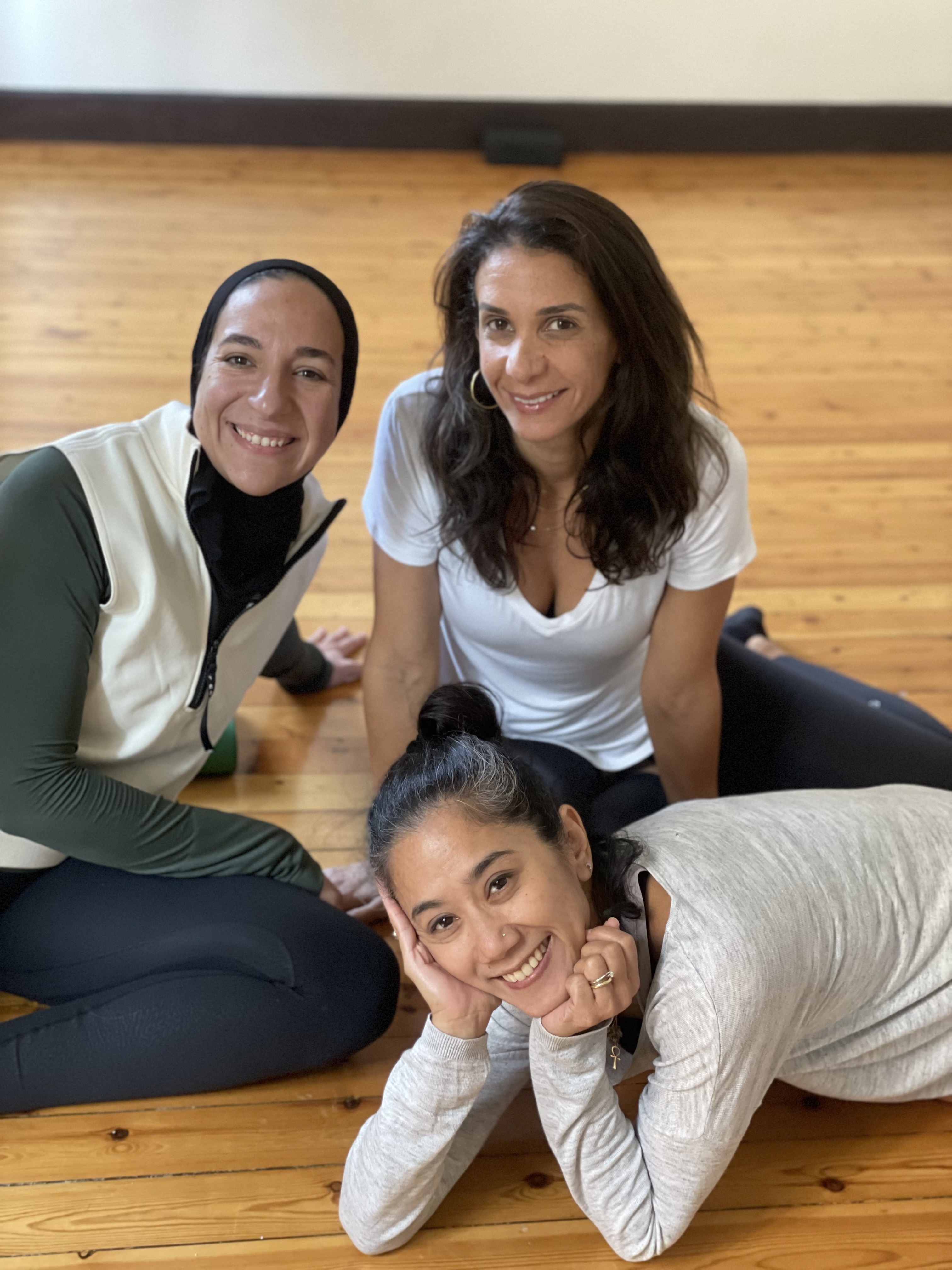
Starting next week, Monday, December 4, Marwa Osman, Yasmine Seoud and Marwa Saleh (not pictured here) will be holding the space through January 2024. See you at Nūn Center. Monday to Thursdays 7:30-10:30am, Fridays 8:30-10:30am. Want to sample the program? We offer 1 week and 1 month INTRODUCTION packages.
Most of us want to start a yoga practice so that we can grow stronger and be more flexible but unwind and find time and space in our busy lives. So, the last thing we probably want to hear when we are signing up for yoga classes is that we need to commit to a near impossible regiment of daily yoga practice.
As a mom of a small child, I now realize how that can be a very big ask for most. It’s taken time (and this is a continuing process) for me to find equilibrium between yoga and motherhood, these two giant forces in my life. I’ve had to make some adjustments–both physically and mentally. But here are some thoughts on why I think this method does in fact work for me as a mother and, actually, as a human, as well.
First of all: there is no actual “ashtanga police.” This idea is largely made up, partly a joke, like the Bogey Man to keep the yoga kiddos in line. And while there are those who take up the informal mantle, be assured that there is no actual centralized body that polices any irregularities in the method. Mostly, the essential bits of ashtanga yoga are preserved through an honor system, the efficacy of the practice itself creates trust in the method (and also the teacher). For those who stick to the rules long enough, consistently enough, the benefits are self-evident. And, so, for the most part, things are passed down the way they are because they work.
I see the ashtanga method a lot like the English language, which has a grammatical order to it, but also a lot of exceptions. The method is centered and steady but also flexible like the yoga that it represents. That’s not to say that guidelines are not important, they are there to keep things from crumbling into chaos, but they also bend when necessary.
Second: We can practice as much or as little as we are able. We often call the method after the city in India where it was developed, Mysore. But the actual thing is called “self-practice.” which means it belongs to us, practitioners. We animate the practice. We can decide how much time we can devote to it. If you ask me as a yoga teacher, I will still tell you that I recommend up to 5 days a week (many will say 6). But the reality is that it’s up to each individual how many days to practice; ultimately, whatever one can manage is the perfect amount. (If you are a beginner, don’t worry, self practice doesn’t mean you are on your own, one to one help is on hand and actually personalized).
Third: the way in which we practice is up to us, whether its with earnestness and gravitas or with ease and lightheartedness. Usually, a combination of the two would be ideal, but as we don’t live in an ideal world, we are allowed to practice in a way that is appropriate for us. If you can’t do a long sequence, then just do standing and finishing postures, is that’s still too much, then just sun salutations and just breathe through the three final seated postures. I’ve had students come in to class and they just can’t do any of it and so they lay down to rest. Everything is practice.
So, if it’s as easy as that, why doesn’t it always feel that way? I’ve met a few special yoga practitioners who always managed to keep the practice light and breezy. I used to always think of them as the anomaly, they seemed little affected by the mania of mysore, they were content to flow without too much effort, they were willing to go the distance but didn’t feel the need to kill themselves doing it. The rest of us… well, maybe you see where I’m going here. Human nature comes to play and so we strive. But the practice is just a mirror. If it feels tough, perhaps because it is simply reflecting back our toughness or the intensity of our expectations.
That’s not to say that the practice isn’t difficult. It can be, and there are definite moments where particular challenges can come up. But many of the challenges come at the time when we are ready. Sometimes we don’t believe our own readiness and so that feels tough mentally. Sometimes, we struggle to get it just right. But the “toughness,” that’s something we often bring into the practice ourselves.
This yoga practice, it’s amazing, it’s a wonderful series of postures, each one preparing us for the next one. It has numerous physical and mental benefits. It is a kind of fitness for the mind, body and soul. And when we start form the beginning, we work in a way that suits each student. It’s not tough. It’s not easy either. It’s thoughtful. And it works!
Classes restart after Eid holidays on Monday, May 1. Our regular schedule is Monday to Thursday mysore style self-practice, 7:30 to 10:30am with led classes on Fridays 8am and 9:30am. All levels are welcome! We are having a 2 week intro starting May 15, which will be led by Yasmine Seoud, who has been assisting for us now for a glorious year!
I’ve gotten my fair share of emails and messages from both my own students and practitioners who don’t study with me asking for advice regarding training to be a teacher. I used to dread getting them, writing back with my honest feedback and feeling the slight awkwardness that ultimately I did not give a satisfactory answer. No, I don’t know so and so doing so and so TTC in fill-in-the-blank-idyllic-location. And, yes, I do think that if one wants to teach the traditional method of ashtanga yoga, that one should go to Mysore and study from the source.
Over the years, I have also had to reconcile my own unsettled feelings. I too, like many new teachers, took a TTC way before I was ready to teach. I’m glad I did it because it put me in the field of a great teacher and a great group of practitioners, which helped me get on track to developing a self-practice. Later, I assisted at another TTC for few years, which I don’t regret because it helped finance my early trips to Mysore and I also learned a lot from them. I have also been through my vigilantly–ironically so–anti teacher training phase citing my teacher’s ire for the commodification of yoga teaching. But I’ve also wondered, though, if it is enough to simply practice before your teacher, the way we qualify for the blessing to teach in Mysore.
Nowadays, I think there is a time and place for everything. And there are just so many roads leading towards yoga that it’s simply easier to celebrate them rather than being overly critical–emphasis on the “overly” because it is also ok to be critical. But, honestly, since I feel less dis-ease about it, I get approached a lot less on the topic and when I do I generally don’t feel bothered.
I am all for repopulating the planet with yoga teachers, however, I question the western mindset that often lead many down this path initially (myself, included). When we advance in our yoga practice, we look to the next level, and the next level for some appears to be teaching. And thus, we look for ways to become a teacher–and now there is a whole industry catering to this one desire.
What if we were simply more focused on being better students? What if we committed time, energy and attention to the daily study of yoga? What if we dove into it without expectation or desire for gain–which is kind of one of the defining factors of yoga in the first place? What if we trusted the teaching enough to lead us? Could we simply love the work without any end goal or certificate of completion? The study of yoga is endless. That’s what makes learning it so juicy, the nectar of the teaching just keeps on flowing. So long as you surrender to being a student! And, believe me, studying yoga will lead you somewhere and if you are meant to teach, if that is truly your karma, it will catch up with you.
Yoga In-Depth is my attempt to answer these questions. When I look back at the various yoga learning experiences that have enriched my life, whether it was working at a TTC or assisting in a mysore program or studying with my teacher in India, mentorship was present through all of these experiences and was a key to my yoga studies. I believe in this way of learning. I am so excited to start this new phase for our program. And it’s a real honor to go in this journey with a group of really dedicated practitioners.
If you are a dedicated ashtanga student with an established practice who is ready for more, please reach out to we@nuncenter.com and they can send you more information on the Yoga In-Depth Mentorship. We also have a ZOOOM Q&A on August 15, 12n. Message Nūn and they’ll send you the Zoom Invite. See you then!
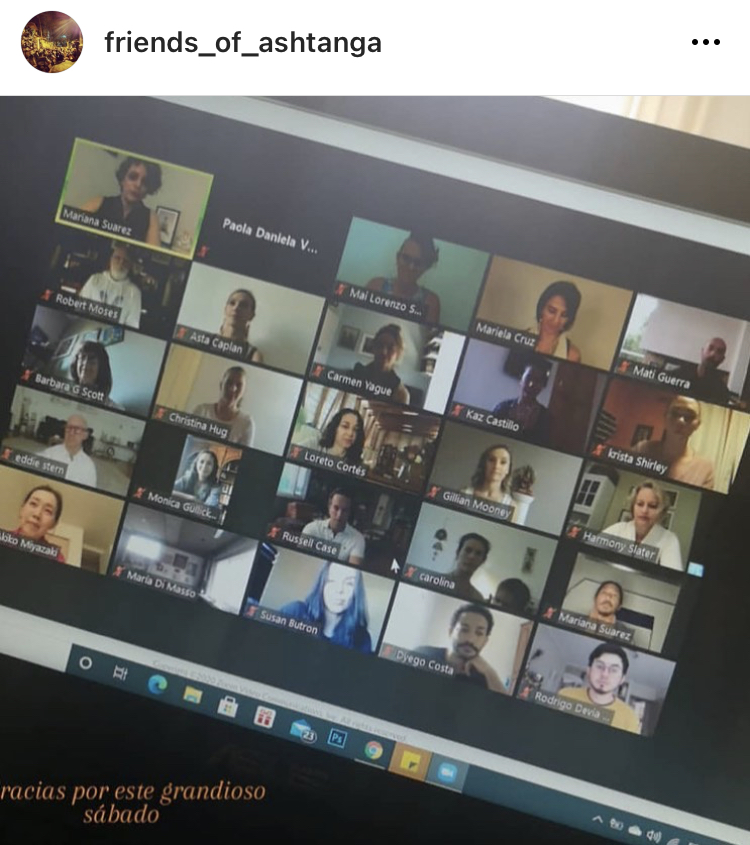
Most of the participants appear before the individual talks. From the Friends of Ashtanga Instagram Page.
As covid19 cases rise here in Cairo and elsewhere, we are reminded of the fragility of life. While we aren’t experiencing any closures here in Egypt (and, hopefully, will continue to be open!), I thought this would be a good time to share my presentation for the Friends Of Ashtanga online conference that happened back in September about what I learned from teaching online.
For the teachers, students, and programs who have had to go back online or have stayed online this entire time, hats off to you. I know many students have decided to go at it alone or have parked their practice in the meantime. I just want to say that there are so may benefits to live instruction, even if its happening through a screen. AND If you can continue to come to class, no matter what format, do so, because your presence right now can really help keep a program alive.
When we paused live sessions here in Cairo mid-March, and moved classes online, I would never have imagined that I’d still be teaching on ZOOM in September. Six months—a crazy amount of time for life to be stalled so. The pandemic may have thrown us off our course, but it unified us also. Being globally connected has never been more apparent as we watched the news report of the spread of this novel coronavirus, first in China, and then in Europe, and then: the world. Over these months, we have connected over our worry, our suffering, our hopes, also. And we have connected by overcoming the obstacles that threaten to disconnect us.
When the WHO declared that covid19 was a pandemic, many mysore programs around the world, including my own, announced that they were migrating sessions online. In a matter of days, my Instagram feed was full of Zoom screenshots of students practicing, each in their individual 2-dimensional boxes—it was bizarre and unsettling how we all jumped online so quickly.
It seemed counter-culture, yoga online. We all love the potency of a room in flow, the steam rising off of moving bodies, that meditative hum of the collective breath. What is ashtanga if not a live, tactile, sensory experience, with students thriving from hands-on assistance?
Yoga, the Great Unifier
Now, in hindsight, I look at the movement online as a great example of yoga, we bent and adapted, we regained our balance and steadiness, we took a deep breath and just got on with it, one day at a time with as little drama as possible.
We went online because we needed the practice and we needed each other. Those early days of the pandemic were both surreal and extraordinary. I Facetime-d with my parents and sisters in the US and in Asia with uncharacteristic regularity. I took led class on Zoom with Sharathji in India through Miami Life Center. I chanted to Ganesha with Eddie Stern on Instagram Stories. I took part in a small online festival celebrating Yoga in Africa. And then, there’s today, Friends of Ashtanga—each of these are beautiful stories of connection.
The mainstay over these six months, however, was—and, is—mornings with my students. Our small community gathered to breathe through uncertainty and change, we stuck together to maintain some sort of normal. As a new mom, these mornings were a healthy anchor for life at home with a newborn.
Virtual Mysore
We discovered together that the mysore format translates surprisingly well online. As individual practitioners, we are used to independently exploring asana, which we already know by heart. Our understanding of drishti and concentration, helps us move our attention inwards, thus keeping us from getting distracted, whether it’s from the glitches from the device or the disembodied voice dispensing instructions to a virtual class room.
Benefitting Students
Being online, allowed students to safely move their practices into their personal spaces, into their actual lives while continuing to feel supported by a teacher. Prior to covid19, only a few students in Cairo could manage a home practice. The tendency was that if they didn’t make it to class, they didn’t manage to practice. These online offerings, I believe, are home practices with training wheels, easing students into comfortably practicing on their own.
It’s also been a great opportunity to practice with softness, kindness, and mindfulness. There has been little rushing, little of that frenetic energy that comes with the desire to catch up with everyone else. Somehow, we all understand, no one is going anywhere, we are just here to practice.
Teacher Online
I believe more than ever in the potency of this practice, that the experience is transcendent. Teaching online really works. Take away the expectation that practicing with a teacher comes with a good press, twist or tug, what we have online is actually closer to how practicing with Sharathji in India is really like, where adjustments are sparse, but the presence of a teacher is plenty.
Even without the assists, students have moved along beautifully. I have witnessed students become stronger during this time, more flexible, more light. Which makes sense because progress is always a side effect of consistent practice
It’s been liberating doing away with the expectation that it’s my “job” to take students physically deeper. We all know that digging deep is the responsibility of each practitioner. Studying online reinforces that our practice is a personal journey, and that there is a healthy amount of space between teacher and student.
The conversation is also different online. Take away that reliance on the language of touch, words have weight and people listen more. And while I’m not suggesting that verbal assists should replace physical adjustments, I think these days have demonstrated that we can communicate the practice in plain and clear ways. (And while there is a beauty of the to allowing the experience unfold through the body, touch and adjustments can be imprecise and inappropriate, relying a lot on inference.)
Mostly, I found as a teacher that my big contribution is simply being there, opening the space, keeping it going, observing, calling out what I see, which is easier when everyone’s practice is tidily laid out in front of you. Being seen has been so important.
In Conclusion
In a way, none of these experiences that I am sharing are out of the ordinary, yoga has always been a great unifier, ashtanga communities have always provided practitioners an outlet to work through their tensions and anxieties, the ashtanga practice has always been a place to find softness and support, and the teaching has always been more energetic than physical. However, personally, prior to coronavirus, it was hard to see these things.
I still miss–and look forward to–in-person teaching in that breathing heaving room–among many, many, MANY other things. But I don’t necessarily want things to go back to EXACTLY how they were. I believe that these times have taught us to think outside the box (yes, inside the box too!), they have challenged us to be flexible and innovative while reminding us that essence of practice exists in whatever space it is allowed to flourish.
Classes are back in session here in Cairo. We are happy to get things started this September. It’s a full month.
On top of our regularly schedules classes, Sunday to Thursday 7-10:30am and our two led classes on September 14 and 28 at 8:30am, we are starting our second Ashtanga Yoga Introduction Course, a 4-week course that includes 3 workshop weekend classes and unlimited Mysore classes for the month. It’s a great program for starting or refreshing your yoga practice.
We’ve added “Mysore+”, additional self practice sessions on September 7 and 21, these classes are for quiet exploration of your practice. I will be available in the room while self practicing myself. It will be a nice time to practice together.
Mysore Zamalek classes are at Nūn Center, 4 Shafik Mansour, Zamalek, Cairo. We accept drop ind from experienced practitioners, please contact us to make an appointment if you are a new student. Our email is mysorezamalek@gmail.com.