Ashtanga Yoga in Ma’adi, Cairo this Ramadan

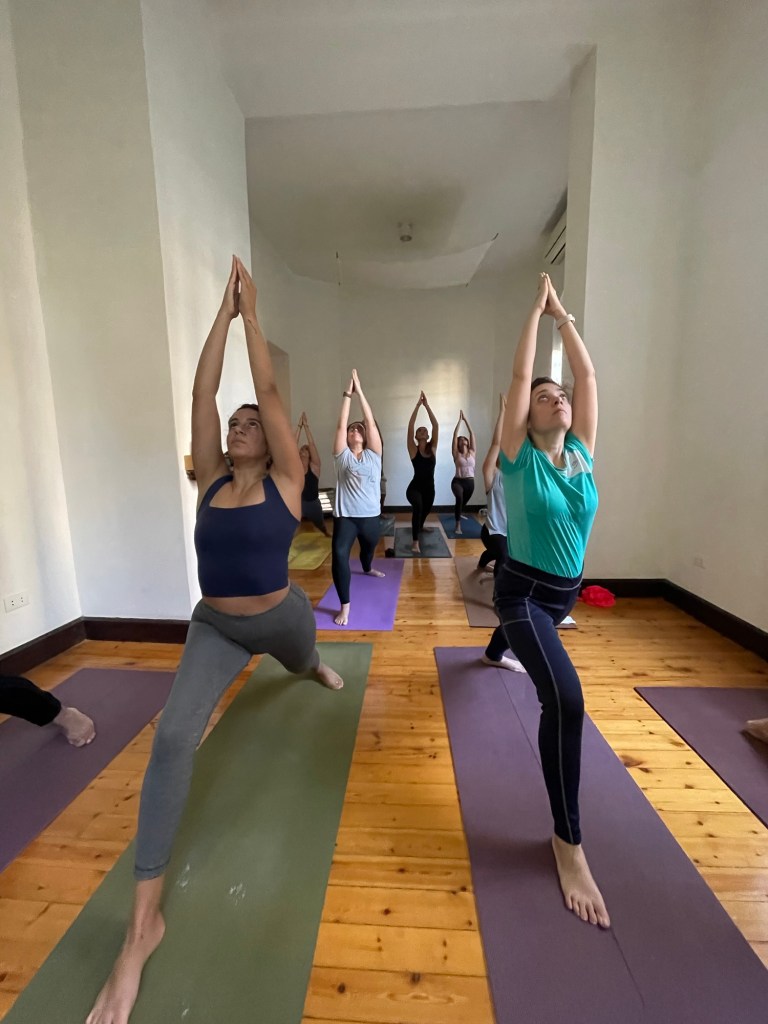
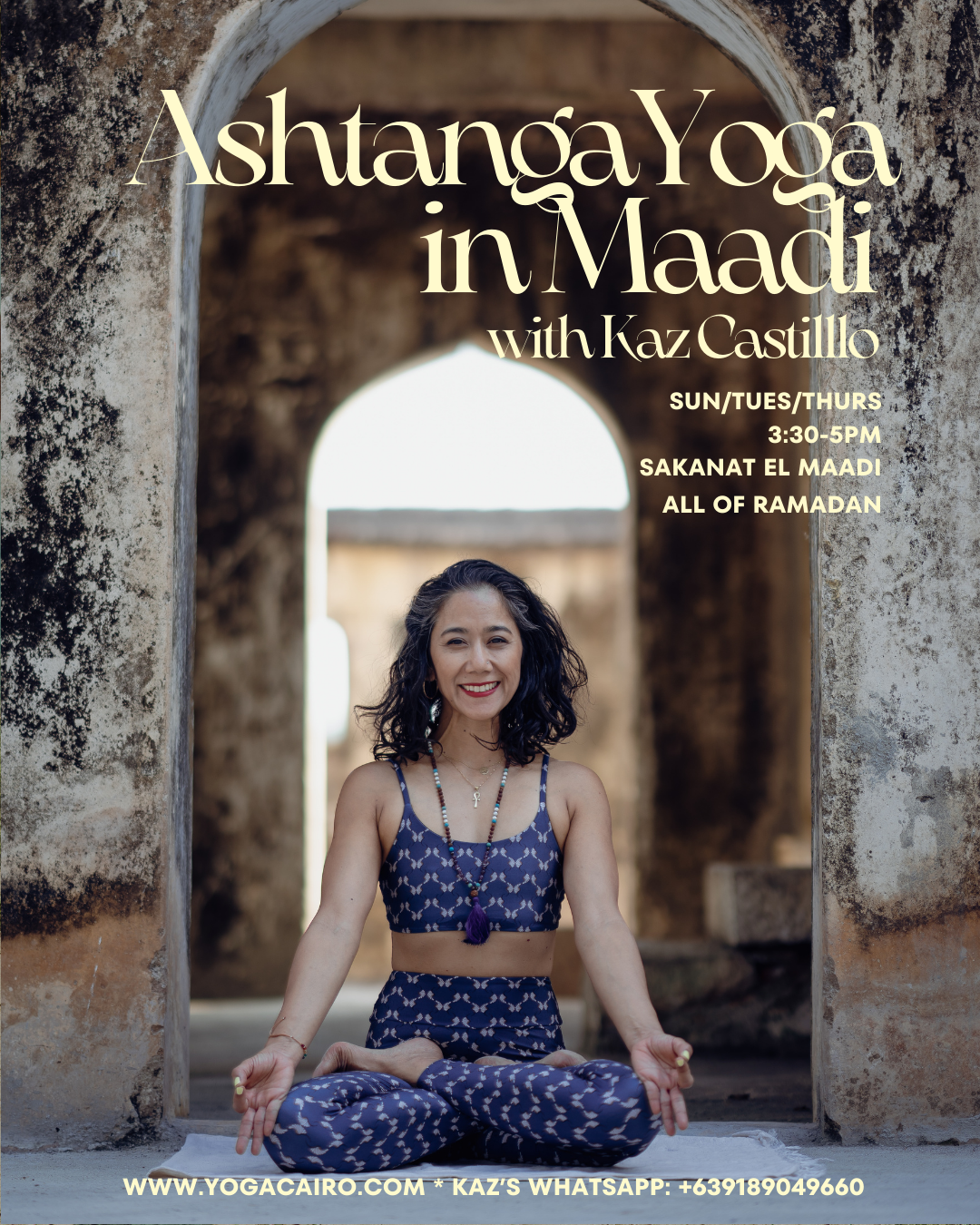
Imagine: inhaling and exhaling your yoga postures in a private rooftop, surrounded by plants and massive tall trees that make Cairo’s Ma’adi so special. I am very excited to be offering these afternoon classes in Ma’adi. It’s a small program in Ramadan, just 3x a week, but also a great pairing with the busy season. We’ll be having class Sunday, Tuesday and Thursday at 3:30pm to 5:00pm, finishing just in time to enjoy the energizing as well as calming benefits during Ramadan.

The rest of the sessions will be Mysore style self-practice, which is the traditional way ashtanga yoga is taught, giving students space to practice silently, connecting with the body. For experienced students with an established practice, instruction is as needed, with an emphasis on verbal cues and hands-on assists supporting the best alignment for you as well as deepening the posture. For new students, instruction is given to help establish the foundational sequence so that students can really learn the sequence the best way for them. This style of teaching pairs so beautifully with the spirit of Ramadan, which is both a solo and communal journey to connecting with our highest purpose.

We are offering two packages: the full program with 12 classes at 3800LE or the option to drop in at 500. We will be opening the Ramadan sessions on the second day, Sunday, March 2 with a gentle guided ashtanga class, offering short cuts and modifications for those settling into their fast and a full led primary on day 12, our last Ramadan session. (More led classes are available at Nūn Center on Fridays at 3pm).

Reservations is a must as spaces are limited. Please message to reserve your spot.

New Year’s Greeting: Let’s Be Surprised

On my recent trip to the Philippines, I went home to the island where I first learned yoga. There, I found myself retracing steps to the Mandala Spa shala, practice space, where my yoga journey began. I practiced with members of my first yoga community, who like me are now older and wiser. It’s wild to go back, to see where I came from, to feel giddy with nostalgia, but to also note that the yoga practice wasn’t the star of any of our lives anymore, but rather an integral support. In fact, we barely spoke of yoga when we were together, through somehow the values of yoga and connection seemed ever present. To be among people with whom yoga is a given, like waking up in the morning, like washing your face, or taking breakfast, it was truly so nourishing to just be in this energy.

In the years that I’ve been teaching a traditional ashtanga yoga mysore program in Cairo, the start of the year is always a good chance to remind new students of the endless potential of starting a regular yoga practice. It’s easy to sell “change” when everyone seems to want to change–at least that’s what we say in the new year. And while there’s value to this tactic, I wish I could sell new students on that which is changeless instead. What remains when we’ve gone through the wheels of transformation? This is yoga too, maybe more so. Not the changes but, more importantly, what doesn’t change. Who we are, our core values, the people and the things that are important to us– these become enhanced through yoga practice.

Either way, change or no change, best to approach any endeavor without expectation. Practice for the sake of practice. So here’s my invitation: come to class, be curious about it, about you in it, and see. Have the tenacity to let it all happen. Most times, the growing can be quite striking, especially in the beginning. Over time, changes become more subtle, yet more profound. At nearly 20 years of yoga practice, I still find myself surprised by it, where it takes me. Let’s be surprised together!

Yoga Cairo’s Mysore Program at Nūn Center resumes on February 11, 2025. Our regular program schedule is 7:30-10:30am (two batches 7:30/8am and 9am) Monday to Thursday with Friday Led Class at the garden 9am sharp. See you soon! DM to book your spot!

ZOOM-ing along: teaching in the time of corona.

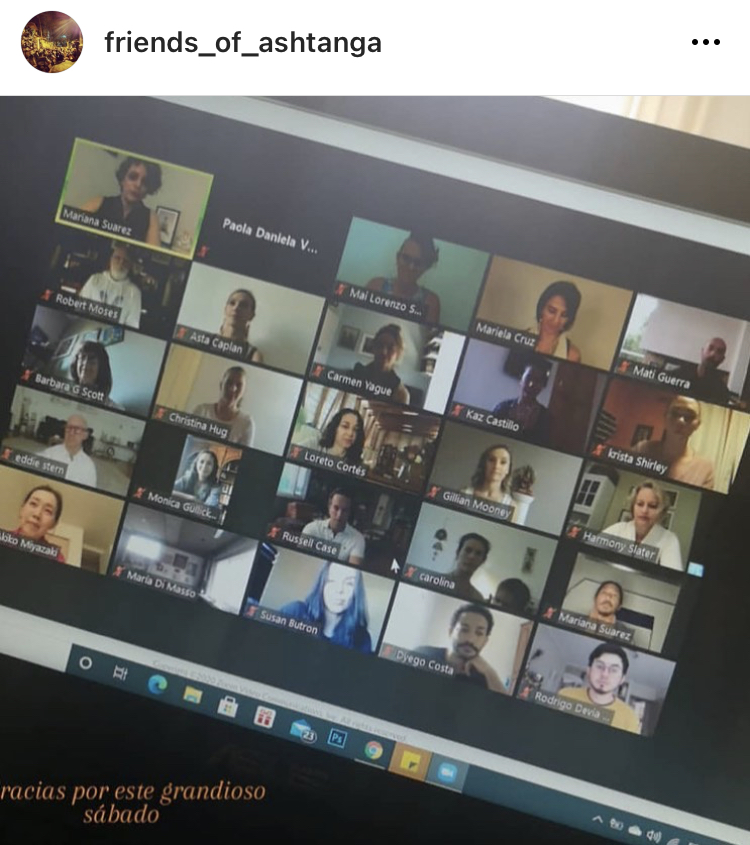
Most of the participants appear before the individual talks. From the Friends of Ashtanga Instagram Page.

As covid19 cases rise here in Cairo and elsewhere, we are reminded of the fragility of life. While we aren’t experiencing any closures here in Egypt (and, hopefully, will continue to be open!), I thought this would be a good time to share my presentation for the Friends Of Ashtanga online conference that happened back in September about what I learned from teaching online.

For the teachers, students, and programs who have had to go back online or have stayed online this entire time, hats off to you. I know many students have decided to go at it alone or have parked their practice in the meantime. I just want to say that there are so may benefits to live instruction, even if its happening through a screen. AND If you can continue to come to class, no matter what format, do so, because your presence right now can really help keep a program alive.

When we paused live sessions here in Cairo mid-March, and moved classes online, I would never have imagined that I’d still be teaching on ZOOM in September. Six months—a crazy amount of time for life to be stalled so.  The pandemic may have thrown us off our course, but it unified us also. Being globally connected has never been more apparent as we watched the news report of the spread of this novel coronavirus, first in China, and then in Europe, and then: the world. Over these months, we have connected over our worry, our suffering, our hopes, also. And we have connected by overcoming the obstacles that threaten to disconnect us.

When the WHO declared that covid19 was a pandemic, many mysore programs around the world, including my own, announced that they were migrating sessions online. In a matter of days, my Instagram feed was full of Zoom screenshots of students practicing, each in their individual 2-dimensional boxes—it was bizarre and unsettling how we all jumped online so quickly.

It seemed counter-culture, yoga online. We all love the potency of a room in flow, the steam rising off of moving bodies, that meditative hum of the collective breath. What is ashtanga if not a live, tactile, sensory experience, with students thriving from hands-on assistance?

Yoga, the Great Unifier

Now, in hindsight, I look at the movement online as a great example of yoga, we bent and adapted, we regained our balance and steadiness, we took a deep breath and just got on with it, one day at a time with as little drama as possible.

We went online because we needed the practice and we needed each other. Those early days of the pandemic were both surreal and extraordinary. I Facetime-d with my parents and sisters in the US and in Asia with uncharacteristic regularity. I took led class on Zoom with Sharathji in India through Miami Life Center. I chanted to Ganesha with Eddie Stern on Instagram Stories. I took part in a small online festival celebrating Yoga in Africa. And then, there’s today, Friends of Ashtanga—each of these are beautiful stories of connection. 

The mainstay over these six months, however, was—and, is—mornings with my students. Our small community gathered to breathe through uncertainty and change, we stuck together to maintain some sort of normal. As a new mom, these mornings were a healthy anchor for life at home with a newborn.

Virtual Mysore

We discovered together that the mysore format translates surprisingly well online. As individual practitioners, we are used to independently exploring asana, which we already know by heart. Our understanding of drishti and concentration, helps us move our attention inwards, thus keeping us from getting distracted, whether it’s from the glitches from the device or the disembodied voice dispensing instructions to a virtual class room.

Benefitting Students

Being online, allowed students to safely move their practices into their personal spaces, into their actual lives while continuing to feel supported by a teacher. Prior to covid19, only a few students in Cairo could manage a home practice. The tendency was that if they didn’t make it to class, they didn’t manage to practice. These online offerings, I believe, are home practices with training wheels, easing students into comfortably practicing on their own.

It’s also been a great opportunity to practice with softness, kindness, and mindfulness. There has been little rushing, little of that frenetic energy that comes with the desire to catch up with everyone else. Somehow, we all understand, no one is going anywhere, we are just here to practice.

Teacher Online

I believe more than ever in the potency of this practice, that the experience is transcendent. Teaching online really works. Take away the expectation that practicing with a teacher comes with a good press, twist or tug, what we have online is actually closer to how practicing with Sharathji in India is really like, where adjustments are sparse, but the presence of a teacher is plenty.

Even without the assists, students have moved along beautifully. I have witnessed students become stronger during this time, more flexible, more light. Which makes sense because progress is always a side effect of consistent practice

It’s been liberating doing away with the expectation that it’s my “job” to take students physically deeper. We all know that digging deep is the responsibility of each practitioner. Studying online reinforces that our practice is a personal journey, and that there is a healthy amount of space between teacher and student.

The conversation is also different online. Take away that reliance on the language of touch, words have weight and people listen more. And while I’m not suggesting that verbal assists should replace physical adjustments, I think these days have demonstrated that we can communicate the practice in plain and clear ways. (And while there is a beauty of the to allowing the experience unfold through the body, touch and adjustments can be imprecise and inappropriate, relying a lot on inference.)   

Mostly, I found as a teacher that my big contribution is simply being there, opening the space, keeping it going, observing, calling out what I see, which is easier when everyone’s practice is tidily laid out in front of you. Being seen has been so important.

In Conclusion

In a way, none of these experiences that I am sharing are out of the ordinary, yoga has always been a great unifier, ashtanga communities have always provided practitioners an outlet to work through their tensions and anxieties, the ashtanga practice has always been a place to find softness and support, and the teaching has always been more energetic than physical. However, personally, prior to coronavirus, it was hard to see these things.

I still miss–and look forward to–in-person teaching in that breathing heaving room–among many, many, MANY other things. But I don’t necessarily want things to go back to EXACTLY how they were. I believe that these times have taught us to think outside the box (yes, inside the box too!), they have challenged us to be flexible and innovative while reminding us that essence of practice exists in whatever space it is allowed to flourish.

The Thread of Practice

Parampara, the unbroken line of lessons from teacher to student, is one of the most striking things about our yoga practice. It is a thread that runs through the practice, that holds it together. Many question this, especially these days. But to say that this has no part in modern day Ashtanga yoga, I think, would be a step in the wrong direction. While I often have long stretches of solo self-practice, I could not do this without a teacher.

Is this system perfect? Well, is our practice perfect? It is all just a process. We’re constantly learning, constantly evolving and innovating.

As I take time off from teaching my own students for the next couple of months to visit my own teacher at the source of Ashtanga yoga in Mysore, India this thread becomes ever more present, ever more felt, ever more experienced.

Yoga becomes alive in such learning spaces. I learned long ago that I had to give up my aspirations to teach. Period. To be a student is one of the greatest gifts, to be in a position to receive, to learn, to grow, and to be guided when undergoing such a precious journey is such a blessing. And while I feel the separation between myself and those who I meet daily on the mat, I know that for now it is time for me to learn, to nourish my own practice, and that the long arms of these two months ahead will extend far longer than one might imagine.

Mysore Zamalek is closed from today till early August. We look forward up restarting with you then!

This May in Mysore Zamalek

So excited to start Ramadan sessions, one of my favorite teaching seasons in Egypt. Unfortunately, I will be unable to complete Ramadan to full term this year as I am traveling back to India for short period of study.

But I am still happy to kick off the season and hopefully can prepare our students for self-practice time ahead. For more info on how to join the program, email me at mysorezamalek@gmail.com or we@nuncenter.com.

BEING Ashtanga Yoga

When Filipa Veiga, Portuguese ashtanga teacher and writer, asked me to join the contingent of yoga teachers offering classes at the Being Gathering 2017 at Boomland in Idanha-a-Nova, Portugal, it put into motion a plan to spend the summer in Europe. I wanted to go see my teacher in mid August in London, I was suddenly committed to my first festival date in early July, what to do then with the time between?

Before I knew it, I had before me a bit of vacation, time to spend with beloved friends, a restart to a personal project that had been put on hold, and a small offering of teaching dates in Portugal, Romania and Vienna. I’m excited for this period after a 7 month stint in Cairo, where I will return to continue teaching after August.

These breaks from routine, the opportunities to connect with other teachers, especially to be a student myself, to tap into the global movement having to do with yoga and healing, allows me time to recharge and also ruminate on what exactly we are doing in our day to day, what is this practice, what is it’s purpose, why do we come to the mat day after day?

On the last day of the festival, I introduced ashtanga yoga as a tool for BEING, for being a better person, for being more focused, more attentive, more present. I alluded to the great Patanjali, to the first line of the Sutras: “Atha yoganuśasunam” Now, begins yoga. It brings us to the present moment. I ended the class with Patanjali, as well, and how he described yoga practice as “dirgha kala nairantarya asevitam,” a long time, without interruption, with whole hearted devotion.

And so begins the summer for me, starting with a most extraordinary of gathering of people, from healers to storytellers, green warriors to spiritual seekers, but also with a great sense of what it means to BE in yoga, how we have a responsibility to be as present with ourselves, our relations, our fellow creatures and planet as much as possible and how practice doesn’t end after our hour and half of sweating and grunting on the mat, it goes on into our day, in every action, in every breath.

Join me in this extraordinary experiment of being through the ashtanga yoga system. I teach in Yoga Lisboa July 11, 12, 13 (www.yoga-lisboa.com), Asociata Ashtanga/Ashtanga Yoga Romania (info@anahata.ro) on July 17-30, then finally in Mysore Vienna from July 31 to August 8 (www.mysorevienna.com).

Photos taken by Clara Lua, Being Gathering, July 2.

Present Practice

Ah…to be present–easier said than done.

How often are we pulled into future projections, expectations? On the flip side, how often do we hold on to old feelings, stories? How many of us are haunted by memories?
How much do we actually live in the presentness of our lives–in all of its wonder, joy, messiness and complexities?

A couple of weeks ago, I was embroiled in a decision-making process that had me  mulling over numbers and future scenarios, as well as past difficulties–all really good tools in terms of making well-informed choices. But I was distracted and confused by it all. In the end, however, it took settling into the present moment, weighing my own feelings about the things I actually know and experience to get to an answer that I could really sit with: that I am happy where I am and that I am little pressed to change that. It seemed so simple, just at that moment.

I am often baffled by my own mind, how it is pulled so easily in so many directions. Once again, practice is an amazing antidote for this. We get on that mat. We do our thing. Our focus and attention may wander here and there, but eventually they are pulled back into our center, and slowly over time we are training ourselves to experience THAT exact breath, THAT exact movement, to stop looking at others or beyond our current practice or our current posture, to trust that change will come when it’s time. When we start to live this experience of being present on our mat, we start to repair the damage of a world that cajoles us into seeking out some future happiness. That’s not to say we aren’t allowed to direct our energy, or even want things for ourselves–its about cultivating that harmony with simply being.

This, I feel, is also what Pattabhi Jois has so famously imparted on us: “Practice, practice, all is coming.” Again, easier said than done. Yet, they key is in the doing. Just practice–the strength, the flexibility, the āsana will all come, but also, perhaps most importantly, this appreciation for the present moment, whatever it looks like.


Ashtanga Yoga and Ramadan

Last year, I decided to teach through the first 3 weeks of Ramadan. It was the first time any of my trips to Egypt coincided with this period. I hadn’t planned for it, but was happy to have a new teaching experience.

I had been told that it would be different, a few teacher-friends based here advised me on what worked best for them and their students during the month-long period where practicing Muslims fasted from sun-up to sundown.

I scheduled classes with a bit of trepidation, a shorter morning class as usual for non-fasters and another afternoon session before the breaking of the fast, iftar. It wasn’t my ideal to break up our already-small group and work the extra hours, but, in my gut, I felt that traditional ashtanga practice would suit Ramadan, that it could be a good compliment to the season as a meditation and as a physical support system.

In truth, the entire rhythm of Cairo changes during this time, the breaking of the fast determines the working and living hours of its 9.5 million residents, regardless of one’s faith. Energy consumption becomes a serious issue among fasters, but non-fasters too take on some of the rigorous social schedule dictated by meal times. Also, revised office hours creates time, particularly in the hours before Iftar. The clubs and bars cease to serve alcohol and everything quiets down or turns inwards.. A totally different energy and pace blankets the city.

Teaching during Ramadan last year reminded me how important it is to be flexible as a teacher; and reinforced my belief that the mysore-style self-practice is designed to be flexible itself, how it can give students the space to tune into their personal needs, and to practice in a way that is nourishing and safe.

In the end, I really fell in love with the experience. I’m happy to say that the students did as well.  The afternoons were hours of exploration through which I could experience Ramadan through my students. Together, through the practice, we tuned into the body, worked with the various phases that comes with fasting, from the lightheadedness and fatigue early on to the lightness of body and bursts of energy that came later.

I saw how the initial effects of fasting effected practitioners and we were careful to respect and honor them especially during the first week of practice. We focused on a softer breath and slow steady movement, careful not to push bodies. We approached postures, like standing forward-bends, carefully to avoid dizziness. We spoke about the yamas and how important it is to practice with non-violence, with honestly, with non-attachment, in a way that we aren’t stealing from ourselves and in a way that we are using our energy wisely.  I encouraged students to honestly tune into their available energy reserves, stopping early on in their practice if they felt low energy. With new students, we learned the sequence slowly, pretty much as we would do in the regular Mysore sessions.

By the second week, students were over the headaches caused by caffeine withdrawal. People were more used to breathing after a day of no water. The body was more used to fasting. Students could do more and proceeded further than the week before. By the third week, students were actually light and lithe, often more so than before Ramadan started. The practice was energetic but also stable and focused.

I saw the effects of the practice in a concentrated form with a group of people on a particular spiritual journey. How the Mysore practice, so often villainized as being a difficult-hard-as-nails sort of yoga method, could be used as a gentle tool for personal introspection as well as a means for students to condition their mind and body, developing flexibility and strength steadily over a period of time.

In a week, Ramadan will start. I’m looking forward once again to teaching those hours before iftar, on top of the morning sessions, experiencing the shifts and learnings that come with it, which inevitably make us not just better students, but hopefully better people in the process.

Mysore Ramadan Schedule (May 27-June 24)
Sunday to Thursday
8:30-10:30am
4:30-6:30pm
Month Pass: 1600LE/ 1 Week Pass 550LE
We accept Drop-In Students who have existing practices already 150LE
(If you are a beginner to the practice, you will need roughly an hour and a month pass)

NŪN CENTER is located at 4 Shafik Mansour, Zamalek. Call or email us for questions or to book for Ramadan: 0122 398 0898 / we@nuncenter.com. http://www.nuncenter.com