Doing the New Year Thing Right

Happy 2026! Excited to be here, I think we all want to know how to start the new year in a good way and, more importantly, how to keep this good way going through out the year.
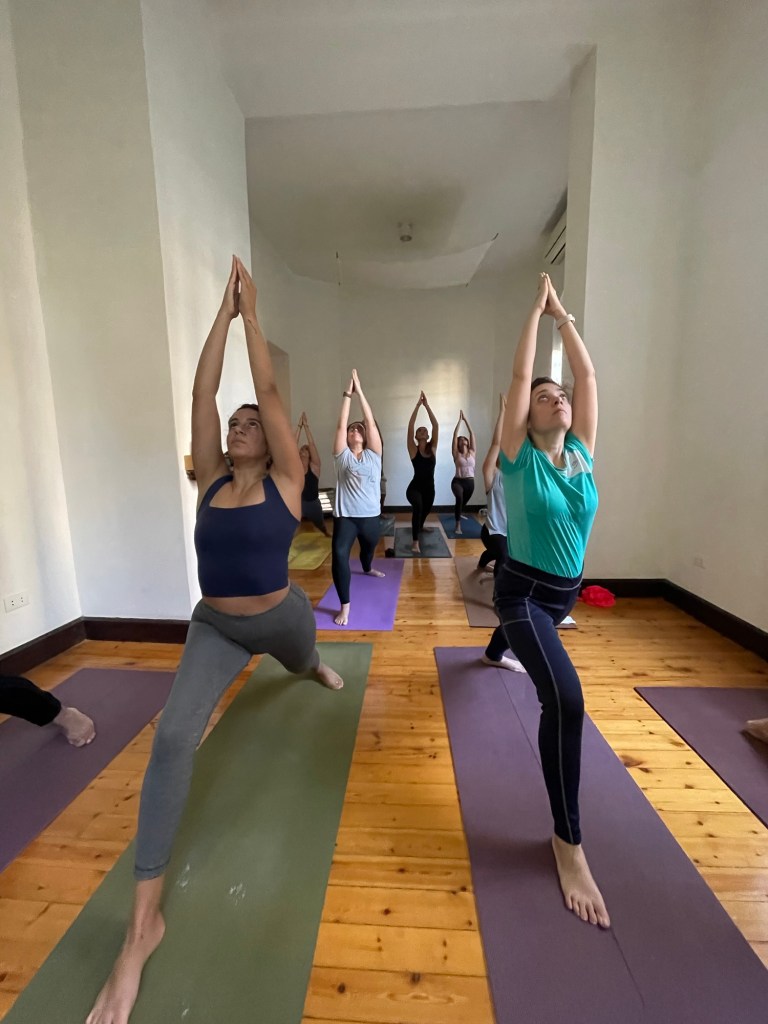
A snapshot of our energetic led class at Nūn Center in Zamalek.

So here we are, well into the first week of the new year! Celebrations and familial obligations out of the way, we ought to be ready to jump into 2026 like we didn’t go through years of just absolute strangeness, right? Is this the year we get back on the program—whatever that was before things got complicated?

Year after year, resolutions are made and broken. Attempts at changing old patterns are strong in the first weeks of the new year but often waver. We shame spiral and then give up. We all know how it goes, so best to be really clear and upfront about it. We aren’t going to get different results by doing the same thing over and over again. We’re not going to break an old pattern by repeating other old patterns, see what I’m getting at?

For many of us “yoga” or something like it is on THE list. You know the one that will make our lives better. Maybe you’ve said: I’m going to do yoga everyday this year. Amazing! I love the enthusiasm. Definitely a good goal.

It’s important to understand what it is that you want to establish. Is it to do yoga daily? Or are you wanting to practice yoga so you can feel more calm, more stable, and create a healthy lifestyle for yourself? If it’s the latter, a daily yoga practice will certainly help but it will take more than turning up daily. It’s important to understand how yoga compliments the life that we are already living, how it can help us grow but also how it can help sustain us when life can be outrageously unsustainable. If your yoga practice is burning you out, then it’s not very yogic.

Here are some suggestions for turning up for yourself in the most yogic way possible in 2026:

  • Make the goals! Goals are good. But this isn’t a sport, the goal posts can move. It’s alright, I swear if you move them mid game.
  • Be forgiving. Don’t use the yoga practice to self flagellate. Of course I’m going to ask you where you’ve been if you missed some classes, that’s because I’m your teacher and I’m concerned and want to understand the context of your absence and how that might affect your practice. But don’t sweat it. Stuff happens.
  • Do your level best. What I mean by level best, is that our best changes based on the circumstances of our lives. Sometimes the best that you can muster is 100%, other times it might be less than 50%.
  • You in Yoga. Yoga is understanding yourself in the context of the yoga practice. Self mastery isn’t going to happen with mastering yogasana. It begins with you knowing how you feel in it!
  • Accountability is key! Sign up for a Mysore program is one way, it’s a bit of a social contract when you have a community of people to practice with. Have a yoga buddy. I have students who ask me directly, please help me stay on the mat and bug me. We need all the help we can get.
  • Strike while the iron is hot. Meaning start now while you have the will and the energy, go big, but be kind to yourself if you aren’t able to fulfill the big-ness of your own aspirations. it’s all good.

Starting a yoga practice, or restarting a yoga practice is a wonderful journey. Can’t wait for you to go on it or return to it. Maybe it will be easy. Maybe it won’t. As someone who has been practicing for 20 years, I can say no matter what level of difficulty it is to stay on the mat, it’s a hundred percent worth it!

Classes will be restarting on January 9th at Nūn Center in Zamalek: 9am Led Class. We’ll be holding a 4-hour intro course on January 10. 1-4pm at Nūn. Everything you need to know to give you the confidence to enter the daily program or to self-practice at home.
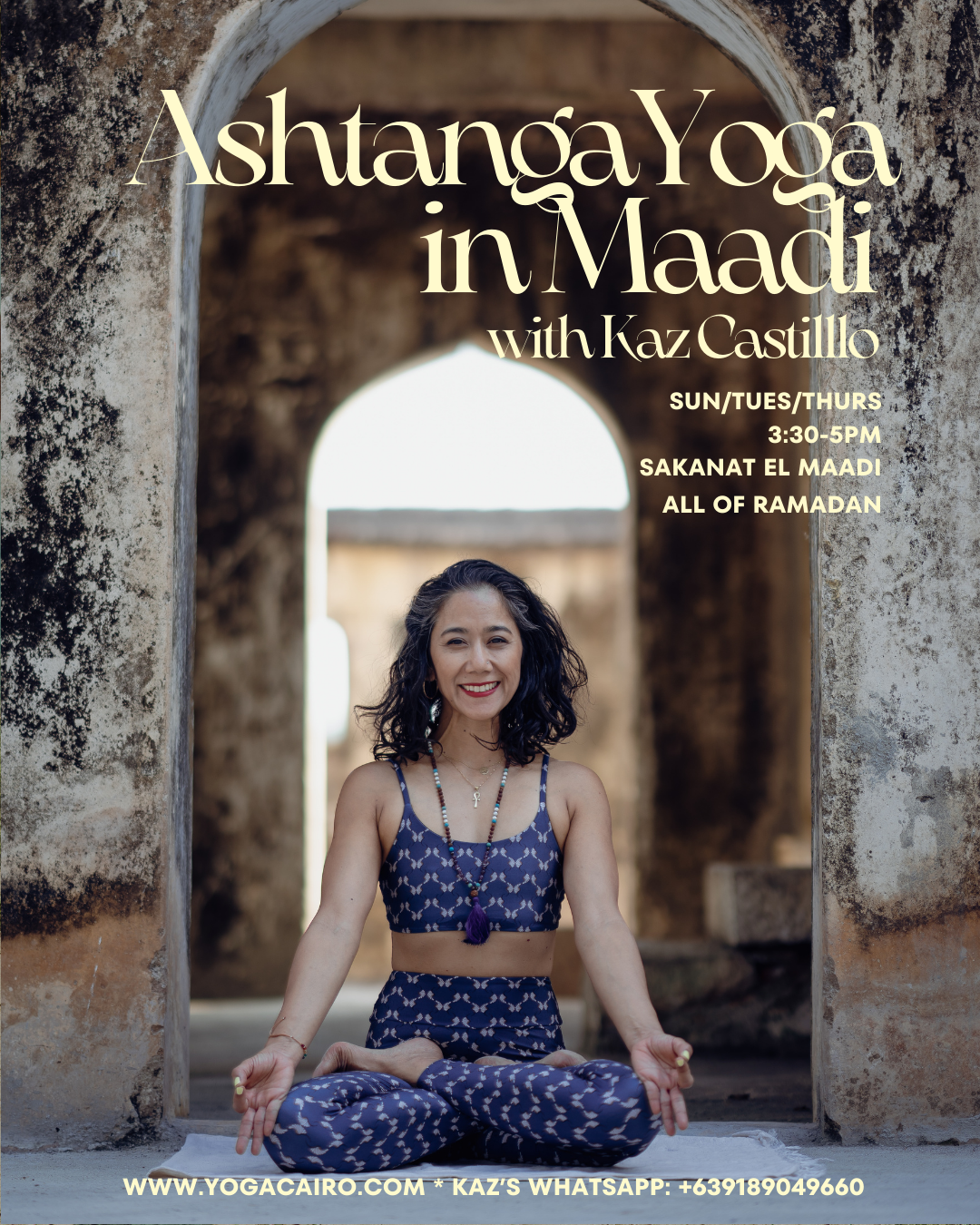
Ashtanga Yoga in Ma’adi, Cairo this Ramadan

Imagine: inhaling and exhaling your yoga postures in a private rooftop, surrounded by plants and massive tall trees that make Cairo’s Ma’adi so special. I am very excited to be offering these afternoon classes in Ma’adi. It’s a small program in Ramadan, just 3x a week, but also a great pairing with the busy season. We’ll be having class Sunday, Tuesday and Thursday at 3:30pm to 5:00pm, finishing just in time to enjoy the energizing as well as calming benefits during Ramadan.

The rest of the sessions will be Mysore style self-practice, which is the traditional way ashtanga yoga is taught, giving students space to practice silently, connecting with the body. For experienced students with an established practice, instruction is as needed, with an emphasis on verbal cues and hands-on assists supporting the best alignment for you as well as deepening the posture. For new students, instruction is given to help establish the foundational sequence so that students can really learn the sequence the best way for them. This style of teaching pairs so beautifully with the spirit of Ramadan, which is both a solo and communal journey to connecting with our highest purpose.

We are offering two packages: the full program with 12 classes at 3800LE or the option to drop in at 500. We will be opening the Ramadan sessions on the second day, Sunday, March 2 with a gentle guided ashtanga class, offering short cuts and modifications for those settling into their fast and a full led primary on day 12, our last Ramadan session. (More led classes are available at Nūn Center on Fridays at 3pm).

Reservations is a must as spaces are limited. Please message to reserve your spot.

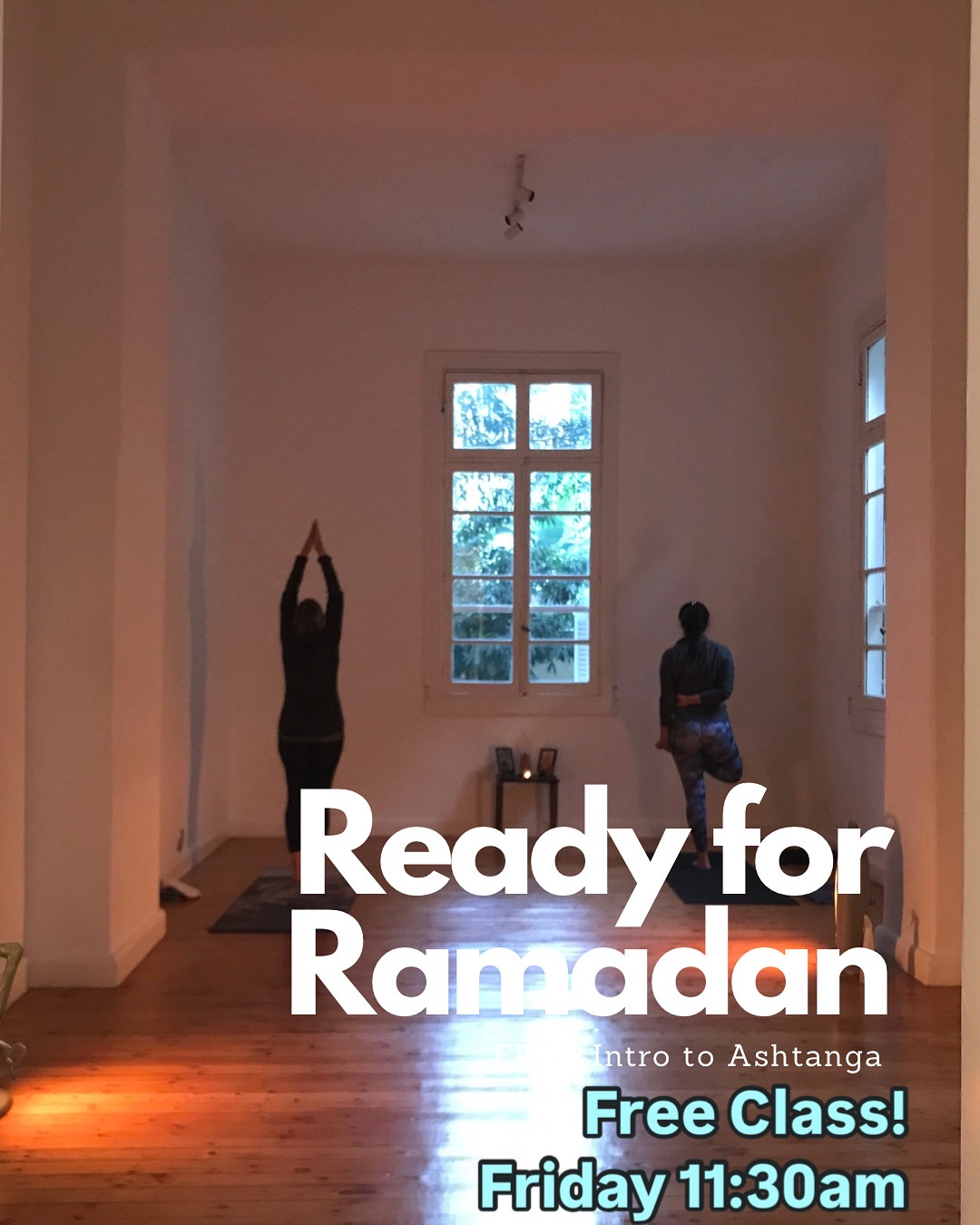
Ready for Ramadan?

63223e83-3dbe-47dc-b17c-40877b1db4e5-1

We’re getting ready for Ramadan here in Cairo and I can’t emphasize enough how this sacred month is my favorite time of the year to teach ashtanga yoga. My first Ramadan in Egypt was in 2016, it was summer then and my intention to teach for two months extended into this holy season; little did I know that it would make such a deep impression on me that I find myself excited to fast, practice, pray, teach and enjoy the collective journey that happens when one consciously decides to observe Ramadan. While I am not Muslim, I love the sense of quiet that descends upon this massive city, how the frenetic all-directions energy of Cairo seems to settle into one stream, schedules synch up, and we dive into nourishing the most important connections in our lives.

Tomorrow, Friday, February 21, a week before Ramadan starts, I am holding a special free class at Nūn Center, open to all for free. It will be an exploration on how yoga techniques, like ashtanga yoga, can help deepen our connections to our body and spirit, which can also enrich our connections with our community, family and world at large. Whether you plan to study ashtanga yoga or not, I believe it can be helpful to practice basic breathing and movements that we will look at.

Yoga Cairo’s Nūn traditional ashtanga program will continue in the mornings Monday to Thursday with Friday led classes happening in the afternoon at 3pm at the Nūn Center garden.

Exciting news is that I will also be teaching in Ma’adi, 3x a week: Sunday, Tuesday and Thursday at 3:30-5pm during the whole month of Ramadan on a lovely private rooftop in Sakanat El Maadi. Message for more information. Hope to see you either in Zamalek or in Maadi!

New Year’s Greeting: Let’s Be Surprised

On my recent trip to the Philippines, I went home to the island where I first learned yoga. There, I found myself retracing steps to the Mandala Spa shala, practice space, where my yoga journey began. I practiced with members of my first yoga community, who like me are now older and wiser. It’s wild to go back, to see where I came from, to feel giddy with nostalgia, but to also note that the yoga practice wasn’t the star of any of our lives anymore, but rather an integral support. In fact, we barely spoke of yoga when we were together, through somehow the values of yoga and connection seemed ever present. To be among people with whom yoga is a given, like waking up in the morning, like washing your face, or taking breakfast, it was truly so nourishing to just be in this energy.

In the years that I’ve been teaching a traditional ashtanga yoga mysore program in Cairo, the start of the year is always a good chance to remind new students of the endless potential of starting a regular yoga practice. It’s easy to sell “change” when everyone seems to want to change–at least that’s what we say in the new year. And while there’s value to this tactic, I wish I could sell new students on that which is changeless instead. What remains when we’ve gone through the wheels of transformation? This is yoga too, maybe more so. Not the changes but, more importantly, what doesn’t change. Who we are, our core values, the people and the things that are important to us– these become enhanced through yoga practice.

Either way, change or no change, best to approach any endeavor without expectation. Practice for the sake of practice. So here’s my invitation: come to class, be curious about it, about you in it, and see. Have the tenacity to let it all happen. Most times, the growing can be quite striking, especially in the beginning. Over time, changes become more subtle, yet more profound. At nearly 20 years of yoga practice, I still find myself surprised by it, where it takes me. Let’s be surprised together!

Yoga Cairo’s Mysore Program at Nūn Center resumes on February 11, 2025. Our regular program schedule is 7:30-10:30am (two batches 7:30/8am and 9am) Monday to Thursday with Friday Led Class at the garden 9am sharp. See you soon! DM to book your spot!

This May in Mysore Zamalek

So excited to start Ramadan sessions, one of my favorite teaching seasons in Egypt. Unfortunately, I will be unable to complete Ramadan to full term this year as I am traveling back to India for short period of study.

But I am still happy to kick off the season and hopefully can prepare our students for self-practice time ahead. For more info on how to join the program, email me at mysorezamalek@gmail.com or we@nuncenter.com.

Mysore Zamalek, October Schedule

October MYSORE ZAMALEK Schedule

We are super excited to be publishing our second month’s schedule. Consistency is key in practice, and the same goes for teaching. And the synergy between teacher and student is grounded in the commitment we have to the practice.

Community will build in any kind of yoga class, but the potential for community in a Mysore Program, where practitioners are regularly studying in the same space, is huge. We hope that students can come to Mysore Zamalek @ Nūn Center and find a kind of home, this is a place where we can grow, sweat out our issues, seek peace, and cultivate health.

If you are interested in joining our Mysore program located here at Nūn Center (4 Shafiq Mansour, Zamalek), please message me at mysorezamalek@gmail.com or book through we@nuncenter.com.

A Different Kind of Saturday Night: Inner Dance at Nūn Center

Gettting back into the Cairo swing means not just starting up Mysore Zamalek but also bringing people together in a different kind of dance party. Inner Dance is back at Nūn Center, Saturday, September 30 at 8pm.

The moving meditation and healing modality from the Philippines is about discovering your highest vibration and letting yourself move to its peculiar and particular ebb and flow.

Wear comfortable clothes. Book through Nūn Center, we@nuncenter.com.

Ashtanga Yoga and Ramadan

Last year, I decided to teach through the first 3 weeks of Ramadan. It was the first time any of my trips to Egypt coincided with this period. I hadn’t planned for it, but was happy to have a new teaching experience.

I had been told that it would be different, a few teacher-friends based here advised me on what worked best for them and their students during the month-long period where practicing Muslims fasted from sun-up to sundown.

I scheduled classes with a bit of trepidation, a shorter morning class as usual for non-fasters and another afternoon session before the breaking of the fast, iftar. It wasn’t my ideal to break up our already-small group and work the extra hours, but, in my gut, I felt that traditional ashtanga practice would suit Ramadan, that it could be a good compliment to the season as a meditation and as a physical support system.

In truth, the entire rhythm of Cairo changes during this time, the breaking of the fast determines the working and living hours of its 9.5 million residents, regardless of one’s faith. Energy consumption becomes a serious issue among fasters, but non-fasters too take on some of the rigorous social schedule dictated by meal times. Also, revised office hours creates time, particularly in the hours before Iftar. The clubs and bars cease to serve alcohol and everything quiets down or turns inwards.. A totally different energy and pace blankets the city.

Teaching during Ramadan last year reminded me how important it is to be flexible as a teacher; and reinforced my belief that the mysore-style self-practice is designed to be flexible itself, how it can give students the space to tune into their personal needs, and to practice in a way that is nourishing and safe.

In the end, I really fell in love with the experience. I’m happy to say that the students did as well.  The afternoons were hours of exploration through which I could experience Ramadan through my students. Together, through the practice, we tuned into the body, worked with the various phases that comes with fasting, from the lightheadedness and fatigue early on to the lightness of body and bursts of energy that came later.

I saw how the initial effects of fasting effected practitioners and we were careful to respect and honor them especially during the first week of practice. We focused on a softer breath and slow steady movement, careful not to push bodies. We approached postures, like standing forward-bends, carefully to avoid dizziness. We spoke about the yamas and how important it is to practice with non-violence, with honestly, with non-attachment, in a way that we aren’t stealing from ourselves and in a way that we are using our energy wisely.  I encouraged students to honestly tune into their available energy reserves, stopping early on in their practice if they felt low energy. With new students, we learned the sequence slowly, pretty much as we would do in the regular Mysore sessions.

By the second week, students were over the headaches caused by caffeine withdrawal. People were more used to breathing after a day of no water. The body was more used to fasting. Students could do more and proceeded further than the week before. By the third week, students were actually light and lithe, often more so than before Ramadan started. The practice was energetic but also stable and focused.

I saw the effects of the practice in a concentrated form with a group of people on a particular spiritual journey. How the Mysore practice, so often villainized as being a difficult-hard-as-nails sort of yoga method, could be used as a gentle tool for personal introspection as well as a means for students to condition their mind and body, developing flexibility and strength steadily over a period of time.

In a week, Ramadan will start. I’m looking forward once again to teaching those hours before iftar, on top of the morning sessions, experiencing the shifts and learnings that come with it, which inevitably make us not just better students, but hopefully better people in the process.

Mysore Ramadan Schedule (May 27-June 24)
Sunday to Thursday
8:30-10:30am
4:30-6:30pm
Month Pass: 1600LE/ 1 Week Pass 550LE
We accept Drop-In Students who have existing practices already 150LE
(If you are a beginner to the practice, you will need roughly an hour and a month pass)

NŪN CENTER is located at 4 Shafik Mansour, Zamalek. Call or email us for questions or to book for Ramadan: 0122 398 0898 / we@nuncenter.com. http://www.nuncenter.com

āsana and the yoga of cairo

It’s been a spell since leaving Cairo, but this piece inspired by the old city and its people has long been stewing. People often ask me why I keep coming back to Cairo. There are many reasons but one of the big ones is this: it inspires a level of sadhana that is well beyond the body. It’s a place that reminds me to live my yoga practice.

There’s this chair in a room. It’s a small receiving room in an old apartment in Downtown Cairo. The square room is painted red, and despite its tiny floor size, it stretches up and up with high ceilings. The chair is the only real furniture in the room. There’s a desk lamp, that sits on the ground and the three walls of the room are filled with artworks of varying sizes that reaches up the wall.

The seat, a wooden antique reclining chair with white cushions, feels lonely to me, partially lit by the lamp. Framed against the bits of modern art crawling up the red, it feels stoic, but solitary.

Later, my friend, to whom this space belongs, tells me about his life in Cairo. The struggles of ordinary life filled with victory and loss; he speaks of caring for a parent dying of cancer; of the failed revolution; of life in Tahir Square; of the many crazy things he witnessed during that crazy time; he shares the oddness and disparity between the different social stratas which he straddles, because Cairo, the world he lives in, constantly vacillates between extremes.

In yoga, “āsana” is often referred to as the postures we take while we practice. It is the “seat” of yoga.

These days, we mistake āsana as taking shapes in space. There is a proliferation of this on the internet with photos and videos of beautifully performed handstands and human pretzels… The day I started writing this article, a funny spoof on the yoga video phenomenon went viral among my yoga circles. The following day, a number of the same people who shared it online were once again liking yogāsana snap shots on social media. There’s nothing wrong with that, we can, of course, appreciate all sides. But it had me thinking, once again, what it means to be sitting in yoga.

It is truly something awesome to see a human being defy the limits and gravity with his/her body. They definitely inspire. But I wonder, are they accurate representations of āsana?

I do not offer any photos for this post, though originally I wanted to share one of the chair itself. My friend asked that I refrain from doing even that, such things are, after all, private and the delicate practice of our lives is sacred.

My friend and his chair (neither pictured here) move me in a way that I do not feel when seeing some popular representations of yoga. My friend and his chair, his seat, remind me that the essence of yoga cannot fully be captured in a polished physical posture, however amazing, however artistically articulated.

My friend, he’s no expert at Cairo life, certainly not at yoga. He’s simply doing his best to just sit in all the crazy, all the joy and all the disappointment, striving to find peace with all of it. And that feels like yoga practice to me.

When we practice, we are practicing our ability to sit in yoga, to find equanimity in the body, mind, heart. The greater practice is life itself, the challenge of which is to find equanimity in the body, mind and heart amidst the chaos of an ever changing world.

I think one of the reasons I continue to be drawn to Cairo is that the city’s version of the ebb and flow of life is on some serious kind of overdrive: it is a vortex of living, of varying energies, sweet and terrible (political, economic, cultural, social, individual) all swirling rapidly together in this thick soup of a city, layered with modern and ancient civilizations, and with them their countless innovations, numerous mistakes and unfathomable mysteries.

To sit in it, to stand, to walk, to move, to work, to be there, to be well–let alone, thrive there–takes a special kind of practice.

That’s not to say that everyone in Cairo is sitting in yoga, with every challenge there’s a good amount of avoidance or numbing–but the opportunity to practice yoga exists at every turn, every interaction, every bit of gridlock and difficulty. It is easy to see this in the lives of many of the city’s inhabitants, most of whom don’t know what the inside of a yoga studio looks like. Practice is alive in the struggle. It’s inhabitants must simply do what they can, working to find some stillness in all this whirlpool of energy; Cairo is their yoga.

The search for softness or grace or space or peace in the whirlpool of life is both challenging and sublime. I suppose it’s like this everywhere, though the extreme energies of a place like Cairo accentuates the experience. It is the same experience in a mysore room, where practice is alive and well, gritty and difficult, at the edge of some seemingly insurmountable odds, which we learn to overcome little by little.

Ultimately, the āsana of Cairo is that of everyplace, it is the practice of every man. It is about how we sit, stand, move, interact with our environment, with the people we meet, it’s how we rise up to our challenges and it’s how we live up to our victories.


Catching Wind, Empowering Practice


So many times I have found myself blown in certain directions. Mostly, though not exclusively, with incredible positive outcomes. Even gale force-like winds and maelstroms, which might have moored me into isolation or thrown me into some catastrophic disaster, would eventually abate and I would land wherever with the softness of a feather. I consider myself blessed to have had such good luck to be propelled so. I also know, that in many ways, I called for it, that I invited the elements myself to move me. Time and time again, I’ve taken myself to some peak, opened my arms in surrender, and like wings unfurled, I would get picked up and thus be transported.

I wondered, however, what would it be like if I participated more in this act of flight? The last year in particular has been about recognizing the difference between flowing with things and flying myself.

It’s been an amazing process, coming to a deeper understanding that all this raw energy can be transformed and directed. That I am not prey or play thing to the forces I perceived to be much greater than myself, but, instead, an active player, instigator, herder of energy.

There is so much in this; the world at large is packed with potential energy, raw, unharnessed. In the microcosm of us, we are likewise full of unrealized vitality and force. When we learn to access this, when we learn to use it skillfully, to move it in certain directions, something huge shifts. We are empowered.

This naturally happens when we practice. There’s this wealth of untapped energy in our bones, our connective tissues, our muscles, our breath, our thoughts and hearts. Our practice helps us soften the gross layers, physical and subtle, emotional and mental, that keep us from connecting with our own physical/metaphysical body.

When we practice with consistency over a long period of time, we start tapping into these energies, which then become apparent in the practice itself. We extract energy from the practice and it fuels us. Our bodies become efficient, so does our breath, we develop an economy of thought and effort and before we know it, we are no longer consuming energy but creating it, so ample that it overflows and drips into our lives causing all sorts of creative bounty /mayhem.

This is my tenth year of yoga practice. It’s not a very long time–I continue to feel like a babe in the woods–but it’s not a short time either. Whatever length it is, it is long enough to observe the effects of practice, how it’s changed, how it’s changed me, how my life has changed because of it.

These days in Cairo’s Nūn Center, there are a number of beginners and some students returning to practice after a substantial break. And naturally the struggles that come with starting an ashtanga practice begin to appear: the body gets tired, the mind wavers, the internal debate on whether to go to class starts when the alarm rings in the morning.

I remember my teacher saying that if you never leave your practice, it will never leave you. I still have those days where doing my own practice is like going to battle with myself. What he said, though, it’s true, and it gets me on my mat, it gets me through the first sticky sun salutation, and, eventually, the practice helps me catch wind.

Mysore Classes here at Nūn continue. Sunday to Thursday, 7:30-10am. This week, we are adding Ashtanga Basic classes Monday and Wednesday at 7pm. These classes can be used as an introduction to the morning Mysore program. Drop ins and all levels are welcome!