Ashtanga Yoga in Ma’adi, Cairo this Ramadan

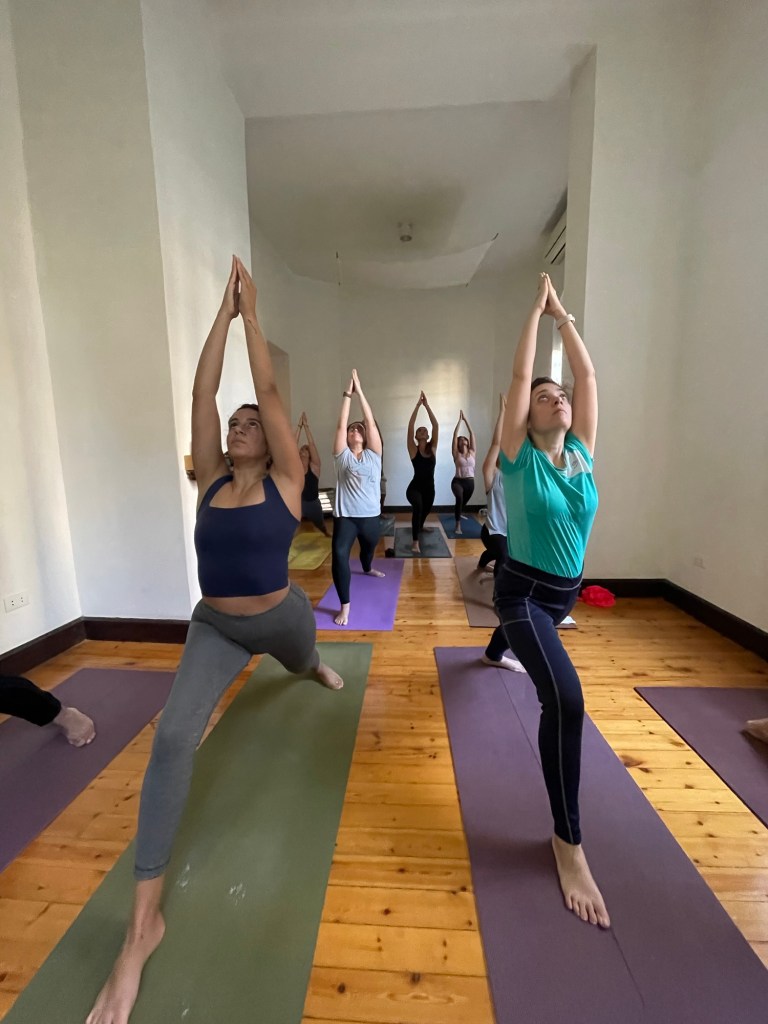
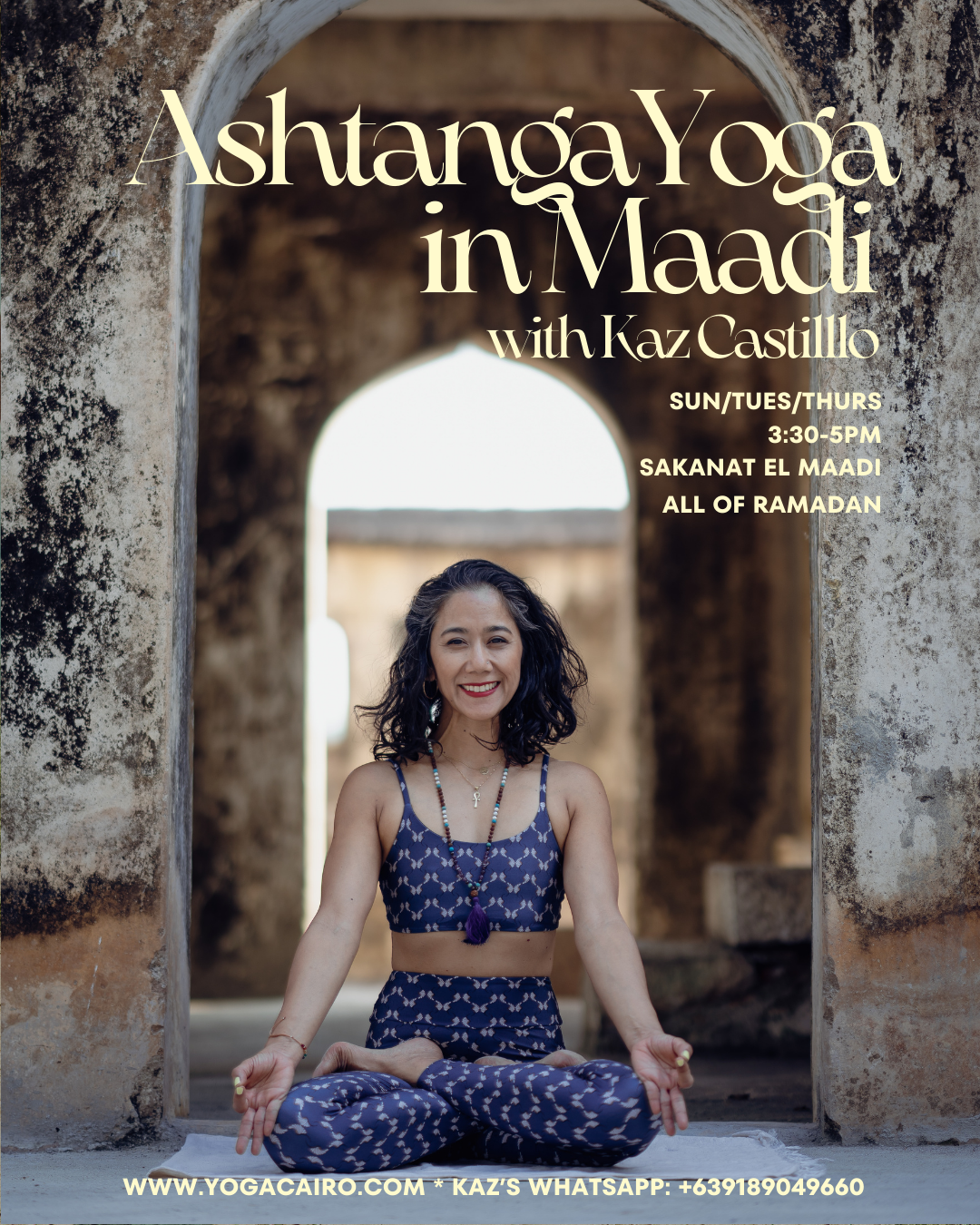
Imagine: inhaling and exhaling your yoga postures in a private rooftop, surrounded by plants and massive tall trees that make Cairo’s Ma’adi so special. I am very excited to be offering these afternoon classes in Ma’adi. It’s a small program in Ramadan, just 3x a week, but also a great pairing with the busy season. We’ll be having class Sunday, Tuesday and Thursday at 3:30pm to 5:00pm, finishing just in time to enjoy the energizing as well as calming benefits during Ramadan.

The rest of the sessions will be Mysore style self-practice, which is the traditional way ashtanga yoga is taught, giving students space to practice silently, connecting with the body. For experienced students with an established practice, instruction is as needed, with an emphasis on verbal cues and hands-on assists supporting the best alignment for you as well as deepening the posture. For new students, instruction is given to help establish the foundational sequence so that students can really learn the sequence the best way for them. This style of teaching pairs so beautifully with the spirit of Ramadan, which is both a solo and communal journey to connecting with our highest purpose.

We are offering two packages: the full program with 12 classes at 3800LE or the option to drop in at 500. We will be opening the Ramadan sessions on the second day, Sunday, March 2 with a gentle guided ashtanga class, offering short cuts and modifications for those settling into their fast and a full led primary on day 12, our last Ramadan session. (More led classes are available at Nūn Center on Fridays at 3pm).

Reservations is a must as spaces are limited. Please message to reserve your spot.

Ready for Ramadan?

63223e83-3dbe-47dc-b17c-40877b1db4e5-1

We’re getting ready for Ramadan here in Cairo and I can’t emphasize enough how this sacred month is my favorite time of the year to teach ashtanga yoga. My first Ramadan in Egypt was in 2016, it was summer then and my intention to teach for two months extended into this holy season; little did I know that it would make such a deep impression on me that I find myself excited to fast, practice, pray, teach and enjoy the collective journey that happens when one consciously decides to observe Ramadan. While I am not Muslim, I love the sense of quiet that descends upon this massive city, how the frenetic all-directions energy of Cairo seems to settle into one stream, schedules synch up, and we dive into nourishing the most important connections in our lives.

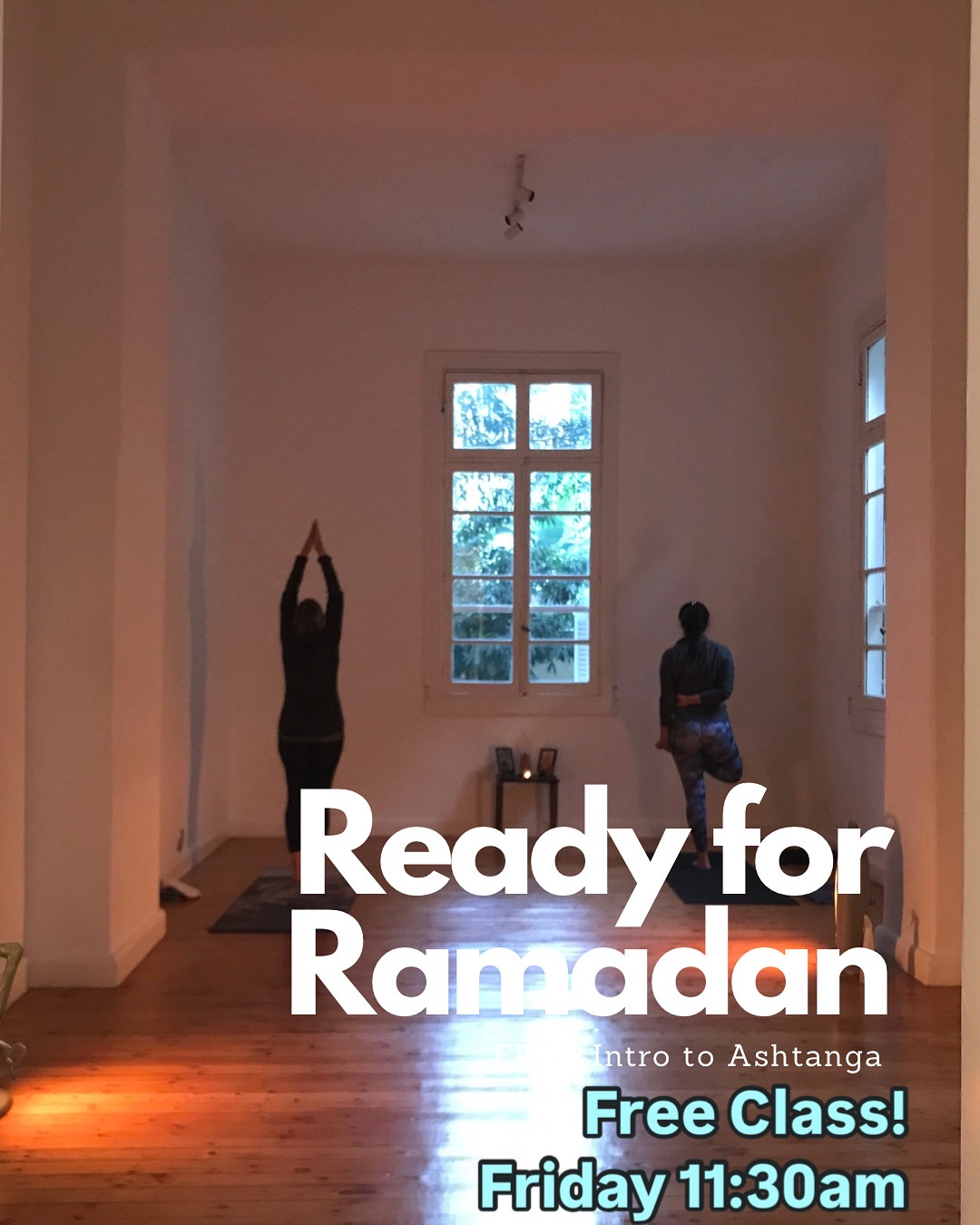
Tomorrow, Friday, February 21, a week before Ramadan starts, I am holding a special free class at Nūn Center, open to all for free. It will be an exploration on how yoga techniques, like ashtanga yoga, can help deepen our connections to our body and spirit, which can also enrich our connections with our community, family and world at large. Whether you plan to study ashtanga yoga or not, I believe it can be helpful to practice basic breathing and movements that we will look at.

Yoga Cairo’s Nūn traditional ashtanga program will continue in the mornings Monday to Thursday with Friday led classes happening in the afternoon at 3pm at the Nūn Center garden.

Exciting news is that I will also be teaching in Ma’adi, 3x a week: Sunday, Tuesday and Thursday at 3:30-5pm during the whole month of Ramadan on a lovely private rooftop in Sakanat El Maadi. Message for more information. Hope to see you either in Zamalek or in Maadi!

New Year’s Greeting: Let’s Be Surprised

On my recent trip to the Philippines, I went home to the island where I first learned yoga. There, I found myself retracing steps to the Mandala Spa shala, practice space, where my yoga journey began. I practiced with members of my first yoga community, who like me are now older and wiser. It’s wild to go back, to see where I came from, to feel giddy with nostalgia, but to also note that the yoga practice wasn’t the star of any of our lives anymore, but rather an integral support. In fact, we barely spoke of yoga when we were together, through somehow the values of yoga and connection seemed ever present. To be among people with whom yoga is a given, like waking up in the morning, like washing your face, or taking breakfast, it was truly so nourishing to just be in this energy.

In the years that I’ve been teaching a traditional ashtanga yoga mysore program in Cairo, the start of the year is always a good chance to remind new students of the endless potential of starting a regular yoga practice. It’s easy to sell “change” when everyone seems to want to change–at least that’s what we say in the new year. And while there’s value to this tactic, I wish I could sell new students on that which is changeless instead. What remains when we’ve gone through the wheels of transformation? This is yoga too, maybe more so. Not the changes but, more importantly, what doesn’t change. Who we are, our core values, the people and the things that are important to us– these become enhanced through yoga practice.

Either way, change or no change, best to approach any endeavor without expectation. Practice for the sake of practice. So here’s my invitation: come to class, be curious about it, about you in it, and see. Have the tenacity to let it all happen. Most times, the growing can be quite striking, especially in the beginning. Over time, changes become more subtle, yet more profound. At nearly 20 years of yoga practice, I still find myself surprised by it, where it takes me. Let’s be surprised together!

Yoga Cairo’s Mysore Program at Nūn Center resumes on February 11, 2025. Our regular program schedule is 7:30-10:30am (two batches 7:30/8am and 9am) Monday to Thursday with Friday Led Class at the garden 9am sharp. See you soon! DM to book your spot!

Why is ashtanga so tough? …maybe it’s not as tough as we think!

Mysore classes at our yoga shala at Nūn Center.

Most of us want to start a yoga practice so that we can grow stronger and be more flexible but unwind and find time and space in our busy lives. So, the last thing we probably want to hear when we are signing up for yoga classes is that we need to commit to a near impossible regiment of daily yoga practice.

As a mom of a small child, I now realize how that can be a very big ask for most. It’s taken time (and this is a continuing process) for me to find equilibrium between yoga and motherhood, these two giant forces in my life. I’ve had to make some adjustments–both physically and mentally. But here are some thoughts on why I think this method does in fact work for me as a mother and, actually, as a human, as well.

First of all: there is no actual “ashtanga police.” This idea is largely made up, partly a joke, like the Bogey Man to keep the yoga kiddos in line. And while there are those who take up the informal mantle, be assured that there is no actual centralized body that polices any irregularities in the method. Mostly, the essential bits of ashtanga yoga are preserved through an honor system, the efficacy of the practice itself creates trust in the method (and also the teacher). For those who stick to the rules long enough, consistently enough, the benefits are self-evident. And, so, for the most part, things are passed down the way they are because they work.

I see the ashtanga method a lot like the English language, which has a grammatical order to it, but also a lot of exceptions. The method is centered and steady but also flexible like the yoga that it represents. That’s not to say that guidelines are not important, they are there to keep things from crumbling into chaos, but they also bend when necessary.

Second: We can practice as much or as little as we are able. We often call the method after the city in India where it was developed, Mysore. But the actual thing is called “self-practice.” which means it belongs to us, practitioners. We animate the practice. We can decide how much time we can devote to it. If you ask me as a yoga teacher, I will still tell you that I recommend up to 5 days a week (many will say 6). But the reality is that it’s up to each individual how many days to practice; ultimately, whatever one can manage is the perfect amount. (If you are a beginner, don’t worry, self practice doesn’t mean you are on your own, one to one help is on hand and actually personalized).

Third: the way in which we practice is up to us, whether its with earnestness and gravitas or with ease and lightheartedness. Usually, a combination of the two would be ideal, but as we don’t live in an ideal world, we are allowed to practice in a way that is appropriate for us. If you can’t do a long sequence, then just do standing and finishing postures, is that’s still too much, then just sun salutations and just breathe through the three final seated postures. I’ve had students come in to class and they just can’t do any of it and so they lay down to rest. Everything is practice.

So, if it’s as easy as that, why doesn’t it always feel that way? I’ve met a few special yoga practitioners who always managed to keep the practice light and breezy. I used to always think of them as the anomaly, they seemed little affected by the mania of mysore, they were content to flow without too much effort, they were willing to go the distance but didn’t feel the need to kill themselves doing it. The rest of us… well, maybe you see where I’m going here. Human nature comes to play and so we strive. But the practice is just a mirror. If it feels tough, perhaps because it is simply reflecting back our toughness or the intensity of our expectations.

That’s not to say that the practice isn’t difficult. It can be, and there are definite moments where particular challenges can come up. But many of the challenges come at the time when we are ready. Sometimes we don’t believe our own readiness and so that feels tough mentally. Sometimes, we struggle to get it just right. But the “toughness,” that’s something we often bring into the practice ourselves.

This yoga practice, it’s amazing, it’s a wonderful series of postures, each one preparing us for the next one. It has numerous physical and mental benefits. It is a kind of fitness for the mind, body and soul. And when we start form the beginning, we work in a way that suits each student. It’s not tough. It’s not easy either. It’s thoughtful. And it works!

Classes restart after Eid holidays on Monday, May 1. Our regular schedule is Monday to Thursday mysore style self-practice, 7:30 to 10:30am with led classes on Fridays 8am and 9:30am. All levels are welcome! We are having a 2 week intro starting May 15, which will be led by Yasmine Seoud, who has been assisting for us now for a glorious year!

Practice Self Forgiveness

img_5515

Photo by Michael Tutaan, Boracay, Philippines

The great irony, perhaps, of diving deeper into this physical practice is how metaphysical it becomes, the more advanced the posture, the more subtle the mind and the heart. How, for example, taking one’s leg behind the head is less about the openness of hips, the ability to internally rotate the leg while lifting the center and, with it, the back–though all fundamentally a part of the process–than it is about cultivating patience and perseverance.

Once in a while, I ask myself, what have I learned? What is new, especially when there are no new postures to investigate or obsess about? It has been two years, almost, since I’ve studied with my teacher in Mysore and my practice seems to be greatly about establishing a steady rhythm, building strength and getting comfortable. Some days are tougher than others, I must admit, developing strength seems to have come with loosing a certain amount of bendiness. And establishing a life in one place, as I have done this year in Egypt, comes with an entirely different set of challenges that sometimes get in the way of the smooth flow of practice.

For me, I think one of the greatest lessons of cozying up to the intermediate series these last two years is learning to forgive myself.  I may have not overcome my own expectations, they creep up on me still while on the mat (not to mention off the mat!), but it’s never so hard as before. Mostly, because I’m not as hard on myself as I was before. Often, I find myself humorously observing the struggles, the days I ate pasta and how that feels in titthibhāsana, the days I can’t get a good grip on the mat in karandavāsana and fall, the days I get on the mat late and I’m so tired that I’m practically crawling through the practice. It’s all ok, I can’t always be my best physically though I can still put my best effort forward based on the conditions that I am given and that I allow myself.

We cause so much undue suffering with unforgiving thoughts: why can’t I do it, what’s wrong with me, why am I not good enough? Such fluctuations of the mind are debilitating, they stall us, not just mentally but physically too, they keep us from moving forward. And thus the relationship between the mind and the body continues. So, instead, let’s be kind to ourselves, let’s be sweet and also honest. Be honorable, admit when it’s hard but do not harden because of it. Forgiveness in itself is a deep and fulfilling practice.


Mysore Zamalek, October Schedule

October MYSORE ZAMALEK Schedule

We are super excited to be publishing our second month’s schedule. Consistency is key in practice, and the same goes for teaching. And the synergy between teacher and student is grounded in the commitment we have to the practice.

Community will build in any kind of yoga class, but the potential for community in a Mysore Program, where practitioners are regularly studying in the same space, is huge. We hope that students can come to Mysore Zamalek @ Nūn Center and find a kind of home, this is a place where we can grow, sweat out our issues, seek peace, and cultivate health.

If you are interested in joining our Mysore program located here at Nūn Center (4 Shafiq Mansour, Zamalek), please message me at mysorezamalek@gmail.com or book through we@nuncenter.com.

Present Practice

Ah…to be present–easier said than done.

How often are we pulled into future projections, expectations? On the flip side, how often do we hold on to old feelings, stories? How many of us are haunted by memories?
How much do we actually live in the presentness of our lives–in all of its wonder, joy, messiness and complexities?

A couple of weeks ago, I was embroiled in a decision-making process that had me  mulling over numbers and future scenarios, as well as past difficulties–all really good tools in terms of making well-informed choices. But I was distracted and confused by it all. In the end, however, it took settling into the present moment, weighing my own feelings about the things I actually know and experience to get to an answer that I could really sit with: that I am happy where I am and that I am little pressed to change that. It seemed so simple, just at that moment.

I am often baffled by my own mind, how it is pulled so easily in so many directions. Once again, practice is an amazing antidote for this. We get on that mat. We do our thing. Our focus and attention may wander here and there, but eventually they are pulled back into our center, and slowly over time we are training ourselves to experience THAT exact breath, THAT exact movement, to stop looking at others or beyond our current practice or our current posture, to trust that change will come when it’s time. When we start to live this experience of being present on our mat, we start to repair the damage of a world that cajoles us into seeking out some future happiness. That’s not to say we aren’t allowed to direct our energy, or even want things for ourselves–its about cultivating that harmony with simply being.

This, I feel, is also what Pattabhi Jois has so famously imparted on us: “Practice, practice, all is coming.” Again, easier said than done. Yet, they key is in the doing. Just practice–the strength, the flexibility, the āsana will all come, but also, perhaps most importantly, this appreciation for the present moment, whatever it looks like.


Practice of Pieces 


Should you come to a “mysore” self-practice class with me for the first time, I’ll most likely ask you to close your eyes and breathe. First, with your ordinary breath. And from there, we start to extend each inhale and exhale, sipping the air from our nostrils until we create a soft sound, which slowly heats the body. We’ll probably do a few sun salutations, maybe some standing postures, but the real lesson on that first day is breathing. It is the most basic unit of learning in the traditional ashtanga method.

Over time, we introduce other units: the engagement of our core muscles or energy locks called bandha. vinyasa or movement-breath, and various postures that condition and open the body differently. On a more subtle level, there are lessons in focus and awareness, effort and conservation of energy, dedication, devotion and self-love–all these units are actually inexhaustible, we return to them over and over, each time more in-depth. Slowly but surely the lessons expand over time.

When we start, it’s a little like learning something in pieces and it’s hard to see the big picture. Many get impatient or frustrated that they can’t see where it’s all going. People get bored of the pace, or angry at the level of concentration we often ask from beginners, or afraid of the level of commitment we ask from all students.

I ask new students to commit for the month, recommending them to practice the 5 teaching days, at the barest minimum 3. And here, in Egypt, I’ve actually seen people physically recoil at my suggestion as if I were some yoga sadist. Yes, I do know life is hard here, that Cairo traffic is ridiculous, that a morning practice is counterflow the nocturnal rhythms of the city. I totally understand. And yet…

I also know that people want to be healthier, they want to have better habits, they want to be more flexible and strong, they want to have peace and focus. So I ask anyway, daring aversion to such structure because I know that this is a formula for change that really works. For those who practice regularly, the pieces come together relatively quickly, and the yoga practice becomes wholesome, full and giving.

As I approach March and another month of teaching here in Cairo, the questions I want to ask from new and old students are the following: Are you willing to show up for yourself on a regular basis? Are you willing to breathe and move, everyday learning something new about the practice and maybe about yourself, everyday recognizing that you are this amazing creature that can get stronger and more flexible not just in the body but in the mind and heart too? Are you willing to stand before the difficulties so that we can piece the practice together?


Regular Teaching continues here at Nūn Center:
Mysore Mornings is Sunday to Thursday, 7-10:30am.
Evenings are Monday & Wednesday, 8-9:30pm.

We have some special programs at the start of this month at Nūn:
Full Led Primary
Friday, March 4, 9-10:30pm

Ashtanga Yoga: Tool For Change
Saturday, March 4, 11am-1pm

Inner Dance, Sound and Movement Meditation
Saturday, March 4, 6-8pm